
Despite recent signs of stabilization in Sino-Indian relations at the national level, subnational cooperation between the two countries remains largely stagnant and closely constrained by broader bilateral dynamics. While local governments in both China and India have clear incentives and precedents for collaboration, political tensions, structural competition, and limited institutional follow-through continue to impede the revival and expansion of these ties.
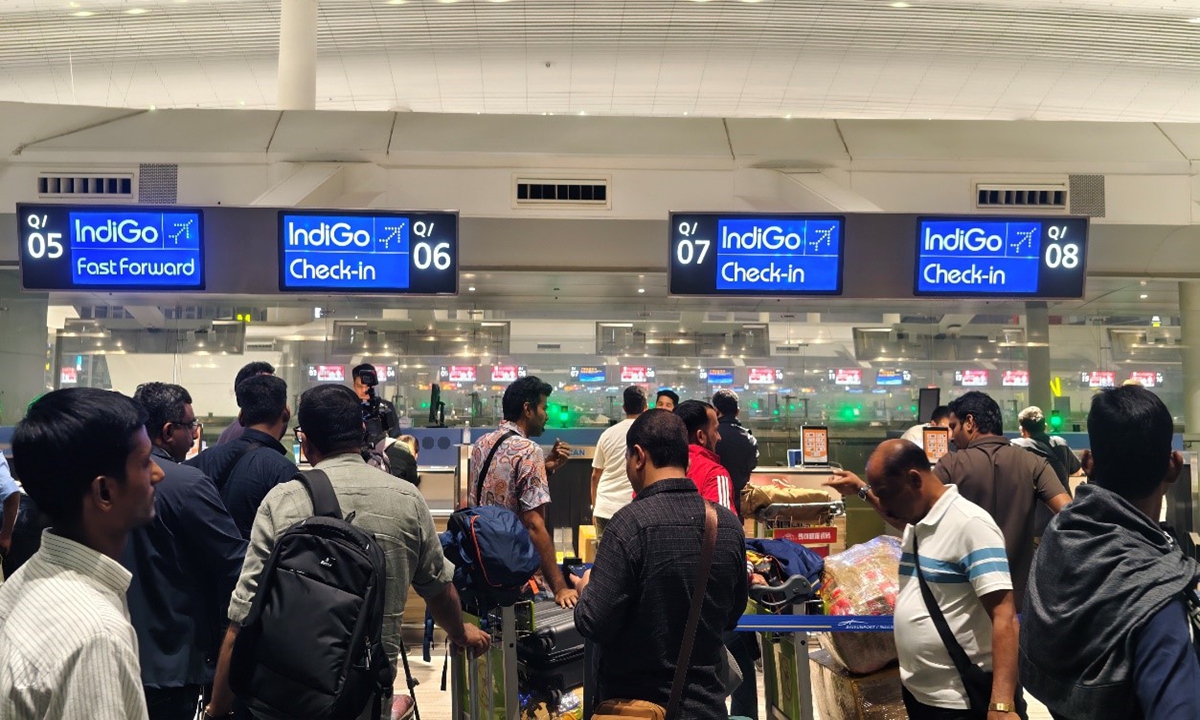
The first batch of passengers taking the resumed China-India direct flight after a five-year hiatus check in their luggage and prepare to depart for Guangzhou on October 26, 2025. (Photo: Courtesy of Indigo)
The last year has witnessed significant strides in the stabilization of Sino-India relations across both low- and high-level domains, including the mutual easing of visa regulations, announcements of resumed direct flights, and military talks on the Line of Actual Control. Although these positive signals suggest an unfreezing of relations between the dragon and the elephant, there are no clear signs that indicate that their subnational relations are indeed warming.
This high-level shift has taken place against a backdrop of increasing uncertainty surrounding Washington’s stance. For instance, data reveals that India's goods exports to the U.S. – its biggest foreign market – declined by 20 percent last September and nearly 40 percent in the past four months, due to the implementation of high tariffs under U.S. President Trump. Given divergences with the U.S. on regional strategy and defense spending, India must strategically pivot toward its "frenemy" – China, while maintaining a "Bhai Bhai"-like relationship with Russia.
This context should have paved the way for a rejuvenating Sino-India subnational relations. Nevertheless, local governments from both sides appear to lag behind. Local exchanges between China and India are closely correlated with their bilateral relations, as previous interactions demonstrate. As of November 2025, the Chinese People's Association for Friendship with Foreign Countries (CPAFFC) officially recognized 11 pairs of sister dyads. Most were established during periods of friendly bilateral ties. In the Sino-Indian context, these sister relationships serve as barometers of bilateral relationships, rather than mere symbolic gestures.
In fact, local governments in both China and India have clear motivations to collaborate with their counterparts to advance local development. Some cities or provinces/states that later formed sister relationships had already identified core areas of cooperation beforehand. For example, although Chengdu and Bangalore established their sister-city ties in 2013 in the presence of Chinese Premier Li Keqiang and Indian Prime Minister Manmohan Singh, their cooperation in software and the high-tech industries dates back to 2006.
Similar patterns appear in Kunming-Kolkata and Shanghai-Mumbai. The first direct flight from China to Kolkata originated in Kunming in 2007, followed by a series of MoUs on collaboration and the formal sister-city relationship in 2013. In the case of Shanghai and Mumbai, during the 2007 China-India Tourism Friendship Year, the cities signed an information technology cooperation agreement and pursued exchanges in areas such as medicine and film. In March 2014, both expressed intents to accelerate a sister-city relationship, which was finalized in September of that year.
Another domestic driving force is the presence of influential and determined central or local leadership in both countries. This means that once leaders realize the significance of subnational cooperation and recognize it as a resilient economic or diplomatic pillar, local administrations and executive departments are likely to follow and implement the directive efficiently.
In India, this dynamic is particularly evident at the local level. For example, as Chief Minister of Gujarat, Narendra Modi focused on attracting foreign investment to his state by hosting Vibrant Gujarat Investor Summits starting in 2003 and visiting China in 2011. Tavares also noted that West Bengal's growing international relevance largely stems from the personal ambition of Chief Minister Mamata Banerjee.
That said, headwinds present significant challenges to Sino-Indian subnational relations. Bilateral ties remain complicated by conflicts and historical legacies, including border disputes and the Dalai Lama issue, alongside structural regional competition. China's slowing economy and tightening fiscal conditions for local governments may prompt a shift in their priorities. Resuming formal subnational relations, which have been suspended since the 2020 border standoff, also poses difficulties for local governments.
Additionally, while some Sino-Indian sister cities, as noted, arose from prior interactions driven by local ambitions, others appear to have been more co-opted by central governments. This is unsurprising in unitary China and federal India, which feature de facto unitary elements. For example, except for the most recent pair – Jinan and Nagpur – the others were established in batches, witnessed by the top leaders of the two countries from 2013 to 2015. Although few official follow-up reports exist on Fujian Province and Tamil Nadu or Quanzhou City and Chennai, President Xi and Prime Minister Modi agreed to support the establishment of these two dyads during their second informal meeting in 2019.
Questions about whether current Sino-Indian relations have truly normalized are understandable, given persistent long-standing and unresolved disputes. However, in contemporary international relations, competition and cooperation are better viewed as strategic choices and instruments. A parallel dilemma that arises with their sister dyads is whether these subnational relationships are merely rhetoric and symbolic. Nonetheless, the stark disparity between the sheer size and global influence of these two great powers and the modest number of their sister pairs underscores untapped potential at the local level. In other words, if China and India seek more pragmatic cooperation, it is imperative to prioritize and revitalize subnational relationships, and potentially even initiate more formal or informal exchanges.
Opportunities for cooperation do not arise out of thin air; they require stakeholders to identify common ground and complementary strengths at both the national and subnational levels. Beyond traditional sisterhood relationships, the Kolkata-to-Kunming (K2K) Forum and the Bangladesh-China-India-Myanmar (BCIM) Economic Corridor, for instance, offer examples and lessons for future endeavors. Together with the bilateral subnational ties, these platforms can enrich engagement channels and serve as innovative mechanisms for the two powers.
