

For Singapore, the China-U.S. relationship is much more than a bilateral concern. It has profound implications for the sense of security, strategic expectations and assessments of the future by all medium-size states.
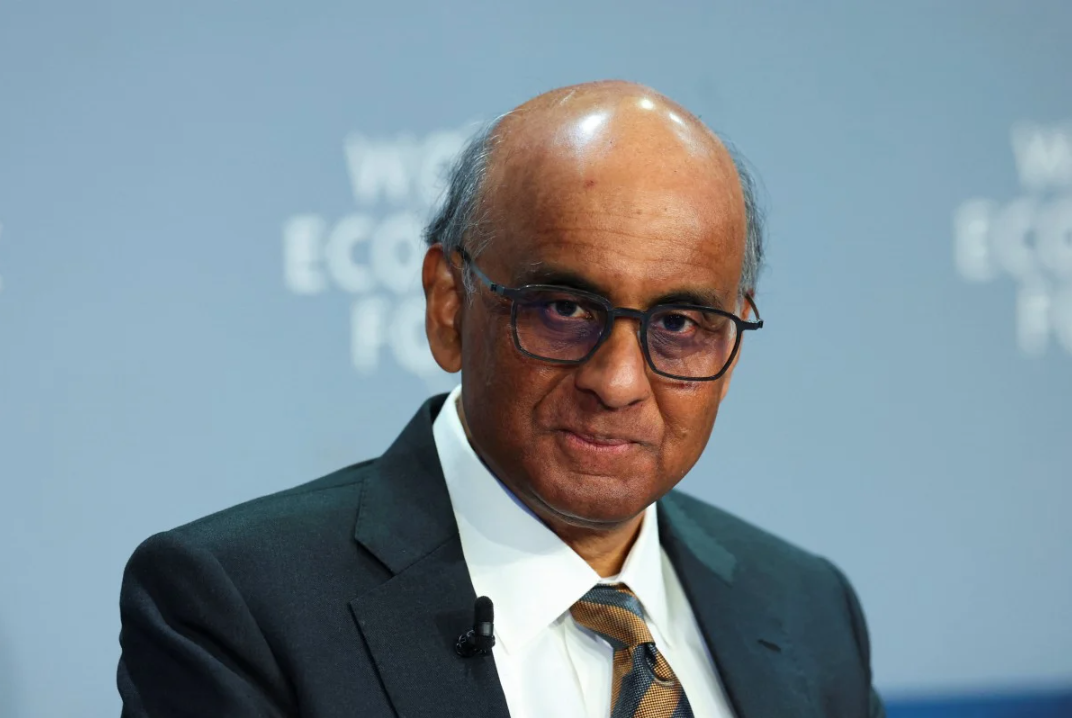
Singapore’s President Tharman Shanmugaratnam calls for U.S.-China rivalry to ‘benefit’ world during the World Economic Forum meeting in Davos, Switzerland, Jan 21, 2026. (Photo: Reuters)
Not long ago, I was part of a field research trip to Singapore, where our group engaged in exchanges with Singaporean government officials, scholars from universities and think tanks and professionals from the business and media sectors, to gain insights into their views on the United States and prospects for China-U.S. relations.
Coinciding with attention-grabbing events, including the U.S. intervention in Venezuela and an attempt to claim sovereignty over Greenland, the discussions revealed a broadly shared and complex mindset across strategic and academic communities in Singapore—one marked by the coexistence of anxiety and expectation.
On one hand, clear unease was expressed over the potential shocks that a destabilized China-U.S. relationship could inflict on the regional economic and security architecture. On the other hand, hope was expressed that China and the U.S. would be able exercise restraint amid competition and maintain a state of “controlled competition.”
Over the past several decades, Singapore has skillfully navigated among major powers through a pragmatic foreign policy. It has emerged as a key beneficiary of the dividends of economic globalization. Stable interactions between China and the U.S. have provided it with a secure external environment and a vast economic hinterland.
However, as great-power competition increasingly spills over into multiple domains, the strategic equilibrium on which Singapore has long relied is gradually being eroded. The escalating frictions between China and the U.S. in areas such as trade and technology have placed Singapore squarely in the middle, intensifying its dilemma.
In the short term, various sectors in Singapore remain broadly optimistic about the trajectory of China-U.S. relations, generally believing that the overall relationship this year will remain in a “manageable” and stable state, without escalating into large-scale confrontational scenarios. This assessment is primarily based on the expectation that the leaders of the two countries will have multiple opportunities this year to engage in direct contact and exchanges in bilateral or multilateral settings. These should facilitate strategic communication, reduce the risk of miscalculation, manage differences and restrain conflict.
A relatively stable China-U.S. relationship also creates favorable conditions for Singapore to continue pursuing its foreign policy of “not taking sides” as it seeks room to address the interests of both major powers.
Yet, when the analytical lens is extended beyond the short-term, event-driven factors come in to play in the longer-term evolution of relations and the restructuring of the global international order. A growing sense of both anxiety and expectation is becoming increasingly evident within Singapore. A widely shared judgment is that the Trump phenomenon is not an accidental manifestation of individual style or a temporary deviation but a fundamental shift and long-term trend rooted in political polarization and populism, which have long been part of America’s domestic social structure. Even if the ruling party in the U.S. changes in the future, the unilateralist orientation, the logic of “America first” and the use of pressure on allies are likely to persist and continue to erode the rules-based international order.
The weakening of this order means that multilateral trade rules would be increasingly replaced by bilateral or minilateral agreements, undermining the free trade environment upon which Singapore’s survival depends. This, in turn, would impose significant shocks on Singapore and other trade-dependent economies that rely heavily on international rules, open markets and institutional stability.
Against this backdrop, Singapore neither wishes to see the China-U.S. rivalry further intensify nor hopes for the world to evolve toward a closed and exclusionary “G2” model. Although there are still differing views within Singapore on how exactly the concept of G2 should be defined, the prevailing perception is that both intense confrontation and an order dominated by a small number of major powers would compress the strategic space available to small and medium-sized states.
If China-U.S. competition were to escalate, Singapore would inevitably face mounting pressure to choose sides, thereby undermining its policy flexibility and making it difficult to sustain its current strategic balance in which it relies on the U.S. for military security while depending on China for economic development.
Conversely, if the international order were to evolve toward a G2 model, global affairs would to a large extent be determined through consultations and bargaining among major powers, eroding the strategic autonomy of small and medium-sized states such as Singapore and correspondingly constraining their space and influence in international affairs.
In the view of some Singaporean scholars, a more desirable outcome would be the emergence of an order of “multilateral polarity.” In such an order, the formation of “poles” would not rely solely on military or coercive power but would be constrained by rules, competency and responsibility. Multiple states or blocs with comparative advantages in different domains would be able to participate, on the basis of equal consultation, in the formulation and refinement of international rules and jointly assume responsibility for global governance. This would prevent any single power or small group of major powers from monopolizing agenda-setting in international affairs. Such an order would not only clarify boundaries for the China-U.S. rivalry and help prevent a loss of control but would also provide a stable developmental environment and sufficient strategic space for small and medium-sized states such as Singapore, allowing them to avoid being forced to choose sides between major powers.
To advance the formation of such an international order, some Singaporean scholars also express agreement with Canadian Prime Minister Mark Carney at the Davos Forum. Carney called for the establishment of issue-based alliances between middle powers. By acting as agenda-setters or hubs of cooperation in specific domains, middle powers would reduce their risk of being drawn into the China-U.S. rivalry, while promoting the decentralization of power within the global system and preventing the emergence of a unipolar or bipolar order.
Such cooperation is not premised on an “anti-U.S.” or “anti-China” stance. Rather, it seeks to reduce dependence on any single major power by building dense and diversified networks of multilateral cooperation to enable middle powers to become a pole within a framework of multilateral polarity. Within this framework, Singapore would have the opportunity to emerge as an important hub.
At the same time, various sectors in Singapore are also keenly aware that the space for cooperation is limited for middle powers. Issue-based collaboration alone is insufficient to sustain such an order independently. Within the current power structure, the choices of middle powers are always influenced by major powers and remain constrained by national interests, meaning they still lack a full degree of autonomy.
If China and the U.S. then experience intensified conflicts in a particular domain, middle-power cooperation may face pressure to take sides. Differences in how each country prioritizes China-U.S. interests could even lead to the breakdown of cooperation and make it impossible to uphold an international order separate from major-power rivalry. In other words, the sustainability of an order characterized by multilateral polarity would largely depend upon how China and the U.S. exercise their power and influence.
Against this backdrop, some Singaporean scholars have articulated a relatively cautious yet broadly representative concern. They worry that China’s policy choices in regional affairs may inadvertently rely on the pattern—or even fully replicate—what they view as past missteps by the United States in certain regions. Venezuela is a case in point. A more power-politics-driven approach came to dominate. Such concerns are not directed at China’s established policies per se but rather serve as a reminder that in safeguarding its own interests, China should resist the temptations of power politics, uphold regional order and stability, and avoid being drawn into a zero-sum competition—something that would place additional strain on the regional order and on small and medium-sized states.
Singapore’s anxiety is emblematic of the broader predicament facing many small and medium-sized countries. It is rooted not only in the survival logic and security concerns typical of such countries but also reflects a deep concern for stability in the Asia-Pacific and for the future of global governance. From this perspective, the China-U.S. relationship is not merely a bilateral issue. It has profound implications for the sense of security, strategic expectations and assessments of the future by third-party states.
