
India’s 2026 BRICS chairship unfolds amid a fragile but continuing thaw in Sino-Indian relations that, despite unresolved territorial disputes, is opening space for de-politicized economic cooperation, supply chain realignment, talent and people-to-people exchanges, with Hong Kong positioned as a practical bridge for sustained engagement between the two countries.
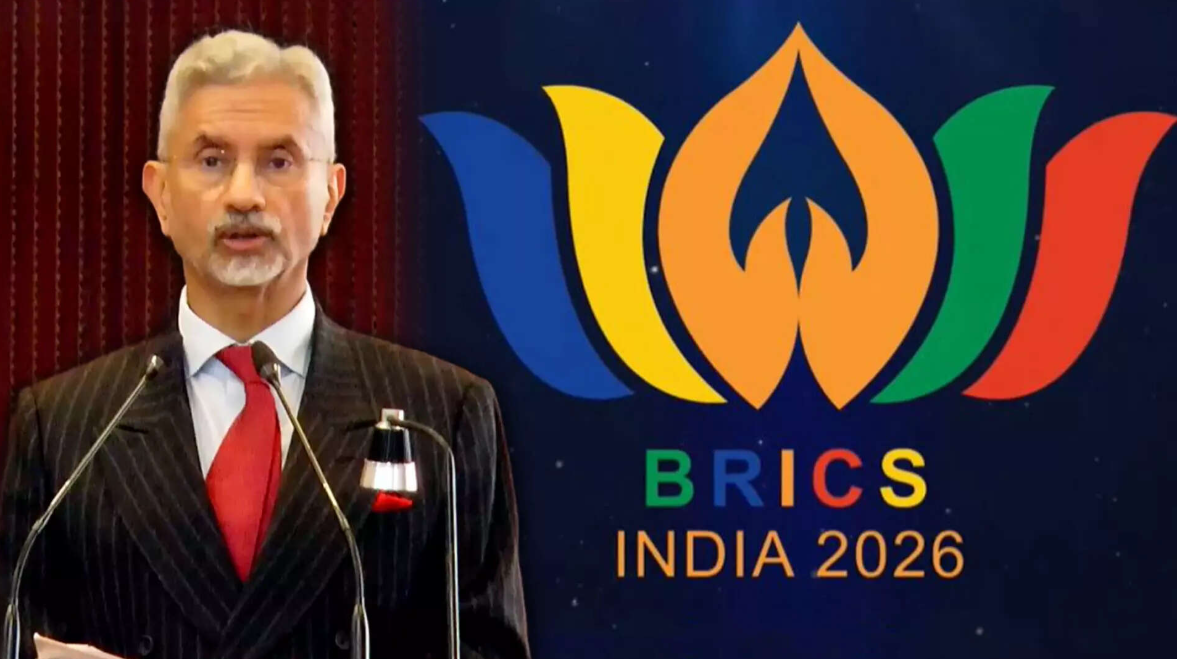
India launches logo for BRICS Presidency 2026 on January 13th.
The turning of a new year does not, in geopolitical terms, guarantee any necessary reset. For after all, the difference between December 31st of one year, and January 1st of the next, is but a single day. The belief that a new year intrinsically marks a new beginning reflects – under most circumstances – a mixture of blind optimism and naïvete.
Yet there are indeed important constructs that are attached to the dawn of a new year, and such constructs can in turn play some role in shaping expectations. For instance, India commenced its chairship of the BRICS grouping in 2026 – the fourth time in the bloc’s history, having previously held the position in 2012, 2016, and 2021.
With this position comes hence the responsibilities of organising the 18th BRICS Summit and affiliated ministerial and working-level meetings. With BRICS+ long viewed by many as a geopolitical entity under the substantial influence of China and Russia, there inevitably will be questions over the extent to which India can – and plans to – seize upon the window to leave a mark on the burgeoning yet beleaguered bloc.
Specifically, there are signs that the latest wave of détente in Sino-Indian relations – which had commenced with the meeting between Chinese President Xi Jinping and Indian Prime Minister Narendra Modi in October 2024 and was cemented by the meeting on the sidelines of the Shanghai Cooperation Organization (SCO) in Tianjin on August 31st, 2025 – is due to continue. The momentum was halted, but only momentarily, by the fallout from the 18-hour detention of an Indian passport-holder at the Shanghai airport in November.
More recently, select sources suggest that the Indian finance ministry will be scraping five-year-old restrictions on Chinese enterprises bidding for government contracts. Whilst the appetite for bidding – in reflection of their self-assessments of their capability to win out – could well remain limited amongst most of these enterprises, this move could serve as a further olive branch from Delhi, as the two capitals seek to steer their relations in a more mutually constructive direction.
Where lies the new ground?
Unsurprisingly, a most apparent area in which China and India alike can benefit concerns supply chain alignment and trade consolidation. Indian exports to China surged in December last year, whilst shipments to the U.S. declined considerably under the arbitrary tariffs imposed by Washington. With the long-touted India-U.S. trade deal falling through – Commerce Secretary Howard Lutnick attributed it to Modi’s not making the call, a claim hotly contested by the Indian government – China has cemented its status as the top merchandise trade partner and export market for India. With Chinese Premier Li Qiang pledging at Summer Davos last year that his country will emerge as a “major consumption power”, all eyes are on whether the leadership can propose and execute a cohesive strategy that bolsters Chinese imports from countries ranging from Germany and France to India and the United Kingdom.
As it stands, China’s primary imports from India include ores, organic chemicals, slag and ash, electric components, refined petroleum, and select metals. Growth in electronics, marine, and agri-exports has been particularly pronounced in recent years, given the heightened barriers to entry from the U.S. With China looking to expand its domestic service consumption – as pledged repeatedly by the leadership since early 2025 – a further question has hence arisen: could India become an important supplier of services to China, especially in the field of telecommunications? More generally, can Indian and Chinese corporations find ways to share and cultivate human capital, paving the way thus for joint ventures between the two most populous countries in the Global South?
In leveraging talent policy to be the anchor of bilateral cooperation, Beijing and Delhi alike can see to the de-politicisation of people-to-people exchanges, which are important in ways beyond the pure economic or innovation angle. Despite the two countries sharing an extensive border and, respectively, several millennia’s worths of rich historical and civilisational thought between them, vast majorities of their populations remain surprisingly oblivious to one another’s proclivities and cultural idiosyncrasies.
It was for this reason, I suspect, that the leading scholars Amitav Acharya, Daniel Bell, Rajeev Bhargava, and Yan Xuetong put together their compendium, Bridging Two Worlds: Comparing Classical Political Thought and Statecraft in India and China, which came out in January 2023. From comparisons between Xunzi, Han Feizi, and Kautilya on international statecraft to critical juxtapositions between how ancient Indian and Chinese political thought made sense of questions of empire, it is apparent that much can be “mined” intellectually from cross-cultural dialogues and conversations between Indian and Chinese thinkers. The crucial questions are – where, when, and how?
Can there be common ground even in domains of critical divergence?
Let us not, however, get ahead of ourselves. Michael Kugelman and Srujan Palkar offer a fairly sobering assessment on the state of Sino-Indian relations – the two countries “share a 2,100-mile-long rugged border, and along that border fifty thousand square miles – an area roughly the size of Greece – are disputed.” The efforts of Chinese Foreign Minister Wang Yi and Indian National Security Advisor Ajit Doval to secure an early harvest solution to territorial disputes remain work in progress, and in the absence of drastic de-escalation in Indo-Pakistani tensions concerning the disputed territories in Kashmir, breakthroughs appear deeply unlikely.
Whilst the territorial question stands at an impasse, the proverbial can be kicked down the road. Territorial integrity and national sovereignty are clearly non-negotiable baselines for both countries, but the salience of and the rhetoric employed in these debates can be adjusted. Secondary securitisation – i.e. the identification of and response to perceived security threats – of Chinese companies and capital operating in India, or Indian talents and professionals in China, can also be duly tackled and ameliorated through the establishment of clearer channels for dispute settlement and communication. Concretely, China and India alike should tacitly acknowledge the side effects and collateral damage of viewing economic engagements through national security lenses and empower civil society actors to serve as unofficial bridge-builders – whether it be through setting up manufacturing operations and investments, conducting educational and academic conferences, or hosting cultural and youth exchanges.
A question that I constantly return to concerns the role of Hong Kong, a Special Administrative Region of China, but also by far China’s most international cosmopolis. By some estimates, Hong Kong has over 32,790 non-resident Indians, and 11,350 persons of Indian origin – that is roughly 0.6% of the city’s population.
I am proud and honoured to have amongst my friends many ethnic Indians born and raised in this city, who care deeply for, and identify strongly with, its innately multicultural landscape and irresistibly magnetic charm. The SAR government should consider extending invitations for talented Indian youth to enroll at Hong Kong higher education institutions, as well as attracting Indian corporations eager to establish a foothold in China – yet who would appreciate the common law jurisdiction and transparent robustness of Hong Kong’s institutions.
There are clear divergences between Beijing and Delhi that cannot be resolved through more people-to-people exchanges or civil society dialogues. Notably in positioning the city as a vital bridge between China and India, the SAR leadership need not be striving to tackle these intractable impediments; instead, the dominant strategy is to ensure that Chinese and Indian talents can have a space, a common ground, in which they collaborate to address some of the world’s most pressing challenges, from climate change to pandemics.
Keeping the faith and creating the space for constructive engagement often go hand in hand.
