
China and Italy’s 55th anniversary of diplomatic ties underscores a shared recognition that disengagement is neither realistic nor beneficial, even as geopolitical tensions rise. The way forward is a pragmatic, economically focused partnership centered on green cooperation, financial connectivity, and people-to-people exchange, and anchored in Italy’s Euro-Atlantic commitments.
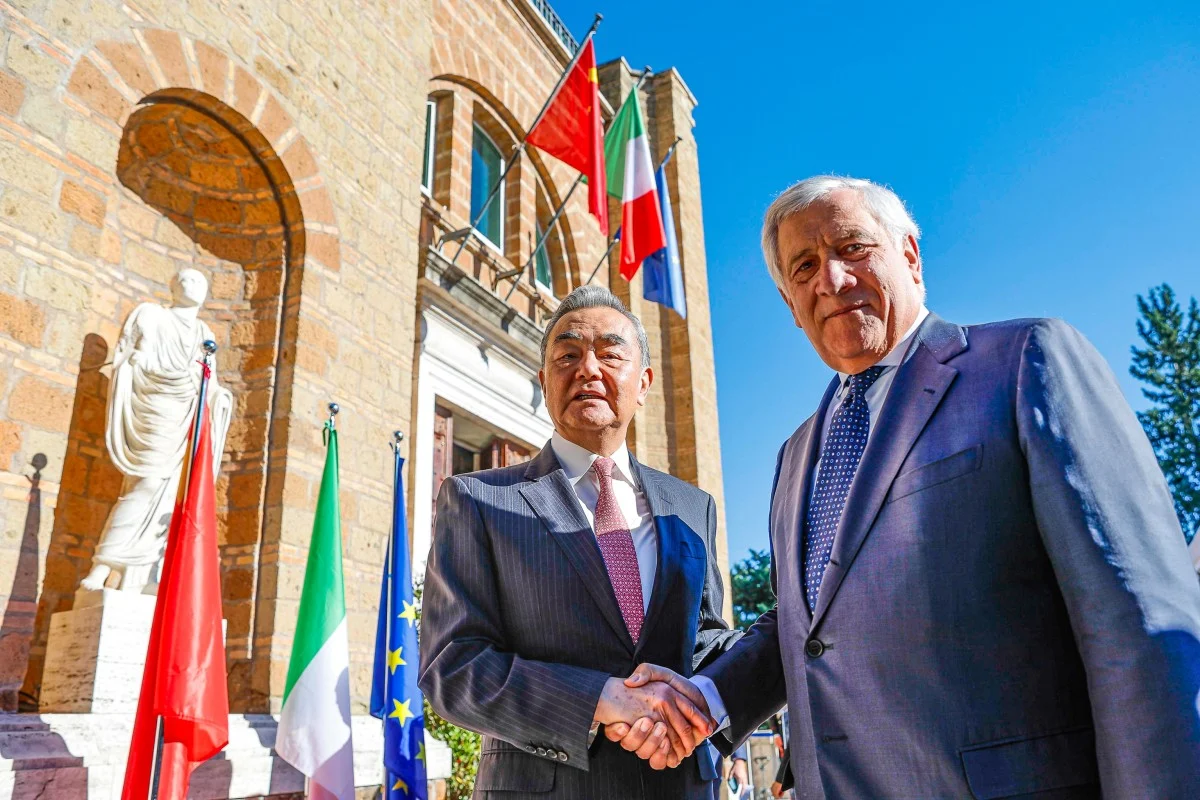
Chinese Foreign Minister Wang Yi (left) and his Italian counterpart Antonio Tajani meet in Rome on Oct 8, 2025.
On November 6th, China and Italy marked the 55th anniversary of diplomatic relations. It is a milestone that invites not only commemoration but also reflection on how a European middle power and an Asian giant can chart a pragmatic, mutually beneficial path forward in an era defined by geopolitical turbulence.
When Italy recognized the People’s Republic of China in 1970, well before many Western partners, it was a bold diplomatic move driven by the desire to engage with a nation whose economic awakening was just beginning. Over the past five decades, the two countries have experienced extraordinary transformations: China has become the world’s second-largest economy, and Italy has consolidated its place as one of the most industrialized economies in Europe, renowned for design, manufacturing excellence, and cultural heritage. Their trajectories, though distinct, have increasingly intersected within global value chains, trade networks, and multilateral institutions.
Yet today, the bilateral relationship stands at a crossroads. The world is entering a new phase of fragmentation, marked by strategic rivalry between the United States and China, the reconfiguration of global supply chains, and growing scrutiny of technological dependencies. Against this backdrop, Italy faces the delicate task of recalibrating its relationship with Beijing while safeguarding its transatlantic commitments and European solidarity.
The decision last year by Rome not to renew its participation in the Belt and Road Initiative was interpreted by some observers as a turning point, even a rupture. In reality, it was an attempt to reposition Italy within the evolving geopolitical landscape. The choice reflected not a retreat from China but a recognition that the initial expectations of the BRI, particularly in terms of trade balance and investment flows, had not materialized as envisioned. It was also an acknowledgment of the growing pressure from Italy’s Western allies to ensure strategic coherence within the G7 and the European Union.
Still, disengagement is not an option. The structural complementarities between the Italian and Chinese economies remain strong. Italy is a world leader in high-end manufacturing, design, and green technologies—areas that align closely with China’s transition toward high-quality, innovation-driven growth under its “new productive forces” agenda. Italian machinery and industrial know-how continue to find demand in China’s advanced manufacturing hubs, while Chinese investment and tourism have, in past years, provided vital opportunities for Italy’s export-oriented economy.
The challenge, therefore, is not whether to engage, but how to engage in a way that reflects realism, reciprocity, and resilience.
For Italy, this means adopting a posture of strategic pragmatism. In the current geopolitical climate, ideology-driven alignment would be a strategic error. Rather, Rome should seek to define its relations with Beijing through an economic lens rooted in long-term competitiveness, while remaining anchored in its Euro-Atlantic commitments. Italy can and should continue to cooperate with China where interests converge, particularly in trade, climate action, and finance, while safeguarding critical sectors and technologies.
Economically, three areas stand out as promising pillars for the next phase of Italy–China relations.
First, green transformation and climate cooperation. Italy’s industrial ecosystem, built on energy efficiency, circular economy practices, and renewable technologies, offers valuable expertise as China intensifies its decarbonization efforts. Collaboration in this field can transcend geopolitical tensions and contribute to shared global goals. Italian firms in sectors such as hydrogen, electric mobility, and sustainable architecture could find fertile ground in China’s evolving green economy. Joint ventures or R&D partnerships can foster innovation while reducing environmental footprints on both sides.
Second, financial connectivity and capital markets. As China continues to internationalize its financial system, Hong Kong remains a natural bridge between Chinese capital and global investors. Italy, with its sophisticated banking system and experience in infrastructure finance, could play a more proactive role in this process. Strengthening financial linkages, for instance through green bond collaboration or joint fund mechanisms, could open new channels for sustainable investment. Italian institutions, including development banks and export credit agencies, should also explore greater engagement with China’s policy banks and multilateral platforms such as the Asian Infrastructure Investment Bank, where Italy is a founding member.
Third, people-to-people and educational exchanges. Despite political fluctuations, the long-term health of any bilateral relationship depends on mutual understanding. Italy’s universities and design schools attract increasing numbers of Chinese students, while cultural diplomacy has proven a resilient bridge even in times of political tension. Reinforcing these exchanges is essential to maintaining dialogue across generations and sectors, ensuring that economic cooperation is supported by cultural empathy.
However, strategic pragmatism also requires clarity about red lines. Italy must coordinate closely with the EU on issues such as technology transfers, supply chain security, and investment screening. A coherent European position vis-à-vis China will allow Italy to avoid being caught between competing powers. Rome’s voice should advocate for open strategic autonomy, promoting a Europe that engages with China on its own terms while avoiding both protectionism and dependence.
The Italian government can also leverage its role as a constructive interlocutor. Historically, Italy has excelled at building bridges between North and South, across the Atlantic and the Mediterranean, and between developed and emerging economies. This diplomatic tradition can serve it well in the current environment, where trust deficits abound, and dialogue is often constrained. As a G7 member with a pragmatic foreign policy, Italy can contribute to reshaping the narrative of Europe–China relations away from confrontation and toward managed interdependence.
As we mark the 55th anniversary of diplomatic ties, both sides would benefit from a renewed framework of cooperation grounded in realism and respect. China is no longer the emerging market of 1970 but a global economic actor whose domestic policies have profound international consequences. Italy, meanwhile, remains a creative, adaptive nation whose influence extends beyond its size, precisely because of its ability to navigate complexity with flexibility and cultural sensitivity.
The future of Italy–China relations will depend not on grand declarations but on consistent, well-calibrated engagement. The world is moving toward multipolarity, and nations that can balance openness with prudence will thrive. For Italy, this means keeping dialogue with Beijing alive, focusing on areas of shared interest, and resisting the temptation to view geopolitics as a zero-sum game.
At a time when economic decoupling risks giving way to ideological division, Italy’s nuanced diplomacy can serve as a reminder that cooperation remains possible even in times of turbulence. Fifty-five years after taking a visionary step toward Beijing, Rome’s best course remains the same: engage, understand, and adapt with a long-term view.
