
China is methodically strengthening its global position through diplomacy with Europe, soft-power engagement toward Taiwan, and long-term economic and energy preparation in the Middle East while presenting itself as a stabilizing force amid global instability. Recent crises, from Taiwan tensions to the Hormuz disruption, reflect a broader shift toward a more multipolar world in which Beijing benefits from strategic patience and the gradual erosion of unquestioned U.S. influence.
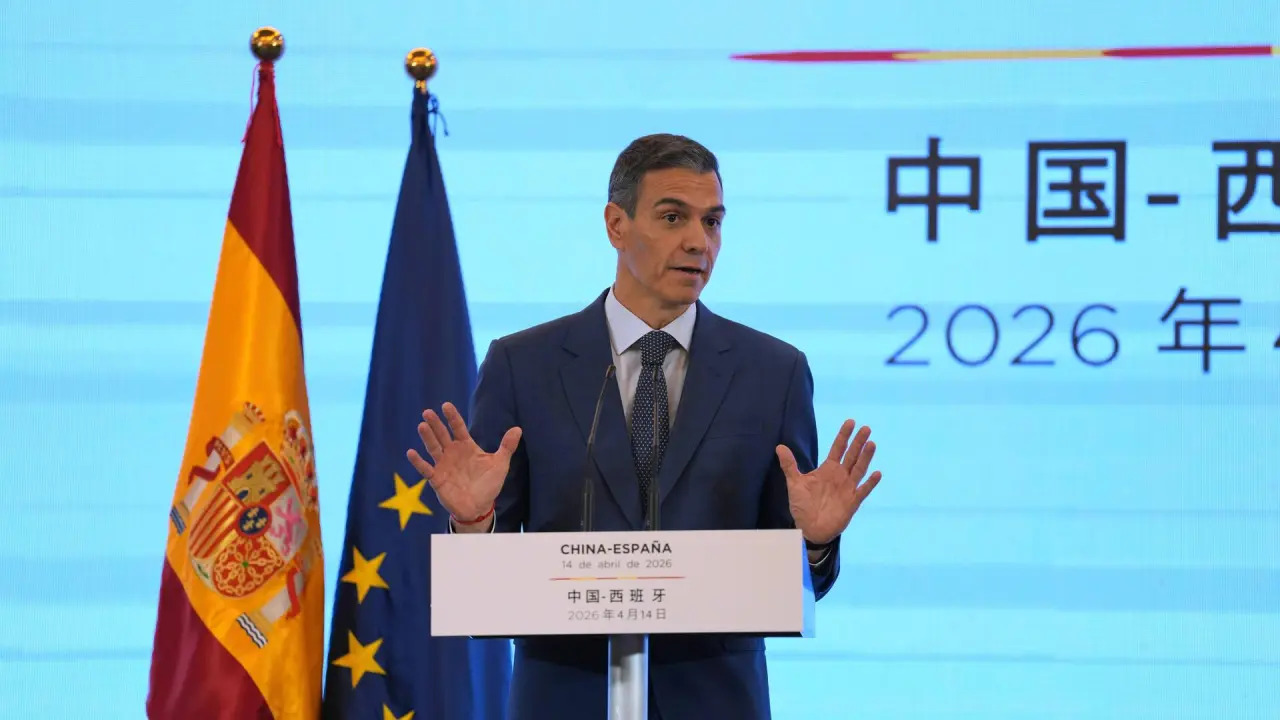
Spanish Prime Minister Pedro Sánchez speaks at a news conference after his meeting with Chinese President Xi Jinping, on April 14, 2026 in Beijing, China.
In the first four months of 2026, a striking procession of European leaders has made its way to Beijing. Spanish Prime Minister Pedro Sánchez arrived on 11 April for his fourth visit in just over three years, following earlier trips in 2023, 2024 and 2025; King Felipe VI had already paid the first Spanish state visit in 18 years in November 2025. In preceding months, the prime ministers of Ireland, Finland and the United Kingdom, together with the German Chancellor, held high-level talks in the Chinese capital. These visits, accompanied by large business delegations, signal a pragmatic recalibration in European foreign policy at a moment when transatlantic solidarity is under strain and global energy markets are convulsing.
The Sánchez visit stood out for its explicit political signalling. During his meeting with President Xi Jinping, Xi delivered his most direct public commentary on the ongoing Iran conflict, warning that the world cannot risk a return to the “law of the jungle.” He stated: “Today the world is engulfed in chaos and faces a choice between the rule of law and the rule of force… China and Spain are principled and morally conscious countries that should strengthen dialogue, enhance mutual trust and closely cooperate to oppose the return of the world to the law of the jungle, jointly defend genuine multilateralism and uphold the international system with the UN at its core.” Sánchez concurred that the two countries could contribute to solutions for trade disputes, geopolitical difficulties, wars, and environmental and social challenges. The leaders agreed to upgrade bilateral relations to a “strategic dialogue” and signed 19 agreements, including ten economic ones. This occurred against the backdrop of Spain’s disagreements with Washington over the Iran war, illustrating how European capitals are using Beijing visits not only for commercial gain but also to signal greater autonomy from U.S. policy.
The outcomes across all visits have been concrete yet incremental. Leaders secured market-access commitments in agriculture, high-tech goods, pharmaceuticals and automotive sectors, while launching mechanisms to address overcapacity and subsidies. Collectively, these engagements have quietly expanded trade channels, eased regulatory friction and reaffirmed Europe’s interest in treating China as an indispensable economic partner rather than solely a systemic rival.
What does this flurry mean? First, it reflects Europe’s growing discomfort with over-reliance on an increasingly transactional Washington. Second, it underscores Beijing’s success in positioning itself as a pole of stability and multilateral defender amid global turbulence. While Brussels maintains its “de-risking” rhetoric, national leaders are voting with their itineraries: pragmatic cooperation now trumps ideological alignment. Beijing is capitalising on this to deepen European divisions from unified transatlantic policy.
Just days before Sánchez’s arrival, Beijing delivered another carefully calibrated diplomatic message – this time aimed at Taiwan. On 10 April, President Xi Jinping received Kuomintang (KMT) Chairwoman Cheng Li-wun in the Great Hall of the People – the first such high-level meeting in a decade. Xi reiterated the “1992 Consensus” and the “one China” principle, framing cross-strait relations as an internal matter for “the Chinese people on both sides of the Strait.” He outlined four pillars: forging a common national identity rooted in history and culture; pursuing peaceful development; rejecting “Taiwan independence” as an existential threat; and expanding exchanges in service of national rejuvenation. Cheng echoed these themes, stressing mutual trust and peaceful development.
On 12 April, Beijing announced ten new facilitation measures: eased tourism, market access for Taiwanese dramas and animation, youth exchanges, simplified food and fishery exports, resumed flights from additional cities, individual tourism from Shanghai and Fujian, and infrastructure support for the outlying islands of Kinmen and Matsu. These steps demonstrate Beijing’s sophisticated “soft integration” strategy – using economic incentives and cultural affinity to shift sentiment inside Taiwan, exploit elite divisions, and maintain political channels even as military pressure persists. The KMT serves as an alternative communication conduit, allowing Beijing to influence internal dynamics without relying solely on external coercion. That said, it does not mean that Beijing is not preparing other approaches to addressing the Taiwan issue if circumstances require it; however, a peaceful resolution remains the most preferred option within China’s official strategic and philosophical framework.
The Taiwan initiative cannot be viewed in isolation from developments in the Middle East, where China’s long-term preparation has been on full display. Since 2005, China has committed more than $269 billion in investments and construction contracts across the region – 2.34 times the U.S. figure for 2014-2023 – with Saudi Arabia ($82 billion), the UAE ($48 billion) and Iraq ($40 billion) as top recipients. The current Iran-related conflict and blockade of the Strait of Hormuz have created immediate risks: at least three Chinese-financed projects damaged and another twelve worth roughly $4.66 billion in high-risk zones.
Yet China has emerged as the least affected major Asian importer. Pre-crisis sourcing showed diversified exposure: approximately 14% from Saudi Arabia, 11% from Iran, 29% from the rest of the Middle East, 20% from Russia, and 26% from the rest of the world. Crucially, Iranian oil flows to China have continued despite the conflict. Over the past decade, Beijing has deliberately built the world’s largest strategic petroleum reserve, exceeding 1.4 billion barrels. Experts estimate that a complete two-month loss of Iranian supplies would draw down these reserves by only about 10%. This resilience is no accident – it reflects years of deliberate preparation for precisely such chokepoint disruptions. For China, the crisis is a “weather the storm” scenario: short-term costs are manageable, while opportunities emerge from cheaper distressed assets, eroded trust in U.S. security guarantees, and accelerated yuan-denominated energy trade (reportedly far less expensive than dollar-based protection schemes).
However, this outward strategic composure coexists with significant internal challenges. Inside China, Xi Jinping continues a sweeping anti-corruption campaign that has reached the highest levels of the party, military, and state-owned enterprises, with several senior figures removed in recent months. These purges aim to consolidate power and discipline the system but also create uncertainty and factional tension within the elite. Compounding this is the lingering shadow of the Evergrande real estate crisis. The developer’s collapse, involving roughly $300 billion in liabilities, exposed deep flaws in China’s property-driven growth model, damaged household confidence, and continues to weigh on local government finances and consumption. While Beijing has stabilised the worst of the fallout, the scandal has left a negative image both domestically and internationally, reminding observers that China’s rise is not without structural vulnerabilities.
On the other hand, Middle East dynamics mirror broader structural weaknesses in the United States. America’s public debt now exceeds $39 trillion – more than 127 percent of GDP – with debt growing faster than output throughout the 21st century. Washington has ceded its status as the “factory of the world” to China and responds with protectionism. The dollar remains dominant but its reserve share declines. The Iran episode has dramatised limits of U.S. power projection: threats go unenforced, traditional allies question the value of petrodollar arrangements, and expensive conventional forces struggle against asymmetric threats like drones and mines. None of this signals imminent collapse – great-power transitions are protracted and often ledger-driven – but it marks an accelerating erosion of relative position.
Taken together, Europe’s steady stream of high-level visits to Beijing, the resonant Xi-Cheng meeting on Taiwan, and China’s quietly formidable resilience in the Middle East crisis weave a remarkably coherent strategic picture. Amid Donald Trump’s confrontational rhetoric on almost all fronts, Beijing is playing a patient, multi-layered game: courting key third parties by offering itself as a steady champion of multilateral order and a bulwark against any return to the “law of the jungle,” while methodically advancing its core Taiwan objective through a sophisticated mix of political outreach and soft-power integration. At the same time, it is capitalising on regional instability without becoming entangled itself – positioning itself to benefit from the very turbulence it did not create. For Washington, the takeaway is sobering and immediate: alliances are not automatic; they require constant, credible renewal. Cross-strait politics remain fluid and internally contestable, open to patient influence rather than outright confrontation. And major global crises have an uncanny way of quietly redistributing influence toward those who have prepared the ground years in advance.
Even if the Hormuz Strait issues were resolved today, the world would still have to absorb the significant, lingering consequences of the month-long blockade. IEA Executive Director Fatih Birol has described the resulting oil-and-gas shock as more serious than the crises of 1973, 1979 and 2022 combined, with daily losses exceeding 13 million barrels of oil equivalent. Likely, supply disruptions, elevated energy prices, and tightened credit conditions across affected sectors are projected to reach their peak this autumn, reminding us that the real economic and geopolitical aftershocks of a chokepoint crisis often arrive long after the tankers begin moving again. Beijing, it seems, is content to let the arithmetic of diversified energy security, cumulative investments, elite-level diplomacy, and incremental integration do much of the heavy lifting. Near future will show whether the United States can arrest its relative decline through bold domestic renewal – or whether this pattern of European hedging and Chinese strategic patience becomes the defining feature of an emerging multipolar world by global crisis at its very inception.
