
Germany’s renewed engagement with China reflects deep shifts in the international system. As alliance cohesion weakens and multipolar trends advances, Berlin is exploring interest-based cooperation beyond traditional Western frameworks, signaling a broader transition from ideology-driven alliances toward pragmatic international partnerships.
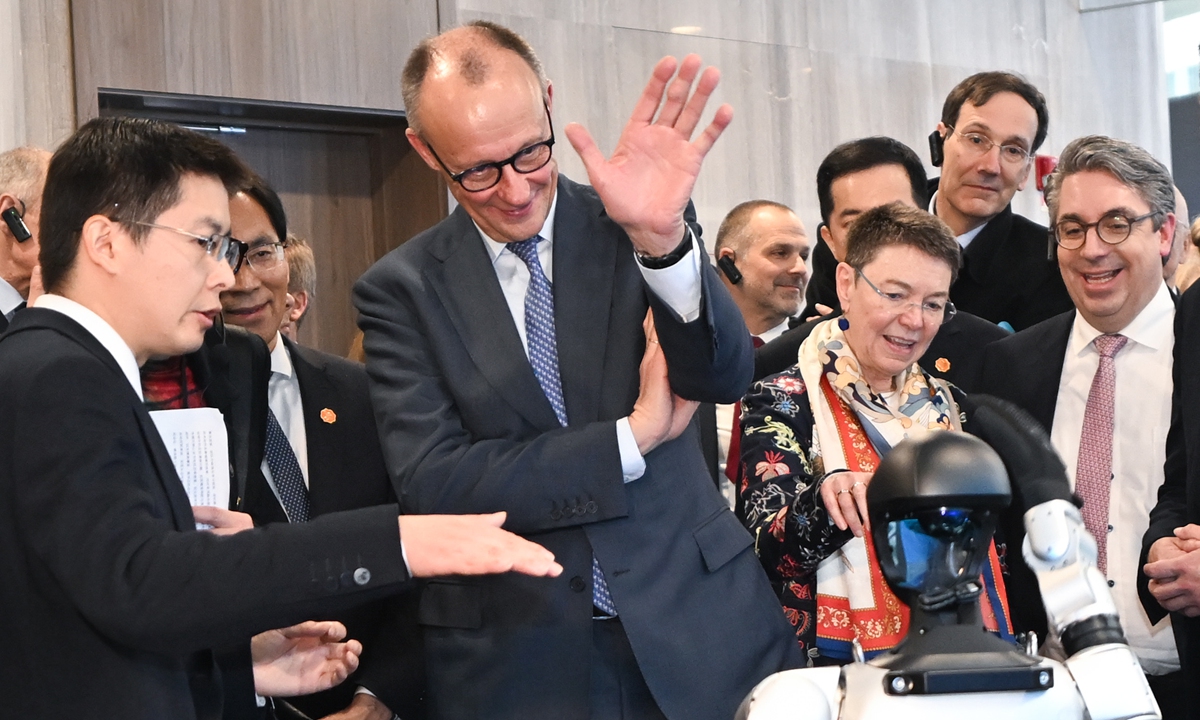
German Chancellor Friedrich Merz waves to a humanoid robot during his visit to the Chinese robot company Unitree Robotics in East China's Hangzhou on Feb 26, 2026. (Photo: cnsphoto)
February 24 marks the fourth anniversary of the outbreak of the Russia-Ukraine conflict, as well as a critical juncture of profound changes in the world order. On the same day, China announced that German Chancellor Friedrich Mertz would visit China from February 25 to 26 at the invitation of the Chinese side. Placing this visit within the broader context of a steady stream of visits tos China by senior European politicians, it reveals the depth of on-going changes in international relations in this era of multipolarization: alliance politics is approaching its endt, while a new model of international cooperation is beginning to emerge By “end”, we’re not talking about the complete collapse of the Western alliances, or the disappearance of international groupings. Rather, the traditional mechanisms that forged or justified alliance relationships based on ideologies, values, religions or ethnicities, which transcend national interests, are being replaced by multipolarized international cooperation based on practical interests.
As the Munich Security Conference, held from February 13 to 15, declared, the rules-based post-WWII international order is “under destruction”, and the world is entering a time of “wrecking-ball politics.” If such “rules-based international order” refers to the post-Cold War system featuring the hegemony by the Western alliance, such lament may not be entirely unfounded. However, if such erosion could spawn a kind of fairer, more just multipolar international order, this is by no means entirely a “destructive”development for the “global majority.” A multipolar world order has every potential to steer toward a new pattern of international relations based on mutual respect, mutual benefit,win-win cooperation, joint governance and sharing.
Chancellor Mertz has reportedly made “unprecedented” and “meticulous”preparations for his China visit, underscoring it strategic significance. First,
the timeing—immediately following the Chinese Lunar New Year— signals Germany’s urgency for strengthening strategic communication with China. Second, rifts within the Western alliance are increasingly difficult to reconcile, as U.S.-EU differences over Russia-Ukraine conflict, economic and trade ties, and Middle East policies continue to deepen. Third, China-Germany economic and trade ties have undergone structural changes.While China has once again become Germany’s largest trading partner, exports to China from Germany’s traditionally competitive industries—such as the automotive sector—have fallen sharply. The previous German model of exporting technologies and profiting from the local markethas become unsustainable. Therefore, Mertz’s visit is not merely to mend the political climate for China-Germany pragmatic cooperation, which has suffered setbacks over the past few years, but about exploring with the Chinese side a new model for future bilateral cooperation.
Compared with the Merkel era, the historical context, logic of interaction and strategic positioning of China-Germany cooperation are different this time. During Merkel’s tenure, the post-WWII order of Western hegemony was relatively stable. Germany was able to benefit from access to the China market and China-Germany industrial chain cooperation, supported by U.S. security guarantee and stable Russian energy supplies. This “three-wheel-drive” structure once enabled the German economy to outperform the rest of Europe for more than a decade. Today, the U.S.technological restrictions on China, trade pressure on Europe, along with the Russia-Ukraine conflict and energy crisis, has put Europe under strain. Germany has thus again become an economic “underachiever” in Europe. An key objective for Mertz for this trip is to find a fresh economic “ballast” for Germany.
Mertz is accompanied by executives from 30 or so leading German companies, far exceeding previous visits. The group has shifted from a“technology-exporting team” to an “innovation cooperation team”, promoting China-Germany economic and trade cooperation to transform from vertical mutual complementarity to equal competition and innovation integration. Strategically, this visit means Germany clearly pursues autonomy, which has positive implications for promoting the rationalization of EU China policy.Germany has distanced itself from the unilateral U.S. approaches and no longer plays the role as a leading player in the Western alliance’s campaign to contain China.
Mertz’s China visit sends several clear global messages, and indicates that the foundation of Western alliance politics is loosening. First, the “ironclad” values narrative of the Western alliance has been seriously eroded, European awareness of strategic autonomy has increased, and U.S. influence over Europe is declining. The ideological cohesion of the Western alliance is weakening. Second, the unilateral U.S. hegemony has its limitss. With chaotic domestic policies, political divisions , and foreign policies that are widely discredited, the country is unable to preserve itsglobal leadership at relatively low cost by unilateral means, and the post-Cold War international order established under its own leadership is being dismantled. Lastly, a multipolar world is emerging at an accelerated speed, the China-U.S.-Europe triangle relationship becomes more balanced, while dialogue and consultation, win-win mutual cooperation are taking the place of camp confrontation and unilateral dominance.
The decline of Western alliance politics essentially reflects a return to “national interest first” in international relations. The previous model of Western alliance framed in terms of shared values butoften ignored countries’ reasonable concerns, appeared cohensive but was in fact fragile. nce the external environment changes, or interest distribution becomes imbalanced, it will descend into division and internal friction. International cooperation in the multipolar era, however, will be more stable and sustainable so long as it is based on mutual respect, follows the principle of equality and mutual benefit, and binds countries with practical needs. In this context, Mertz’s visit could help advance pragmatic China-Germany cooperationin such fields as economy and trade, science and technology, and green energies, reduceideological constraints, focus on common development and risk-handling, and offer a potential model for a new type of international cooperation.
Of course, in this time of unprecedented, profound changes in world order, major country rivalry and cooperation will co-exist in the long term, frustrations and frictions in China-Germany ties will persisit. Yet peaceful development and win-win cooperation is in the fundamental interests of all nations. Mertz’s China visit is a symbolic milestone. As the old alliance politiccal structures continue to lossen, a new type of international cooperation with national interests as its cornerstones that follows the path of multilateralism will usher in a more just and balanced global order , injecing enduring energy into world peace and development.
