
Trump and Xi’s latest meeting was a remarkable display of amiability between the U.S. and China, yet the conflicts at hand saw no progress toward resolution.
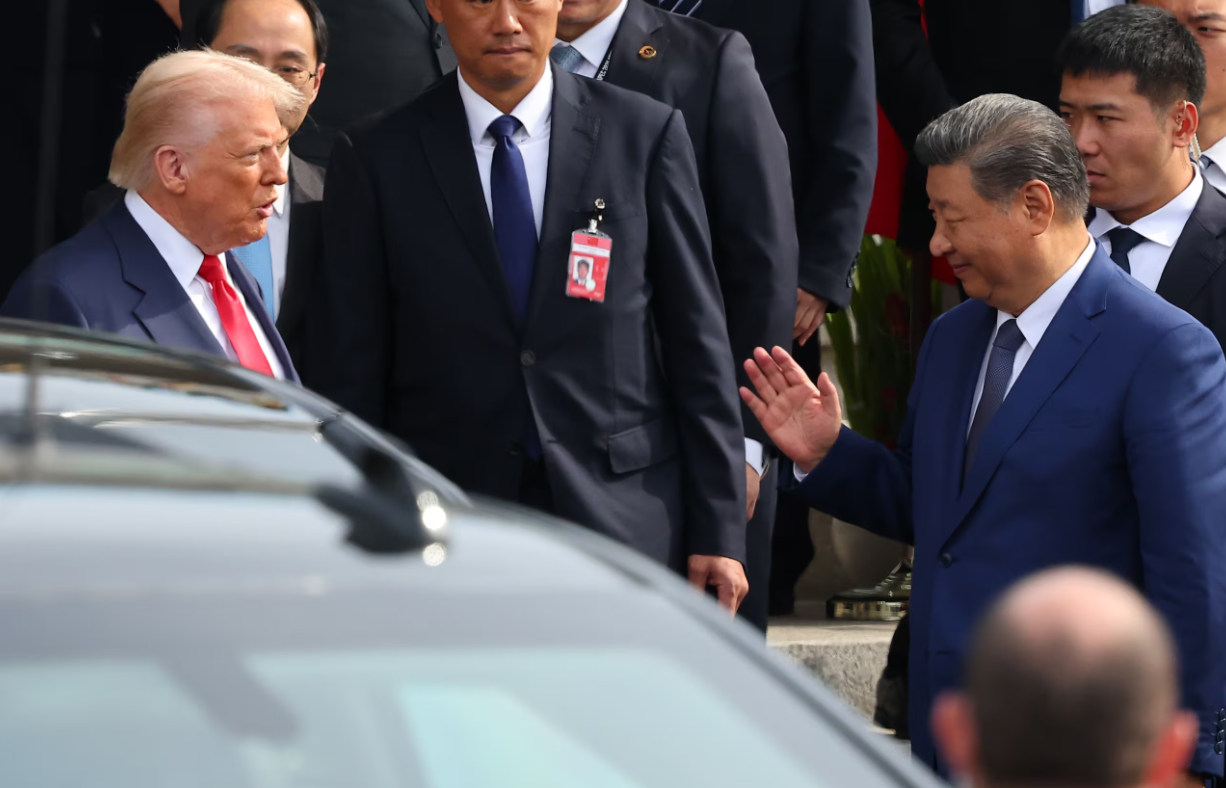
U.S. President Donald Trump and Chinese President Xi Jinping greet each other as they leave the meeting room following the U.S.-China summit at the protocol room Naraemaru of Gimhae Air Force Base in Busan on Oct. 30, 2025. (Photo: Yonhap)
On October 30th, right ahead of the APEC Economic Leaders' Meeting this year, U.S. President Donald Trump and Chinese President Xi Jinping held a face-to-face meeting in Busan – their first in over six years. The meeting wrapped up in under two hours – despite prior expectations that it would last for longer. This was subsequently followed by a call between the two leaders in late November.
Whilst Trump enthusiastically dubbed the Busan summit a “12 out of 10”, the substantially more cautious tone from the Chinese read-out suggested that the discussion met – but did not exceed – expectations when it came to establishing a floor to the bilateral relationship.
Indeed, the outcomes that emerged were primarily confined within the domains of bilateral trade, supply chains, and decisions over select sensitive technologies – and, of course, the elephant in the room, rare earths. Trump pledged to reduce the “fentanyl” tariffs on Chinese goods from 20% to 10% and suspend the expansion of export controls on Chinese firms listed on the Entity List. In exchange, Xi offered to reduce the barriers for American purchases of rare earths, as well as commence purchasing significant volumes of soybeans, a key export for states such as Iowa, Kansas, and North Dakota.
Notably, neither side’s portrayal of the meeting contained references of geopolitical flash-points such as Taiwan or the South China Sea; nor were there breakthroughs on the front of meaningfully restoring bilateral government-to-government engagement – though the de facto resumption of military-to-military dialogue, with Pentagon Chief Pete Hegseth speaking with his Chinese counterpart Dong Jun a day later, appears to indicate a degree of openness from both leaderships in dethawing their long-frozen defense leadership communication channels.
A Stop Gap that Both Sides Wanted
There is a temptation to attribute this meeting to China’s weaponisation of rare earths, the “trump card” that the Chinese have enthusiastically deployed since Trump’s “Liberation Day” and the ensuing escalatory spiral of tariffs in April this year. With control over 70% of the global mining and 90% of processing facilities, Beijing has built up an impressive lead and effective stranglehold over these seventeen highly vital elements in modern defense and advanced manufacturing. Suspensions of their exports to the U.S. had resulted in significant pressure mounting amongst leading U.S. weapons and automobile manufacturers, some of whom count amongst Trump’s firmest backers – they most certainly made their displeasure clear with the commander-in-chief.
Trump’s desire for a meeting with Xi was hence understandable. Furthermore, with the slew of recent state and impending mid-term elections (in 2026), there exists significant public pressure upon him to mitigate against the double whammy of skyrocketing yield rates and surging inflation – even despite his blatantly vacuous denials of inflation’s occurrence. Restrictions upon rare earth supply would clearly contribute to the latter and indirectly compound the former. Faced with a then-persisting legislative gridlock in Congress, the President resorted to his preferred modus vivendi in dealing with disputes – a top-down, leader-to-leader, one-to-one chat that would sidestep bureaucratic apparatus and institutional norms.
On the other hand, we should also not underestimate the keenness with which Beijing approached the meeting. With a 5% growth target set for the year and a sluggish consumption rebound, the Chinese leadership was acutely aware of the economic – and ensuing political – perils that an unresolved standoff over trade with the U.S. could cause. The tariffs imposed by the Trump administration, in both direct and “transshipment” (namely, targeting third parties, reinforced through the “poison pill” mechanisms that the U.S. has incorporated into select deals with partners in ASEAN) forms, coupled with the BIS 50% rule that had ensnared companies such as Nexperia, could be highly inimical to China’s growth this and next year.
As such, Trump’s ‘climbdown’ in tariffs and concessions – albeit confusingly communicated – concerning sensitive technologies thus came as much-welcome news for Chinese exporters, and their employees.
No Grand Bargain, No Real Reset
Within the Chinese foreign policy establishment, the vigorous debate over whether Taiwan should be brought up as an item of active discussion and deal-making was eventually settled – in favour of the risk-averse option: don’t bring it up. This decision was in part influenced by the capricious flip-flopping exhibited by Trump days prior to Busan, with a dramatic surge in tariffs and a cancellation of the meet threatened with two weeks to go; it was also driven by the broader belief that with the election of Cheng Li-wun as the leader of KMT, some room should be given to the newly installed KMT leadership to devise and map out a pragmatic path towards “peaceful reunification” – in the words of the Beijing leadership.
Furthermore, foreign policy strategists and thinkers in Beijing appear convinced that despite Trump’s personal proclivities towards a “transactional” resolution of the Taiwan question (see, for instance, veteran journalist David Rennie’s recent piece concerning the Chinese elite’s attitudes towards Trump), his cabinet would be deeply skeptical towards any perceived capitulation over Taiwan. These various factors collectively contributed to a consensus view amongst top Chinese leaders that meaningful, substantive talks about Taiwan, should they be in the pipeline, should take place over a proper state visit by Trump to China, scheduled tentatively to occur early next year. The home ground advantage there, coupled with the lack of a full-on summit (APEC 2025), would grant the Chinese far more time and bandwidth to prepare for a comprehensive “deal-striking” process.
Trump’s mentioning of G2 came as a perhaps welcome surprise for those wishing for a restoration of normalcy to the bilateral dynamic – yet was evidently too good to be true. Across the aisle of Congress, there yet remains a potent bipartisan consensus that continually frames China as an existential enemy to the U.S.. Should the war in Ukraine trend towards de-escalation next year, the American military-industrial-security complex would thus have all the energy it needs to focus its efforts on containing and combating China. At that point, whilst rare earths remain a formidable point of leverage for the Chinese, ongoing efforts at diversifying their sourcing and processing – as epitomised by the slew of agreements signed between Washington and Kuala Lumpur, Tokyo, and Canberra (and a potential deal with the Tatmadaw junta in Myanmar on the table) – suggest that the U.S. beltway is also increasingly unfazed by China’s weaponisation of rare earths on a 3-to-5 year time horizon.
Trump could well be the most doveish voice on China in his cabinet, yet he is also by far the least consistent individual in his “team.” There is no guarantee that he would not feel egregiously offended by any particular Chinese act or statement down the line, especially given the spin by his advisors, and opt petulantly for a full-blown restoration of bellicose measures and rhetoric. Hence the respite in Sino-American tensions, whilst welcome, could well be momentary. There has been no real reset to the structurally hostile inter-governmental dynamic.
“Everything Comes with A Price”
On the surface, Beijing appears to have emerged with the upper hand in its latest round of exchanges with Washington. By committing to the continued supply of a long-standing export, it has seen to the restoration of U.S. tariffs to pre-April levels. Yet we should also remember that the drastic increase to tariffs was introduced by Trump in the first place, and that the U.S. could well double down on de facto encirclement of Chinese goods through pursuing more fine-grained and enforced transshipment “prohibitions” or tariffs.
Furthermore, China’s explicit invoking of rare earths has indubitably sown significant seeds of distrust and concern amongst powers ranging from the European Union to Oceania, from India to ASEAN. Many amongst these countries will likely seek to “de-risk” their rare earth supply chains – through investing in homegrown processing capacities or forming more resilient and robust partnerships with economies emerging as alternative processers to China. Beijing would likely struggle to make the case for these states’ continued dependence upon it for rare earth supply in the medium to long run. The cat is out of the bag, so to speak.
