
The new White House National Security Strategy provides a critical window for understanding America’s view of the roles of major powers and the international order. But Donald Trump’s brash and unpredictable personal characteristics are a wild card that will keep the world in suspense.
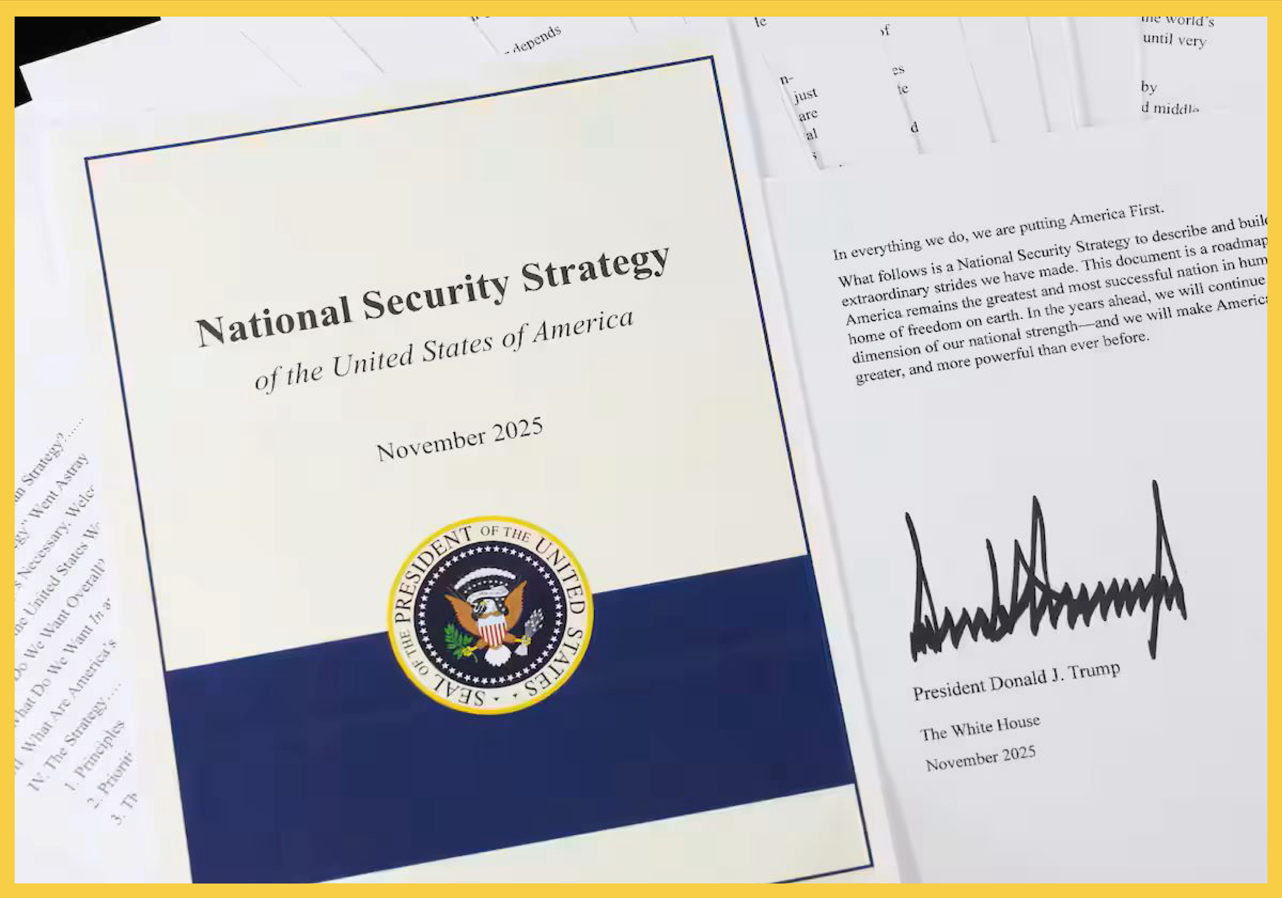
Late on Dec. 4, the U.S. administration under President Donald Trump released its 2025 National Security Strategy, which presented a clear plan for the foreign policies for Trump 2.0.
Although not the shortest since 1987, it is the earliest to be published in a new administration, even earlier than in Trump’s first term. Against the backdrop of dramatic reforms at the president’s National Security Council, the swift NSS publication reflects the Trump camp’s many long-brewing ideas about America’s global role.
If the Trump 1.0 NSS embodied the broad consensus reached through many years of discourse about China, the latest NSS carries prominent marks of Trump’s personal ideas and preferences. The most critical of those lie in the so-called “America first” concept, which belongs to none of the existing philosophies or principles. Following that logic, the singular goal of U.S. domestic and foreign strategies as well as policies is to be effective in maximizing the country’s interests; thus any investment in world affairs that has no direct bearing on U.S. interests must stop.
The purpose of the introverting agenda is to “make America great again” and preserve its leading role and status as No.1 in such realms of national competitiveness as economy, military, science and technology. Only this, in Trump’s view, can position the U.S. to promote “peace through strength,” and make sure it will continue to have maximum global influence without intervening in global affairs or assuming international burdens.
Under the new NSS framework, if certain global or regional issues directly involve U.S. interests, it will intervene with the strongest possible national power and competitiveness to maximize those interests. In other words, the Trump administration wants a hierarchical order in which the U.S. sits at the top of food chain. When affairs are irrelevant to U.S. interests, it will refuse to get involved at all, let alone force an explicit preference or stance based on values or ideology. Instead, it will leave such matters to be resolved through consultations by the major powers that care. This results in a global landscape wherein regional powers dominate based on the law of the jungle.
Regionally, the Trump administration focuses on the Western Hemisphere in the new NSS; its country focus continues to be China. These two strategic dimensions combine to produce a narrative in which a “non-Hemispheric competitor” is prevented from exerting much influence in the affairs of the Western Hemisphere, where the Trump corollary to the Monroe Doctrine had already emerged during the last general election cycle.
Trump’s adulation of the McKinley era after his return to the White House can be seen in his endeavors over the past 11 months to enhance U.S. control over Latin America—the Caribbean area in particular. Trump leaves no doubt that the Western Hemisphere is of critical importance to U.S. interests. Other strategic zones may be set aside when U.S. interests don’t exist there, but this will never be the case in the Western Hemisphere.
Preventing Latin America from causing trouble for the U.S. through total control of Latin American resources, as well as preventing the rise of anti-U.S. factions and what the U.S. identifies as influence by extra regional actors has always been the basic position of previous U.S. administrations except when distracted by affairs in the Middle East or Asia-Pacific.
Today, however, U.S. strategic resources have been refocused on the Western Hemisphere. For Trump 2.0 in particular, Latin American affairs—and especially Caribbean affairs—are taken as domestic issues, unlike other foreign affairs. This means the “America first” doctrine prioritizes the strengthening of control over Latin America. The goal is to consolidate the essential geo-strategic foundation so that America can make adjustments more easily in the future.
China, over the past eight years—a time during which its role in the NSS reports shifted from being a “competitor” to a “revisionist power” and finally to “the only competitor with both the intent to reshape the international order and, increasingly, the economic, diplomatic, military and technological power to do it”—has seen increasingly harsh standoffs, even confrontational strategic positioning. The ambiguous new NSS definition of China—calling it a “near-peer”—is thought-provoking.
Competition certainly will continue; however, it may no longer be the Cold War-style return of a rivalry of values and ideology but rather an actual major power contest in terms of national strength and rhetorical power. The apparent evolution from “strategic pivoting” to “economic pivoting,” which features a special emphasis on avoiding military conflict as much as possible, is fully capable of redefining the China-U.S. game. It’s no longer a live-or-die rivalry, or even a win-lose situation, but boils down to a determination of who is better.
Meanwhile, China should remain vigilant. The frequent expressions by the United States regarding the Indo-Pacific region or the Taiwan issue may be seen as necessary responses to the traditional hawks in the government. These to a great extent reveal that Trump’s stance—and the force behind him—has yet to become a strategic consensus within the U.S., or even within the Republican Party.
The report’s proposal to “win the economic future” and prevent military confrontation based on strength is not only inherently self-contradictory but also suggests an inevitable future of conspicuous duplicity in actual policy choices and implementation.
The new NSS foreshadows certain key adjustments in U.S. foreign strategy and policies, yet this is certainly no mere mutation in the orientation of hegemony. Rather, it is a fundamental transformation in the format of hegemony. Considering the brash and unpredictable personal characteristics of Donald Trump himself, whether the ideas in the report become a new consensus or will be rolled back remains in suspense. Either way, for at least the next three years when the report still holds, it clearly will provide a critical window for understanding the roles of major powers in America’s eyes and for reshaping the world order.
