
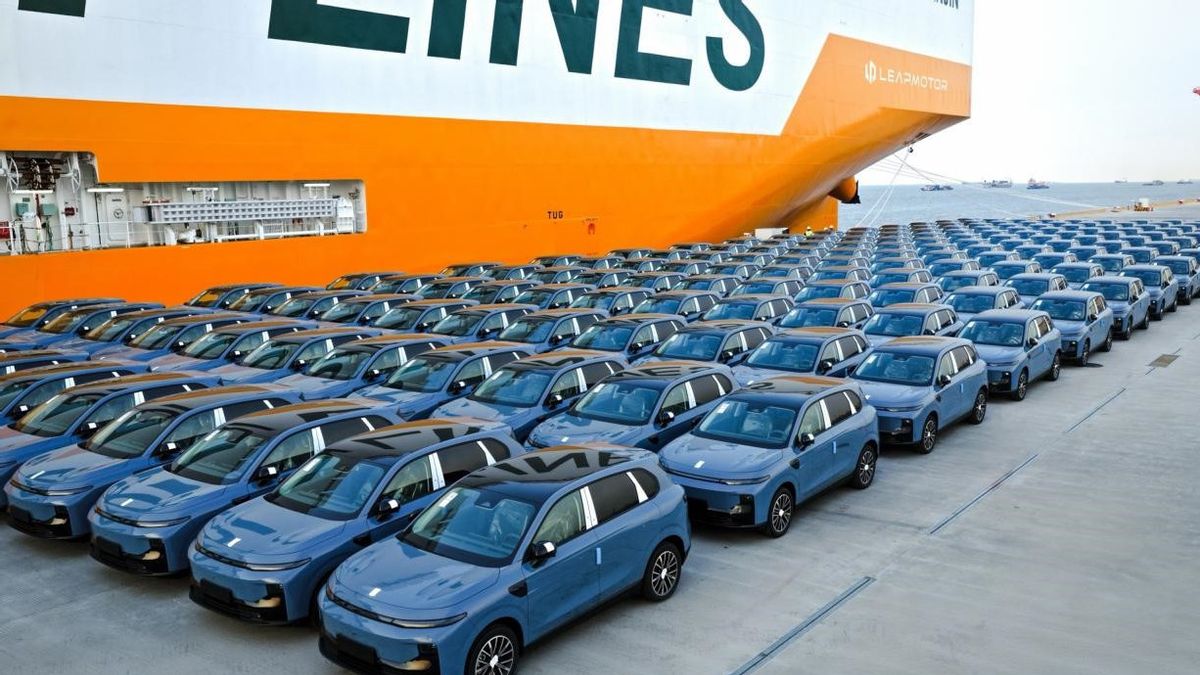
Export of B10 electric cars to Europe. (Photo Leapmotor)
Hostage Interdependence and Managed Cohabitation
The land of Machiavelli, Richelieu, and Metternich has rediscovered a rule of power politics it once grasped instinctively: do not attack suppliers you cannot replace. For years, this rule was buried beneath moralism, regulatory theater, and Atlantic subservience. Its return marks no awakening, only a belated admission of constraint.
What Brussels presents as a China policy rests on a self-imposed condition of “hostage interdependence,” an exposure created by reliance without leverage. European leaders confuse declaratory toughness for power, Washington monetizes their obedience, and Beijing assigns a price to Europe’s vulnerability. Every major confrontation over the past two years has followed the same arc: tariffs softened into negotiations, retaliation restricted rather than escalated, public outrage yielding to selective accommodation. This repetitive pattern has hardened from failure after failure into doctrine.
The apparent China-Europe thaw rests on a simple exchange. Europe remains tied to Chinese supply chains it cannot replace, and China still needs a European market that absorbs volume. The détente is actually a transaction shaped by cost, leverage, and asymmetric exposure, not renewed trust. Beijing cannot treat Brussels as expendable while U.S. controls, tariffs, and blacklists narrow access and raise costs, and the same logic applies in reverse.
The result is managed cohabitation, best understood as Europe attempting to exit its long-standing hostage interdependence. Both sides retain instruments of punishment, yet both now prefer to contain disputes. Beijing adjusts tactics without altering objectives, while Brussels announces enforcement it seldom executes. Member states pursue bilateral accommodations that erode collective leverage. The thaw exists because cohabitation is cheaper than divorce, even as escalation remains a standing option.
The evidence lies less in rhetoric than in what moves. In January 2026, the European Commission labeled as “guidance” what amounted to a retreat from earlier anti-subsidy investigations, allowing Chinese automakers to offer minimum price commitments on electric vehicles in lieu of levies of up to 45.3 percent. Brussels framed this as industrial defense and Beijing accepted it as a reasonable compromise. Each side won: Europe preserved the appearance of enforcement without inviting retaliation, and China retained market access while protecting margins.
The detour exposed the exercise itself. In October 2024, the Commission invested all its political capital in EV tariffs, presenting them as essential to European competitiveness. By April 2025, it was negotiating the same minimum price mechanism it had rejected months earlier, despite its failure in the solar panel dispute twelve years before. The sequence leaves little ambiguity: current leaders overrode the very competitiveness they claimed to defend after expending vast resources to protect it.
Chinese firms bypassed tariffs and reputational costs with ease, as Chinese EV sales in Europe climbed sharply from 2023 through 2025 and exceeded 400,000 units by 2024 alone. Yet Brussels pressed ahead because the alternative carried political costs: admitting that Europe needs Chinese EVs to meet climate targets and that the Commission has failed to create conditions under which European manufacturers can match price, scale, or speed. This was forward flight, unworthy of statecraft.
Calibrated Pressure
Beijing’s response pattern is more disciplined. Export controls on gallium, germanium, and graphite, followed by the dairy investigation, revealed a calibrated method. In December 2025, China imposed anti-subsidy fees of up to 42.7 percent on European dairy products after an anti-subsidy probe launched in August 2024, weeks before Brussels announced EV tariffs under pressure from Paris and Madrid, even as Spain later abstained. Beijing chose a sector where French exposure was highest, signaling that escalation would trigger politically concentrated pain on its own terms.
That logic surfaced when Emmanuel Macron returned from Beijing in December warning that Europe was prepared to impose tariffs unless China addressed the trade imbalance. Two weeks later, long-shelved dairy measures hit French producers. European leaders issue warnings; China answers by striking domestic industries in the capitals that issue them.
Yet the Trump Corollary effects have a habit of provoking surprises. Days later, China reopened beef and pork markets to Ireland and Spain, revived aircraft orders to France, and extended narrow access concessions tailored to individual governments. Each move carried an implicit condition: cooperation is rewarded, leadership of confrontation punished.
The Nexperia episode revealed hostage interdependence in operational form. The Dutch government seized control of the Chinese-owned semiconductor firm one day after Washington expanded export controls to subsidiaries of listed entities. Those controls were lifted within a month. Yet in the meantime, The Hague acted under U.S. pressure without assessing likely revenge. Beijing responded by blocking shipments from Nexperia’s Dongguan plant, which accounted for most of the firm’s output. European automakers faced immediate disruption.
Dutch officials first denied U.S. influence with cast-iron certainty, then admitted they were unprepared for China’s response, exposing that they acted without assessing Beijing’s most probable reaction. Within weeks, the control order was suspended. The episode underscored how Europe relies on Chinese manufacturing for components it cannot produce at scale, and China can convert that reliance into leverage whenever European governments act on American priorities.
The EU trade deficit with China reached €305.8 billion in 2024, a scale that reveals the hostage interdependence’s scale. The gap widened even as import volumes fell. Europe condemns overcapacity while continuing to import because cheap goods restrain inflation, placate voters, and feed production chains. The EU leaders’ political language denies what economic behavior confirms.
Governing by Postponement
Accordingly, Brussels has responded by perfecting a style of toughness that rarely reaches execution. Measures are announced to satisfy Washington while their substance dissolves into procedures designed to delay effect. The recent revision of the Cybersecurity Act, nominally aimed at phasing out Huawei and ZTE, spoke loudly to American audiences while deferring real impact into processes that can stretch indefinitely.
The same pattern governs parliamentary theater. Resolutions demanding sanctions on Hong Kong Chief Executive after Jimmy Lai’s conviction have been passed repeatedly since 2023 without producing a single policy change. Outrage is staged, commerce is sabotaged at the ratification stage, and institutional roles distribute moral signaling upward while responsibility for consequences remains nowhere to be found.
Unfortunately, trade diversification follows the same script. The Mercosur agreement and the India trade deal were sold as historic breakthroughs, proof that Europe could dilute exposure to China. Yet neither delivers without parliamentary ratification, leaving the EU with three parallel trade fictions: China (CAI), Mercosur, and India. When von der Leyen hailed the India agreement as “the mother of all deals,” Delhi signed a comparable arrangement with Washington days later, turning the claim into yet another gesture without consequence.
Indeed, EU leaders speak as if options exist that power does not support. They announce investigations, threaten enforcement, and proclaim unity, then trade it away through accommodations that drain collective leverage. Furthermore, every state carries a pressure point Beijing can exploit, and every government will abandon Brussels rhetoric when domestic jobs are at stake.
A serious policy would begin by naming the thaw for what it is: an armistice with invoices attached. It would channel capital into manufacturing capacity where necessity translates into exposure, building supply rather than policing others’ output. It would treat industrial scale as power, not as a regulatory problem to be managed. It would stop mistaking parliamentary outrage and filibustering for executive action. Without that clarity, Europe will repeat the cycle of public threats, private accommodation, and periodic shocks that reveal how little control it holds over the terms of its prosperity.
Because Europe exhausted the space for pretense long ago. Beijing counts on European fragility, Washington exploits European dependence, and EU leaders, aided by loyal courtiers, insist that procedure and inimitable principles can compensate for missing power. The issue is recognition of dependence: Europe also relies on China. You do not attack suppliers without substitutes, and you do not provoke powers without leverage. Hence, the current thaw is not a policy success but the bill for a costly lesson in geopolitics, one EU leaders audited at full tuition while European citizens settle the account.
