
Reframing Europe as an example of civilizational erosion reinforces crisis narratives among conservatives in the United States while mirroring problems that exist within Europe itself. In effect, Washington is using Europe’s crisis to tell a story about America.
![[CropImg]U.S. National Security Strategy 2025.jpg](/d/file/202512/a00c8042414dfdb1ce2820a4433b4baf.jpg)
Read the full 2025 National Security Strategy here
After the release of the 2025 U.S. National Security Strategy, the chapter on Europe quickly emerged as one of the document’s most controversial sections, inevitably calling to mind Vice President JD Vance’s speech at the Munich Security Conference in February. The NSS can be read as an amplified version of that speech, redefining Europe through a sharply ideological narrative based on civilizations that departs from the traditional U.S. emphasis on shared transatlantic values. It reveals a paradigm shift in the President Donald Trump’s approach to Europe and signals the direction transatlantic relations may be heading.
The NSS opens its Europe section by stating that Europe’s real problems are deep. This diagnostic tone departs markedly from the more measured style of past strategies. The report goes on to assert that this economic decline is eclipsed by the real and more stark prospect of an erased civilization. Immigration, declining birthrates, alleged restrictions on speech and weakened national identity are all grouped into what the report frames as a civilizational survival crisis.
This reflects a U.S. government that is no longer evaluating Europe through its institutional capacity or strategic role but rather through a civilizational and cultural framework. Thus, domestic European social tensions become folded into Washington’s own strategic narrative.
On this basis, the NSS raises unprecedented doubts about the reliability of European allies, noting that it is far from obvious whether certain countries will have economies and militaries strong enough to do so. This effectively places some European states under scrutiny as potentially unreliable in the future. The report further argues that “certain NATO members will become majority non-European,” linking demographic change directly to questions of strategic orientation and political stability.
No previous U.S. strategic document has framed long-term alliance reliability in such explicitly civilizational terms, underscoring how the Trump administration’s assessment of Europe is no longer grounded primarily in institutions, capabilities or geopolitical interests but rather in cultural and identity-based sustainability.
This civilizational narrative also extends to Washington’s preferences toward Europe’s internal politics. The report notes that “the growing influence of patriotic European parties indeed gives cause for great optimism.” In the European context “patriotic parties” often refers to right-wing or even radical far-right movements. A public expression of optimism toward these elements by the U.S. government risks reinforcing Europe’s internal political polarization.
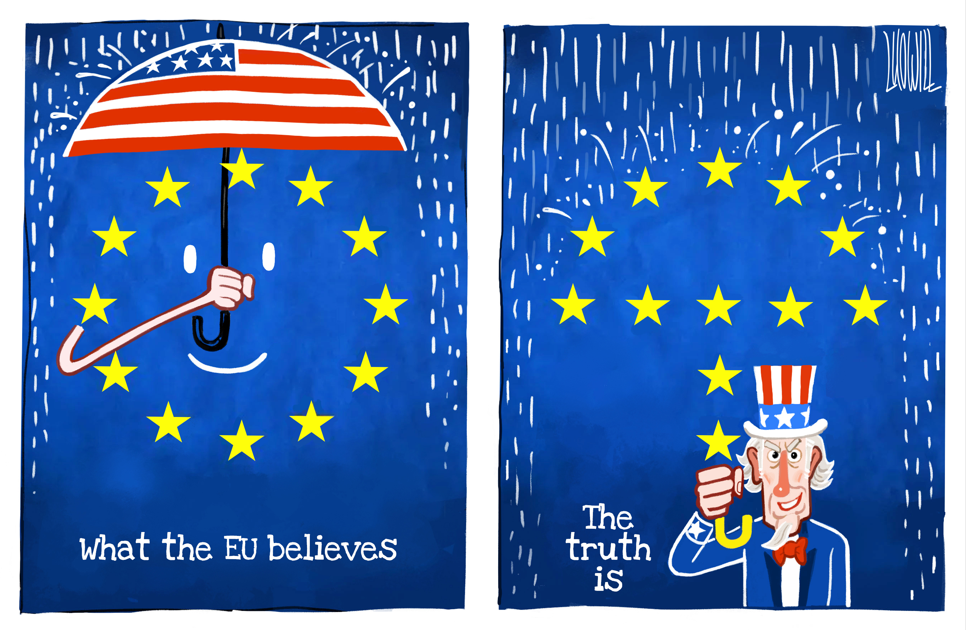
(Graphics by Luo Jie of China-US Focus)
This tendency is further reflected in the report’s depiction of the European Union, which is implicitly cast as part of Europe’s problem rather than part of the solution. Ideologically, the Trump administration no longer views the EU as a natural strategic partner of the United States but rather as a political structure to be resisted—or bypassed when necessary.
The NSS section on the Ukraine conflict makes the U.S. strategic ordering even clearer. The report states that it is a core interest of the United States to negotiate an expeditious cessation of hostilities in Ukraine and reestablish strategic stability with Russia. This indicates that Washington is prioritizing a quick end to the conflict and the restoration of U.S.-Russia stability above other considerations.
The NSS is sharply critical of Europe’s approach, stating that officials hold unrealistic expectations for the war and further asserting that these governments subvert democratic processes, preventing the public desire for peace from translating into policy. Within this narrative, Europe—by supporting Ukraine and emphasizing deterrence—becomes an obstacle to peace. The Trump administration’s logic is straightforward: It prefers a transactional settlement, whereas Europe’s more values-driven goals are dismissed as unrealistic.
Taken together, the NSS characterizations make clear that the Trump administration’s adjustment of U.S. policy in Europe is not merely a short-term tactical shift but a structural transformation shaped by domestic politics, evolving global strategic priorities and a deepening dissatisfaction with the liberal international order.
Domestically in the United States, the civilizational narrative has reemerged as a powerful tool of political mobilization. Reframing Europe through a lens of civilizational crisis allows the administration to externalize and amplify issues that also divide American society—immigration, identity politics and cultural anxiety. Presenting Europe as an example of civilizational erosion reinforces crisis narratives among Trump’s conservative base while mirroring problems that exist within Europe itself. In effect, Washington is using Europe’s crisis to tell a story about America.
At the same time, as U.S. strategic priorities shift, Europe no longer occupies the central position it held during the Cold War. Today, U.S. resources are being directed toward economic rivalry, supply chain restructuring and strategic competition with China. Europe is not a decisive variable in the list of priorities. For the Trump administration, a Europe that can deliver a quick cease-fire in Ukraine, restore U.S.-Russia stability at low cost and reduce America’s strategic burden is far more appealing than one that demands long-term security commitments. If Europe’s stability can be achieved at lower cost, the incentive for strategic reallocation grows.
The administration’s deep mistrust of the EU as a supranational project also shapes America’s policy recalibration. While past U.S. governments occasionally criticized EU economic or defense policies, they still saw the EU as a stabilizing force. Trump, however, views the EU as a symbol of liberal institutional overreach—a structure that limits national sovereignty and complicates U.S. leverage. A more fragmented Europe, with stronger nationalist currents, allows Washington greater room to pursue bilateral deals on trade, industrial policy or energy. Encouraging far-right nationalism thus provides the U.S. with additional leverage in shaping Europe’s future.
The effects of this shift are already visible in the structure of transatlantic relations. The military alliance may endure, and NATO’s treaty obligations will not vanish overnight, but political trust is weakening in ways that could prove long-lasting. The U.S. no longer evaluates Europe as a community of shared values but as a region whose civilizational viability is in question. This creates persistent splits in how both sides define threats, set security objectives and interpret each other’s intentions.
These differences will be especially evident regarding Russia. If the U.S. prioritizes a quick stability-driven cease-fire while Europe insists on a justice-based peace for Ukraine, their strategic aims will drift apart. Europe could find itself unable to shape the postwar settlement, and may even be at risk of being marginalized by U.S.-Russia bargaining.
Washington’s stance toward Europe’s domestic political landscape will further reshape the continent. Open or implicit U.S. sympathy for European right-wing forces will influence electoral dynamics and weaken the EU’s ability to maintain policy cohesion. As internal fragmentation intensifies, Europe’s bargaining power in great-power politics—including on Russia, China and global supply chain governance—will diminish. A weaker, divided Europe enhances U.S. leverage and increases Washington’s ability to redefine the transatlantic order.
Looking ahead, U.S.-Europe relations are entering a period of profound uncertainty. Europe remains dependent on the U.S. for security in the near term, yet finds it increasingly difficult to accept a civilizational narrative that frames the continent as culturally endangered. Meanwhile, the U.S. no longer treats Europe as an indispensable partner, but as a strategic variable to be recalculated based on cost, risk and geopolitical returns. The foundational logic of the relationship is shifting from an alliance community to conditional cooperation, from institutionalized partnership to more transactional arrangements.
The NSS shows that the transatlantic relationship has reached a tipping point. For Europe, the shift is both a source of pressure and a potential opportunity. It compels Europe to rethink the real meaning of strategic autonomy—not merely increasing defense spending or building military capacity but developing the political and strategic ability to safeguard its interests amid fluctuations in U.S.-Russia and U.S.-China relations, as well as to reduce its dependence on any single external power. If Europe can identify and seize opportunities in the midst of crisis and forge more unified strategic objectives, then even a fundamental U.S. recalibration of its approach to Europe may still allow the continent to elevate its role in the international system. Conversely, if Europe remains divided politically and strategically, its position in future great-power dynamics may become even more marginalized.
