
Mark Carney’s visit to China was a significant development in contemporary global politics, reflecting not only growing Western engagement with the East, but also signaling a broader shift in which the East itself is emerging as a focal point of global political and economic attention.
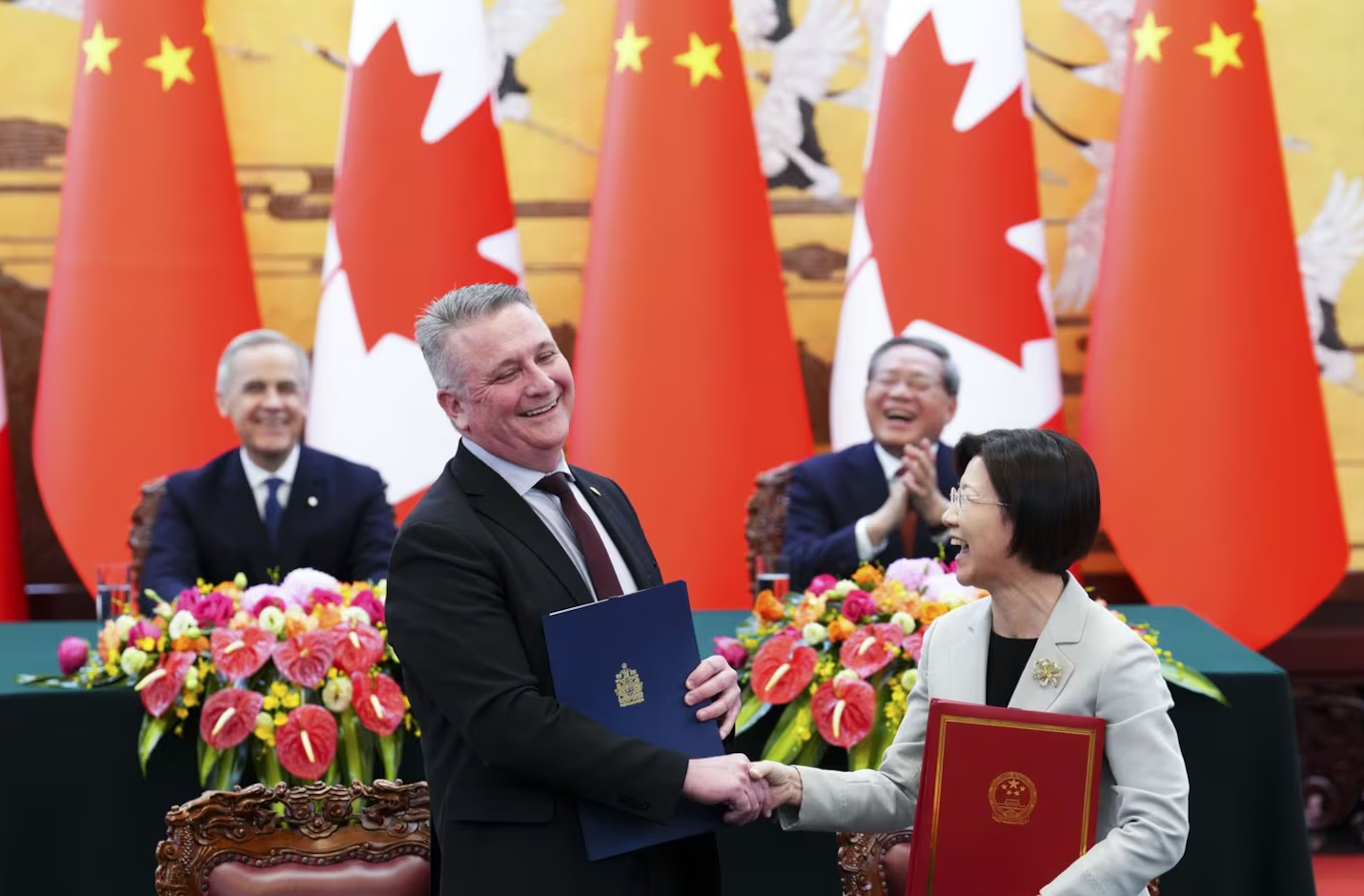
Canadian Minister of Agriculture and Agri-Food Heath MacDonald and Sun Meijun, Minister of the General Administration of Customs in China, take part in a signing ceremony at the Great Hall of the People in Beijing on Jan 15, 2026.
For the international community, the four-day visit to China in January of Canadian Prime Minister Mark Carney is nothing short of a paradigm shift. Within the previous paradigm—one that had persisted for centuries—it was inconceivable for a Western state such as Canada to engage strategically with an Eastern state such as China in this manner.
In the final phase of this earlier paradigm, ever since the United States assumed leadership of the Western world, Western countries have largely operated in accordance with American preferences and—willingly or not—have aligned themselves with its positions. Eastern countries, particularly Russia and China, have seen the situation more or less through the same lens as the one adopted by the United States.
Western democracies are now confronted with a Trumpian America—an America fundamentally different from the one they had known before. The earlier United States had never really appeared to be an open threat to its allies. It did not issue explicit threats to them. But Trump has told Canada that it should declare itself the 51st state of the United States and submit to the authority of the American government. He has persistently referred to former Prime Minister Justin Trudeau as “Governor Trudeau.”
Trump has issued open threats to Denmark on Greenland. Across Europe, people are staging demonstrations of support for their allies. The slogan “Make America go away” is rising as a public demand.
The two factors that have given rise to the new paradigm fundamentally boil down to Trump’s arrogant, narcissistic, self-centered and self-serving conduct; and the foreign policy readjustment that has emerged among U.S. allies as a consequence of that conduct. Perhaps no one is safe from a Trumpian government. And now, even Europe is no longer secure. Under Trump, neither neighboring states nor distant countries are safe—neither enemies nor allies; neither the United Nations nor the International Court of Justice; neither international law nor international ethics; neither international trade nor the terrestrial environment. International institutions, alliances, and treaties are all at risk. All of these effects emanate from Trump and are intensifying global instability.
In the view of many Americans and non-Americans alike, the United States itself is not safe from Trump. Fareed Zakaria, the renowned author and CNN host, writes that Trump is determined to squander what the United States has achieved through a century of sustained effort.
The other side
On the other hand, there stands China, the world’s second-largest economy and also the second-largest military and political power. Its leadership is neither trigger-happy nor inclined to use threatening language on virtually every occasion and in every matter. Especially in its dealings with weaker countries, China’s approach is marked by goodwill and respect. Even toward the United States, its posture is not provocative but grounded in dignity, sovereignty and equality. Its leadership is conveying to the world a message of peace, development, coexistence and shared prosperity. It is genuinely practicing respect for the sovereignty of all countries. It is strengthening international law, international institutions and international agreements. It treats all countries with dignity and equality.
Trumpian America is different. It operates on a doctrine of dominance and power. It seeks to impose and resolve all matters and conflicts through the use of coercive force, whereas China, grounded in the principles of mutual respect and peaceful coexistence, is winning hearts and minds in developing countries. Even developed countries have come to understand this contrast and have begun to reorient their foreign policies and international relations accordingly.
The recent visit of the Canadian prime minister is an example of this phenomenon. Of all America’s allies, Canada has arguably been the principal target of Trump, having been repeatedly subjected to humiliation and disparagement. Trump also employed tariffs against Canada with considerable severity. The prime minister’s visit signifies that the West has not only turned its gaze eastward but has also extended its hand.
Divided global community
Divisions within the human community have brought nothing but pain and suffering. The division between East and West is one such cleavage. It offers no real benefit to ordinary people. On the contrary, it creates obstacles and hardships. Both East and West must accept one another if the global community is to become a human community in the true sense. Together, East and West can eradicate ignorance, poverty, disease and war from the world.
For the sake of human welfare and progress, the East has long embraced, with an open heart, the international institutions, principles, and laws established by the West.
The East has the potential to play a leading role in shaping a more inclusive and cooperative global order. The East, like the West, possesses the competence and capacity to provide leadership to the world. Trudeau’s arrival in Beijing and the warm reception extended by China’s leaders were welcome news for those who advocate global peace and international stability.
The visit was a significant development in contemporary global politics, reflecting not only growing Western engagement with the East, but also signaling a broader shift in which the East itself is emerging as a focal point of global political and economic attention. More important, the visit may be seen as a positive step toward bridging long-standing global divides.
