The three-way summit in Shenzhen gave China additional diplomatic options, particularly in managing uncertainty about Washington’s China policy after the midterm elections. It also reinforced Beijing’s ability to engage both the U.S. and Russia on its own terms.
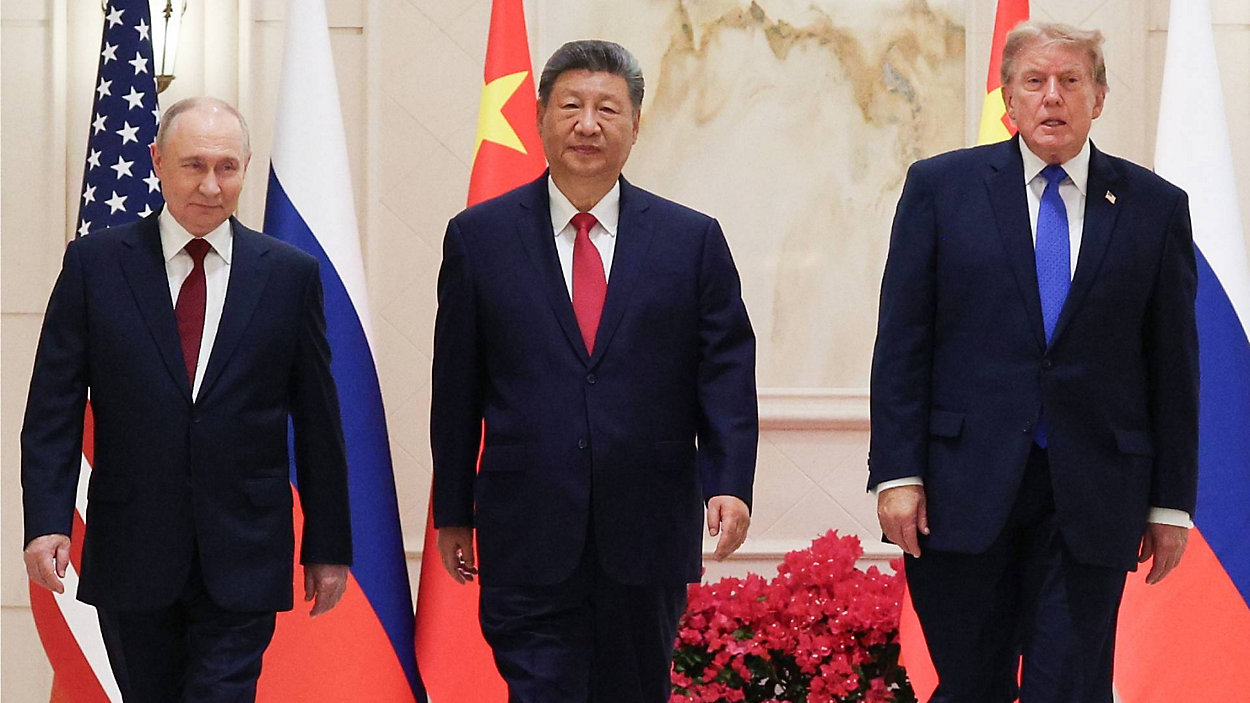
Russian President Vladimir Putin, Chinese President Xi Jinping and U.S. President Donald Trump arrive for a trilateral meeting at Kylin Villa on November 19, 2026 in Shenzhen, China.
After the summit meeting of presidents Xi Jinping, Vladimir Putin and Donald Trump in Shenzhen on Nov. 19, the three leaders issued their four-point Declaration Toward Peace, which addressed UN reform, energy supplies, international judicial jurisdiction and nuclear risks. Yet the meeting fell well short of a grand bargain on major geopolitical or security issues. Some media commentary quickly swung from fears of a “Yalta 2.0” to the opposite extreme, dismissing the summit as empty diplomatic spectacle.
Why, then, was Beijing willing to take the risk of bringing the three leaders together? One answer is that China sees leader-level diplomacy as a form of insurance against uncertainty in American policy, particularly after the Republican Party was eviscerated in the U.S. midterm elections. Beijing cannot determine Washington’s choices, but it can seek to counterbalance the influence of China hawks within the Trump administration and preserve room to manage disputes over trade, technology and Taiwan before they escalate into broader confrontation.
Trump is unusually receptive to personal diplomacy, but his administration remains divided over China. His appetite for deals competes with pressure from officials who see technological restrictions and sustained strategic pressure as essential to containing Beijing. Trump himself has acknowledged competing views within his administration over China’s access to advanced American technology. After the Republicans' merciless midterm thrashing, domestic political pressures could sharpen the divisions.
From Beijing’s perspective, Trump’s views of China and the bilateral relationship are constantly being shaped by the people around him. Without regular engagement at the highest level, particularly on issues where he hopes to achieve tangible results, his approach could be swayed by China hawks. Beijing therefore sees value in maintaining direct contact with the president and giving him reason to favor a more stable relationship. The agreement reached during the bilateral meeting in Shenzhen to develop an action plan for a constructive relationship of strategic stability is significant in this respect. It offers a framework for managing differences, even as American policy remains contested.
China’s relationship with Russia follows a different logic. Beijing has built a durable strategic partnership with Moscow, underpinned by energy cooperation, geographic proximity, Eurasian connectivity and diplomatic coordination. So interest shared with Russia provide a stable foundation for the relationship, regardless of how American policy might fluctuate. China seeks more predictable relations with Washington while preserving the strategic depth of its partnership with Russia. Neither relationship needs to come at the expense of the other.
Nor does Beijing necessarily oppose a rapprochement between Washington and Moscow. Less hostility between the two could reduce wider tensions and create more favorable conditions for strategic stability. What China wants to avoid is a return to zero-sum triangular diplomacy, particularly a "reverse Nixon" strategy aimed at weakening its relationship with Russia. By hosting both presidents, Beijing demonstrated that it can engage Washington and Moscow on its own terms, without allowing either relationship to determine the other.
The calculation extends to Asia. Japan and the Philippines have strengthened security ties with Washington, while Taiwan remains a dangerous potential flashpoint. The military balance will not change because of a Xi-Putin-Trump meeting. But governments also plan based on what they expect America to do next. A president who seeks an understanding with Beijing, even temporarily, complicates the assumption that confrontation is Washington’s inevitable course.
This uncertainty cuts both ways. Some of America’s partners may become more cautious; others may seek stronger security guarantees. Beijing cannot control the response. But it has an interest in preventing the region from settling into a permanent expectation of confrontation, particularly when such expectations can themselves encourage risk-taking.
The peace declaration illustrates how the three governments can pursue such limited accommodation. Its language reflects different national priorities, not a shared political vision. Washington’s criticism of the International Criminal Court coincided with Moscow’s insistence that the immunity of state officials must be respected. References to state consent and abuses of jurisdiction by “other similar bodies” also echo China’s long-standing objections to the South China Sea arbitration. The three countries were able to incorporate different concerns into a common document without demanding that their disagreements disappear. For Beijing, this suggests that practical coordination need not begin with political alignment.
The nuclear provision offers a more consequential test. The expiration of New START in February has removed an important constraint on American and Russian strategic arsenals. China, whose nuclear forces remain considerably smaller, has little reason to accept equivalent numerical limits.
The leaders reaffirmed that nuclear war cannot be won and must never be fought. This demonstrates that despite strategic rivalry and security disagreements China, Russia and the United States can still agree on the fundamental unacceptability of nuclear war. The consensus helps uphold the international nuclear taboo and sidesteps more aggressive approaches to nuclear deterrence. It also sends a cautionary signal amid debates over expanded nuclear-sharing arrangements, so-called “friendly proliferation” and possible exceptions to Japan’s Three Non-Nuclear Principles. The leaders also promised dialogue on nuclear risks and non-proliferation. More reliable crisis communications, measures to prevent military incidents, discussions about vulnerabilities in nuclear command-and-control systems and safeguards to ensure meaningful human control over nuclear decisions would provide a useful beginning.
There is an important distinction between reducing risks and settling geopolitical disputes. The former may be possible even when the latter remains out of reach. China has no interest in accepting responsibility for a settlement in Ukraine whose terms it cannot guarantee. Nor can any agreement on European security be durable if the countries most directly affected are excluded. Beijing is also mindful that a three-power arrangement perceived as sidelining Europe could complicate its relations with the EU at a time when both sides have reason to preserve strategic dialogue. For China, engaging Washington and Moscow should not come at the expense of Europe’s ability to shape its own security future.
As I argued in a May 2025 essay in The Diplomat (“Why China Is Not Interested in Great Power Carve-ups”), Beijing has little reason to embrace a Yalta 2.0 arrangement. China's rise has depended on globalization, economic interdependence and relationships extending across geopolitical divisions. A world divided into rigid spheres of influence would constrain those relationships, undermine China’s strategic flexibility and risk legitimizing practices of great-power domination that Beijing has historically opposed. Yet Yalta carries another historical meaning. Three countries share a distinctive historical identity as major victorious powers from World War II and permanent members of the United Nations Security Council. This shared history offers a language of common responsibility that transcends contemporary strategic disagreements.
Admittedly, China presents itself as a supporter of an equal, orderly, multipolar world. Yet bringing together three major powers inevitably raises concerns that they might claim special authority over smaller countries. This is where the distinction between the Group of Three (G3) and the Responsible Three (R3) becomes important. The former implies an exclusive club that claims the right to shape the international order. The latter recognizes that extraordinary capabilities bring particular responsibilities, especially the duty to maintain the peace and prevent catastrophic conflict.
The R3 could also remain limited in ambition and open to wider participation. China’s economic and diplomatic relationships extend far beyond Washington and Moscow. Europe, the Asia-Pacific and the Global South are essential to China’s long-term development and international influence. An exclusive three-power arrangement could undermine these relationships. This suggests that the logic of R3 could extend toward R3+X: more flexible coordination involving the three major powers alongside relevant countries and international institutions. Beijing has a strong interest in ensuring that great-power consultation complements, not displaces, broader international cooperation.
No single meeting can resolve the deep differences dividing the three powers—particularly those between China and the United States—over major international and regional issues. Nor can it fundamentally alter Washington’s perception of Beijing as its overriding strategic rival, if not its only one. But the historic trialogue in Shenzhen gave China additional diplomatic options, particularly in managing uncertainty about Washington’s China policy after the midterm elections. It also reinforced Beijing’s ability to engage both the U.S. and Russia on its own terms. Finally, it served as a reminder to those in Asia who hope to win Trump’s favor or support by adopting a more confrontational stance toward China that Washington’s approach to Beijing may be less predictable than they assume. For Beijing, that is the logic of the gamble.
