The recent meeting of 21 member states of the Asia Pacific Economic Cooperation forum in Shenzhen, China concluded with little to show for it. To simply take place and for the leaders to be seen seems to have been the main point—certainly for the historic meeting between the Chinese, Russian, and American presidents. But even that trilateral accomplished little. The clear “winner” of the summit was the host: Xi Jinping and China.
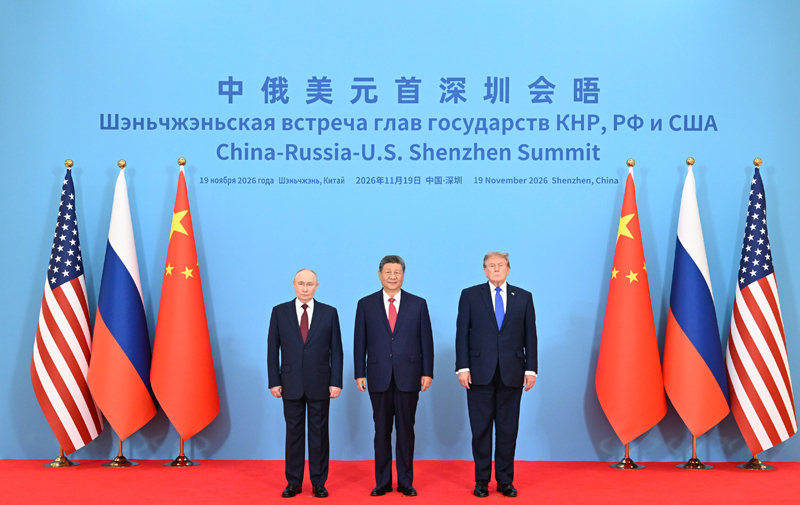
Chinese President Xi Jinping holds a China-Russia-U.S. summit with Russian President Vladimir Putin and U.S. President Donald Trump in Shenzhen, south China's Guangdong Province, Nov. 19, 2026.
The 33rd Asia-Pacific Economic Cooperation (APEC) Leaders Meeting which convened in Shenzhen, China on November 19, 2026 was largely underwhelming and a lost opportunity on a number of levels.
First, APEC itself continues to search for a raison d’etre. The organization was established in 1989 by a dozen member states panning the Pacific Ocean (a by-product of the then popular concept of the “Pacific Century) with the purpose of expanding trade and investment across and within the trans-Pacific region, primarily through lowering or eliminating tariffs and non-tariff barriers (NTBs) to trade and increasing people-to-people interflows.
Today APEC has grown to include 21 member states, but the organization continues to search for coherent meaning and binding influence. The best it seems capable of doing is producing lengthy documents filled with aspirational and illusive verbiage that make little sense. This meeting produced an eight-page document filled with meaningless language. I feel sorry for the bureaucrats who had to spend days drafting such verbiage and getting all twenty-one governments to agree to it; perhaps AI can translate the bureaucratese into understandable English? Moreover, this document has zero binding and enforceable commitments among the signatories. Even this year’s statement admits: “We affirm our commitment to APEC… guided by its voluntary, non-binding, and consensus-driven principles.”
To be fair, APEC does aspire to create a region-wide “Free Trade of the Asia-Pacific (FTAAP). Well, good luck with that. ASEAN and China have had an FTA in place since 2002 (upgraded three times since), and that is indeed an important facilitator of trade and investment between the PRC and the eleven ASEAN states (both China and ASEAN now count each other as their No. 1 trade partners). But there is no way that other members of APEC are going to join a regionwide FTA.
One wonders why such an organization even exists in today’s world? One feasible answer is what political scientists call “path dependency,” i.e. it exists therefore it must continue to exist. The other, and more meaningful, answer is that APEC is—and has always been—a multilateral forum that facilitates bilateral meetings among heads-of-state on its sidelines (so-called “bilats”). Actually, most of the member states’ leaders never have an opportunity to meet with each other (especially those from Latin America and Asia), and some of these states have tricky bilateral problems to finesse. So, in this regard, APEC serves a useful purpose.
At this year’s meeting, clearly the most important side meetings of this year’s APEC summit was the trilateral meeting between Chinese President Xi Jinping, Russian President Vladimir Putin, and American president Donald Trump (and each had a bilateral with each other). As much media commentary has noted, this was the first time since the February 1945 meeting in Yalta between Roosevelt, Churchill, and Stalin that the three leaders of these three major powers have met together.
This in itself is historic. It also is significant that China was the convener. If this does resurrect the “strategic triangle” of the 1970s (which is doubtful), for the first time China is in the “pivot” position and Xi Jinping played the role perfectly.
The three leaders did issue a four-point declaration:
- UN Security Council Reform: As permanent UNSC members, the three nations pledged to reform the United Nations to better address global challenges and uphold international peace.
- Energy Cooperation: They committed to increasing the production and supply of refined petroleum products to support global stability and energy flows.
- State Immunity and Jurisdiction: The leaders emphasized the principle of state consent and immunity for officials, agreeing that bodies like the International Criminal Court must not abuse their jurisdiction.
- Nuclear Security: Reaffirming that a nuclear war cannot be won and must never be fought, the countries agreed to dialogue on reducing nuclear risks and non-proliferation.
It seems that each country got one favored point and one was in agreement by all three. China and Russia have been the foremost advocates for UN reform (the United States has withdrawn from no fewer than 35 UN bodies and treaties under the Trump administration!), so the first point was Beijing’s and Moscow’s. The second point was in the interests of all three powers, although China does not export much oil, but it did legitimize Russia’s exports (circumventing Ukraine sanctions). The third point was clearly for Moscow and Putin personally, as there is currently an ICC arrest warrant out for him. The fourth point is something that President Trump has been pushing for (trilateral nuclear arms control), but China has been clear it has no interest (until it reaches parity with the U.S. and Russia)—so all three could agree on the need for “reducing nuclear risks” (read: No First Use declarations, as favored by Beijing and Moscow) and non-proliferation.
The other main outcome of the trilateral leaders’ meeting is that it legitimized President Putin as an actor in high-level global diplomacy (while he is viewed as a pariah by many countries). For the part of Trump and Xi, they were able to maintain some momentum in the “strategic stabilization” of U.S.-China relations. All in all, the APEC summit in Shenzhen was underwhelming.
