
America’s Gold Eagle framework is fragmenting global technology, accelerating the securitization of AI and pushing the world closer to a new kind of technological cold war—one that threatens to make AI a source of permanent global conflict rather than a shared tool for collective progress.
(Copyright: The Innovation Attorney)
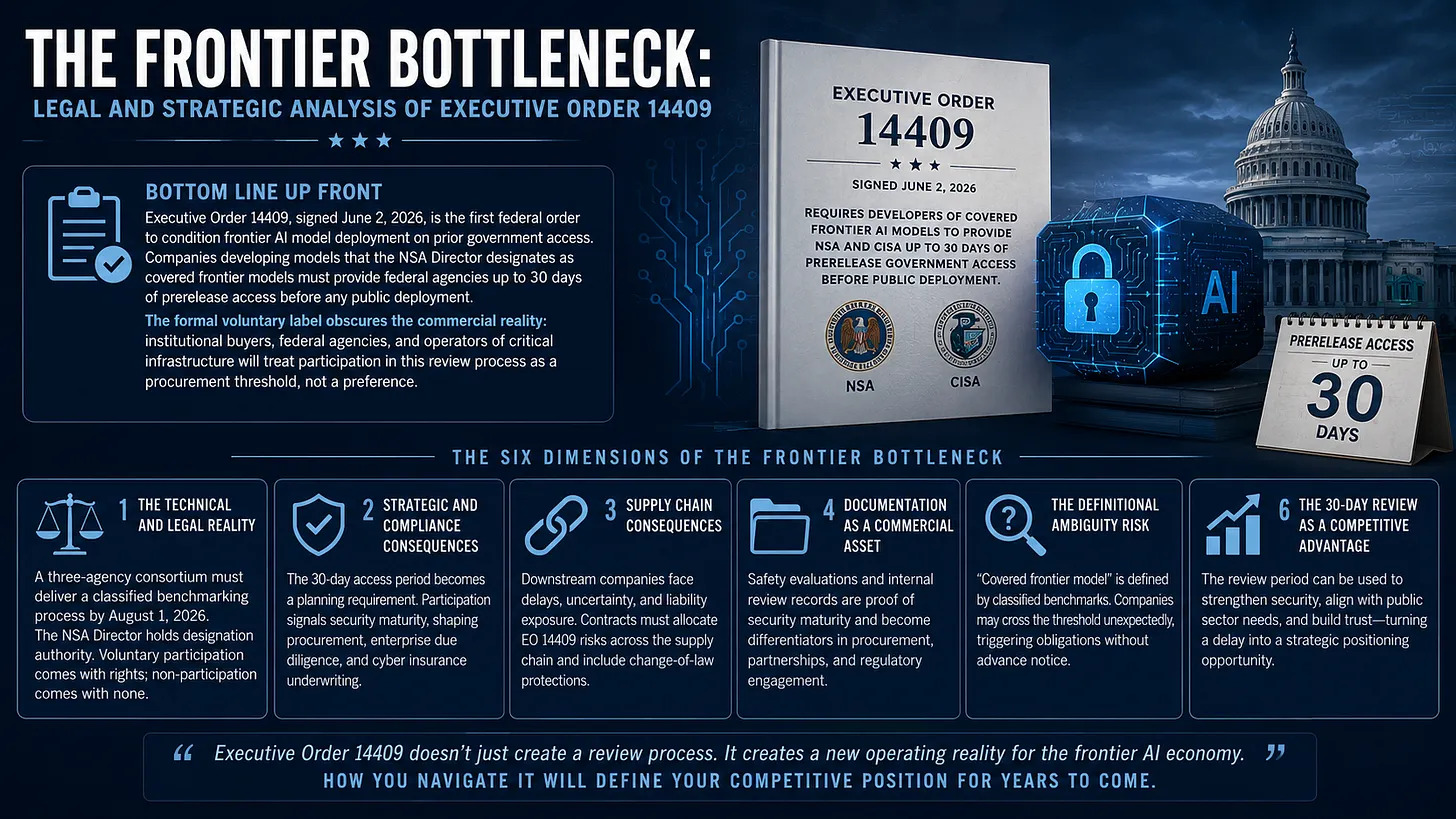
In June, U.S. President Donald Trump issued Executive Order 14409, “Promoting Advanced Artificial Intelligence Innovation and Security”—a landmark policy that redefines America’s national strategy for AI development and cybersecurity. In mid-July, the White House formally launched the Gold Eagle Initiative—an AI-powered cybersecurity clearinghouse mandated under Section 2(d) of the earlier order and marking the start of a new American approach to dominating the global AI landscape.
Far from being a mere domestic regulatory adjustment, Executive Order 14409 and its Gold Eagle operational arm have escalated what was already fierce global AI competition and have driven nations around the world to double down on targeted investments, strategic industrial planning and securitized AI deployment. What was once a contest over technological superiority has evolved into a multifaceted geopolitical, economic and military rivalry, one that threatens to split the global tech ecosystem into competing blocs unless the international community adopts a cooperative, rules-based framework to balance innovation with security.
Seeking to dominate
EO 14409 is the culmination of the Trump administration’s yearlong effort to reframe American AI policy around his “America first” principle, reversing what it viewed as the Biden administration’s overreaching regulatory constraints on the tech sector. Its purposes are to preserve America’s global lead in AI innovation by partnering with the private sector rather than by imposing burdensome top-down regulation; to strike a deliberate balance between unfettered tech development and national security by hardening critical infrastructure against AI-driven cyberthreats; and to protect American intellectual property and technological superiority from adversarial efforts by other countries to steal or replicate U.S. AI advancements.
EO 14409 and the Gold Eagle Initiative are part of a deliberate strategic calculation by the Trump administration to leverage America’s unrivaled private-sector AI dominance—led by companies such as OpenAI, Anthropic and Google—while using government-coordinated cybersecurity collaboration to insulate America’s critical infrastructure from foreign adversaries. By tying AI innovation directly to national security, the policy does not merely defend U.S. technological superiority; it weaponizes AI cybersecurity, turning a domestic policy tool into a means of asserting global geopolitical leverage.
Global AI competition
America’s unilateral escalation of AI-centric cybersecurity and technological competition has triggered a cascading global response, with major economies and middle powers alike rolling out coordinated, well-funded strategies to advance their own AI capabilities. What has emerged is a bifurcated global AI race: On one side, the United States and its treaty allies are pursuing a model that pairs private-sector-led innovation with government-secured tech dominance; on the other, China and other nations are advancing state-centered, full-chain AI strategies to reduce reliance on Western technology and challenge U.S. hegemony.
For the U.S., Gold Eagle is far more than a cybersecurity measure; it is a strategic instrument to consolidate global AI dominance. By centralizing vulnerability intelligence-sharing between the federal government and America’s leading AI developers, the initiative aims to ensure that U.S. companies maintain a decisive defensive technological edge even as they deploy their models globally. EO 14409’s refusal to impose new regulations on AI developers further fuels this advantage: It eliminates compliance costs that could slow domestic innovation, while the administration continues to enforce strict export controls on high-performance AI chips and frontier model technology to block adversarial nations from accessing U.S. advancements. The overarching goal is clear: to ensure that the United States remains the unrivaled leader in both AI innovation and the cybersecurity frameworks that enable global deployment.
China’s approach
China has followed a strategy of “double wheel driving”—that is, leveraging homegrown semiconductor manufacturing to build independent AI hardware capacity, while using AI software advancements to upgrade traditional industries. This is happening in sectors from manufacturing to healthcare as part of China’s response to the U.S. escalation. It’s a state-led, whole-of-nation AI strategy focused on indigenous innovation to reduce technological dependence on the West.
In July, China's National Development and Reform Commission formally issued its AI Cooperation Development Action Plan, a comprehensive policy that lays out eight strategic priorities:
• Expanding high-quality AI data supplies;
• Lowering barriers to intelligent computing power access;
• Nurturing a shared open-source ecosystem,
• Accelerating AI industrial integration
• Cultivating specialized tech talent;
• Aligning global tech rules and standards;
• Collaborating on AI security governance; and
• Advancing AI’s “for good” public applications.
Russia and others in the mix
Russia’s AI strategy is narrowly tailored to its core national security needs and the constraints of Western sanctions, with a focus on import substitution and military AI applications. In July, the Russian government confirmed a new support package for the domestic AI industry worth 71.7 billion rubles annually. The plan includes tax incentives for AI model developers and priority access to electrical grids for new data centers—a critical advantage for firms operating in Russia’s energy-constrained tech ecosystem. Through the Innovation Assistance Foundation’s “Start-II” federal competition, small tech enterprises can access grants of up to 30 million rubles to develop AI solutions for domestic use, with the key requirement that these projects replace imported software or hardware that Russian entities can no longer access due to international sanctions.
South Korea has positioned itself as a critical swing state in the global AI race, leveraging its world-leading semiconductor manufacturing capability to carve out a niche as a key AI infrastructure supplier. In March, the country’s Presidential National AI Strategy Committee declared 2026 the “AI G3 Leap Year” and unveiled a total AI budget of 9.9 trillion won ($7.1 billion)—nearly triple the previous year’s allocation, That represents 28.6 percent of the country’s total national research and development budget.
Japan is focusing on “sovereign AI” capacity and physical AI integration—specifically, using AI-powered robots to address its longstanding labor shortage and revitalize the traditional manufacturing sector. This year, the Japanese government unveiled a 1 trillion yen sovereign AI plan as part of its broader 2.3 trillion national growth strategy. The package allocates 800 billion yen to expand domestic semiconductor manufacturing. Another 400 billion yen funds AI research centers at RIKEN and the National Institute of Informatics, which are developing homegrown large language models for government and corporate use. And 500 billion yen is earmarked to support small and medium-sized enterprises in adopting AI tools and systems.
The Gold Eagle Initiative undertaken by the United States has sharpened the defining fault line in global AI competition: The private-sector-led, security-focused model in the U.S. stands in direct opposition to China’s state-coordinated, full-chain innovation strategy. Middle powers, including South Korea and Japan are navigating this divide by leveraging their core industrial strengths—semiconductors for South Korea, precision manufacturing for Japan—to secure independent niches in the global AI supply chain. Meanwhile, countries such as Russia are pursuing targeted, sanction-resistant AI strategies that prioritize national security over global market share.
The bifurcated competition is fragmenting global tech supply chains, accelerating the securitization of AI and pushing the world closer to a new kind of technological cold war—one that threatens to make AI a source of permanent global conflict, rather than a shared tool for collective progress.
The right path
The global AI race triggered by America’s Gold Eagle Initiative and other national strategies is at a tipping point. Without coordinated international action, zero-sum rivalry will not only divide the global AI ecosystem into competing, incompatible blocs but will also escalate cyber conflicts, widen the global digital divide and put AI-powered critical infrastructure at ever-greater risk. To ensure AI delivers on its promise of global shared prosperity while mitigating the risks of AI-driven conflict or misuse, the international community should do the following three things:
First, replace malignant rivalries with constructive, targeted international cooperation. AI-driven cyberthreats—from vulnerability exploits against critical infrastructure to disinformation campaigns powered by frontier models—are inherently borderless. A vulnerability in an American AI model can be exploited by actors in Asia or Europe; a cyberattack on a Chinese AI data center can disrupt global supply chains that support economies on every continent. This reality means that no single nation, even one as technologically advanced as the United States, can secure its AI systems or critical infrastructure through unilateral action alone.
Second, promote open-source AI to counter technological hegemony and narrow the global divide. One of the most dangerous side-effects of the current AI competition is the growing concentration of AI technological power in the hands of a small number of Western tech giants and wealthy developed nations. Closed, proprietary AI models—developed and controlled by companies like OpenAI and Anthropic—give the United States unprecedented influence over how AI technology is used globally, while many developing nations lack the technical or financial resources to build their own frontier AI systems. This dynamic is creating a new digital colonialism in which developing countries are forced to rely on U.S.-controlled AI tools for everything from healthcare to national security. This widens the global digital divide and exacerbates existing global inequalities.
Third, establish a UN-centered multilateral governance system to enforce global AI norms. For international cooperation and open-source AI collaboration to be sustainable, the global community must replace the current fragmented, national-level AI regulatory regimes with a universal, legally binding governance framework.
Currently, global AI rules are a patchwork of conflicting national laws. For example, the European Union AI Act imposes strict compliance requirements on high-risk AI systems; the United States relies on voluntary public-private collaboration; and China’s AI regulations are tailored to its own state-led development model. This fragmentation creates costly compliance burdens for global tech companies, creates loopholes that bad actors can exploit and does nothing to constrain the nationalistic tech policies that are driving the current AI race.
The United Nations is the only legitimate global body capable of shepherding a coordinated, multilateral AI governance framework. In July, the UN convened its first Global Dialogue on AI Governance, bringing together representatives from all 193 member states to discuss shared AI risks and opportunities. This was a critical first step—but the dialogue is a forum for discussion, not a rule-setting body; it lacks the authority to enforce binding global norms.
To move forward, the UN General Assembly should formalize the existing UN AI Governance Advisory Board into a permanent, specialized regulatory body tasked with drafting a globally binding AI security convention that covers the entire lifecycle of AI systems, from development and testing to deployment and ongoing use.
The AI revolution is too important, and its risks too great, to be left to unregulated national competition. By replacing rivalry with cooperation, advancing open-source AI as a global public good, and establishing a universal, rules-based governance system under the UN’s auspices, the world can ensure that AI becomes a shared tool for global prosperity, not the next great battlefield of international conflict.
The choice is simple: either the world governs AI together, or AI-driven competition further divides the world. Every country should consider this issue seriously.
