
Against the backdrop of China-U.S. competition in AI, China-ASEAN cooperation can offer regional countries more practical help in navigating the competitive landscape with greater confidence.
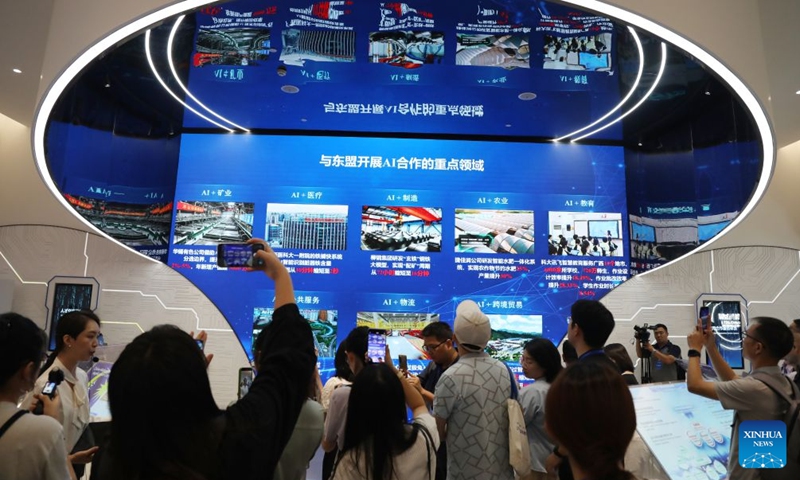
China-ASEAN Countries Artificial Intelligence (AI) Application Cooperation Center is held in Nanning, south China's Guangxi Zhuang Autonomous Region, Oct. 12, 2026.
I recently traveled to Hanoi, Vietnam, for a seminar about artificial intelligence, strategic competition and regional security and spoke with participants from across Southeast Asia. The topic of strategic competition between the United States and China ran through almost the entire day’s discussions, but what struck me most was how participants viewed their own countries’ circumstances. They hope to use advanced technology to accelerate their development, yet they also worry about how much autonomy they will retain as public services, critical infrastructure and security decisions become increasingly dependent on foreign technology. Southeast Asia’s choices on AI now bear on how it balances development, security and foreign relations.
Southeast Asian countries have often worked with several major powers to avoid becoming overly dependent on any one of them. The development of AI has made this balance harder to maintain. Many systems require ongoing access to external computing resources, model updates and technical support, with dependence deepening over time. Once these technologies are embedded in government administration and critical infrastructure, supply disruptions can interfere with the functioning of the state. Even a government that wants to adjust its foreign policy must then consider whether it will still be able to use the technology it already relies on. Technological dependence can thus constrain diplomatic choices.
The U.S. competition with China adds political risk to this dependence. In July last year, Malaysia announced permit requirements for the export, transshipment and transit of high-performance AI chips originating in the United States. Technology controls imposed by major powers have thus entered the development agendas of countries in the region. Governments seeking to attract investment and build digital infrastructure must also consider whether they can secure reliable access to technology and what diplomatic pressures their partnerships may bring. The greater the uncertainty in China-U.S. relations, the harder it is for Southeast Asia to address economic development separately from security concerns.
Those countries will not all make the same choices. With its existing strengths, Singapore is well positioned to participate in technological research and development and the shaping of international governance rules. Malaysia and Vietnam place greater emphasis on building digital infrastructure and upgrading domestic industries, while countries with weaker digital foundations are still acquiring the basic skills and infrastructure they need. Their political and security ties to China and the United States also vary, as do their assessments of external risks. Each country will therefore work with different partners in different areas according to its stage of development and security needs.
These differences also mean that a country’s choice of technology alone cannot tell us where its foreign policy is headed. A government might use Chinese models to improve public services, cooperate with the United States on security and learn about governance from other partners. These choices need not conflict, but governments must manage the different conditions attached to each partnership. Europe, Japan, South Korea and India can broaden the region’s options, although they cannot readily eliminate reliance on key U.S. and Chinese technologies. Southeast Asian countries need to distinguish between partnerships that complement each other and arrangements that might limit their ability to work with other countries in the future.
To reduce these constraints, they also need to turn foreign technology into capabilities of their own. Governments need to link AI development to education, research and industrial policy, making a sustained effort to develop talent and improve the conditions needed to put the technology to use. If AI is confined to a few sectors while much of society lacks the ability to use and assess it, countries will struggle to realize its full development benefits and will be more likely to remain dependent on outside support for the long term. Building these capabilities will require more than bringing in a few large projects.
Most Southeast Asian countries would struggle to match China and the United States in funding the development of world-leading models, but they can build expertise around their own languages and public service needs. SEA-LION, a project led by AI Singapore, develops models for Southeast Asian languages and cultures. Different versions built on Llama and Gemma have been developed by U.S. companies. Another developing model is China’s Qwen. These efforts show that using foreign technology and building domestic capabilities can proceed together. Only with the ability to evaluate and improve technology can countries decide which tools suit their needs and which uses should be restricted.
This capacity for independent judgment is especially important when it comes to security. When AI is used for maritime surveillance, intelligence analysis and cyberdefense, adopting foreign technology can also mean adopting a foreign system’s framework for assessing threats. If governments cannot independently check these assessments, they may come under the influence of technology providers without realizing it. In regional disputes and crises, countries must retain the authority to decide, based on their own interests, how to interpret another party’s intentions and when to act. Therefore they need to preserve the ability to verify information, correct errors and suspend the use of systems so that technology serves national decision-making.
Individual countries’ investments, however, may not be enough to address such problems. Gaps in skills and infrastructure across Southeast Asia are substantial, and countries with weaker capabilities find it harder to assess foreign technology and take part in discussions about international rules. If ASEAN can organize joint research, share testing resources and provide training, it can reduce the burden of each country building the same capabilities separately. Regional cooperation could thus help more members develop their technological capabilities and enable ASEAN to set out clearer common requirements in negotiations with major powers, so that individual countries are no longer left to accept external terms on their own.
The ASEAN AI Safety Network now being developed could provide a platform for these efforts. In September, ASEAN’s senior digital officials and heads of telecommunications regulatory bodies continued discussions on establishing the network and emphasized cooperation with external partners. Differences in national laws and levels of development make fully uniform rules difficult to agree on in the short term, but countries can begin by making joint arrangements to address cross-border risks, such as agreeing on which incidents require notification and how to coordinate a response. This would preserve each country’s authority to set domestic policy while providing clear rules for different partners to participate in regional cooperation.
For China, understanding Southeast Asia’s desire to chart its own development path would help put cooperation on a firmer footing. China and ASEAN can align their technological cooperation with national development plans, increase investment in talent development, public services and governance research; and consider offering greater support to members with weaker digital foundations. In discussions of regional standards and safety rules, taking full account of ASEAN countries’ views would make cooperation more responsive to local needs. Enabling countries in the region to control how technology is used and to participate in rulemaking would help ease concerns among all parties and build a more lasting foundation of mutual trust.
Such cooperation also requires a relatively stable environment in U.S.-China relations. My experience in their Track II dialogues on AI has led me to believe that, even amid intense competition, the two countries need to keep communicating about major AI safety incidents. A technological accident or an AI-assisted cross-border attack could very easily trigger a rapid rise in bilateral tensions if mistaken for a hostile act by a state. Southeast Asia faces these risks too and should therefore take part in relevant discussions and raise its own security concerns. Opening discussion and joint action on risk issues to more regional partners could also help reduce the disruption that competition causes to ongoing cooperation.
My observations at the Hanoi seminar suggest that the U.S.–China rivalry will continue to shape Southeast Asia’s AI choices for a long time, but countries can strengthen their ability to make those choices through domestic investment and regional cooperation. ASEAN has already issued the ASEAN Responsible AI Roadmap (2025-30), which sets out an overall framework for regional AI development and offers tiered implementation pathways that member states can adapt to their own circumstances. Countries in the region have also begun to step up investment. They need to set development priorities according to their own circumstances, seek key technologies from a range of sources and retain the ability to make independent judgments on security issues.
If China-ASEAN cooperation supports these efforts, it can offer countries in the region more practical help in navigating great-power competition with greater confidence while building a firmer foundation for the partnership.
