
Britain may not become a third AI superpower alongside China and the United States, but it is well positioned to serve as an important bridge across different governance frameworks.
AI generated from The Tech Founders
Recently, I led a Tsinghua University student delegation to the United Kingdom for research on AI safety and global governance. During the trip, we met with officials from UK government agencies, researchers at AI safety institutions, scholars from leading think tanks and universities and representatives from major media organizations.
One impression became increasingly clear throughout these exchanges: Discussions in the UK have moved well beyond the question of which country—China or the United States—will lead the AI race. Instead, British policymakers and scholars are asking two broader questions: What role can the UK play as strategic competition intensifies? And where is global AI governance heading?
The UK’s position is unique. It remains one of the world’s leading centers for AI research, innovation and talent, yet it cannot match either the United States or China in terms of market size, computing resources, investment capital or scale of technology companies. Recognizing these structural constraints, it has increasingly focused on global AI governance as a way to translate its scientific strengths and international influence into institutional leadership. From hosting the world’s first AI Safety Summit at Bletchley Park in 2023, to establishing the UK AI Safety Institute and promoting international cooperation on frontier AI evaluations, safety standards and risk governance, Britain has sought to position itself at the forefront of global AI governance.
Model vs. cosystem
During our meetings across the UK, one assessment surfaced repeatedly: China and the U.S. have firmly established themselves as the two principal powers shaping the future of artificial intelligence, but the nature of their competition is changing.
British experts generally believe that the U.S. enjoys an overall lead. Its strengths in frontier model development, venture capital, advanced semiconductors, global innovation networks and world-class talent remain difficult for any other country to replicate in the near term. At the same time, perceptions of China’s AI capabilities have evolved noticeably from just a few years ago. The rapid progress of Chinese large language models and the country’s vibrant open-source ecosystem have convinced many British observers that the technological gap between China and the U.S. is narrowing, ushering in what they increasingly describe as a “bipolar” landscape in global AI development.
Rather than focusing on which model temporarily tops the benchmark rankings, British researchers are paying closer attention to the structural factors that will shape long-term competitiveness. One phrase surfaced during our discussions: the innovation ecosystem. In the UK’s view, future leadership in AI will depend less on the performance of any single model and more on the strength of an entire ecosystem. Advanced chips, computing infrastructure, data centers, energy supplies, talent development, industrial adoption, regulatory capacity and supply-chain resilience are all becoming integral components of national AI competitiveness.
This broader perspective also reflects how the scope of China-U.S. technological competition has expanded. A few years ago, U.S. policy toward China centered primarily on advanced chips and semiconductor manufacturing equipment, with what Washington described as a “small yard, high fence” approach. Today, competition increasingly encompasses cloud computing, AI infrastructure, frontier model development, industrial applications and even international standards. As a general-purpose technology capable of transforming virtually every sector of the economy, AI is reshaping not only technological competition but also industrial development, national security and global governance.
Building bridges
Against this backdrop, the UK has been rethinking its place in the evolving AI landscape. One theme that emerged repeatedly during our conversations was the idea of the middle power. Many British scholars acknowledged that the UK is unlikely to become a third AI superpower alongside China and the United States. Yet they also rejected the notion that Britain must align itself with one side or the other.
Instead, the UK increasingly sees its comparative advantage in serving as a bridge-builder, a role that begins with international institutions. Britain hopes to draw on its experience in science and technology governance, multilateral diplomacy and international rule-making to strengthen communication between different AI governance frameworks and prevent global governance from fragmenting along geopolitical lines.
Equally important, this role extends beyond governments. Several British scholars pointed out that some of the most important disagreements in AI governance do not arise between countries but between different communities—engineers, technology companies, policymakers and social scientists. These groups often view innovation, risk and regulation through very different lenses. Effective AI governance, therefore, requires not only international coordination but also sustained dialogue across disciplines and sectors.
This emphasis on connectivity also reflects the distinctive nature of AI itself. Unlike many traditional international regimes, where governments are the primary actors, advances in AI are largely driven by private companies and research institutions. Government-to-government negotiations alone cannot keep pace with technological change. At the same time, intensifying China-U.S. competition has made governments increasingly cautious about imposing regulations that could weaken their own technological competitiveness. Throughout our discussions in the UK, one question surfaced again and again: How can countries strike an appropriate balance between promoting innovation and managing risk?
It is precisely for this reason that many British experts worry less about whether China or the U.S. gains a temporary technological edge and more about the possibility that global AI governance could gradually evolve into separate and disconnected systems. If technical standards, safety evaluation frameworks, regulatory approaches and innovation ecosystems continue to diverge, international cooperation on managing AI risks will become considerably more difficult.
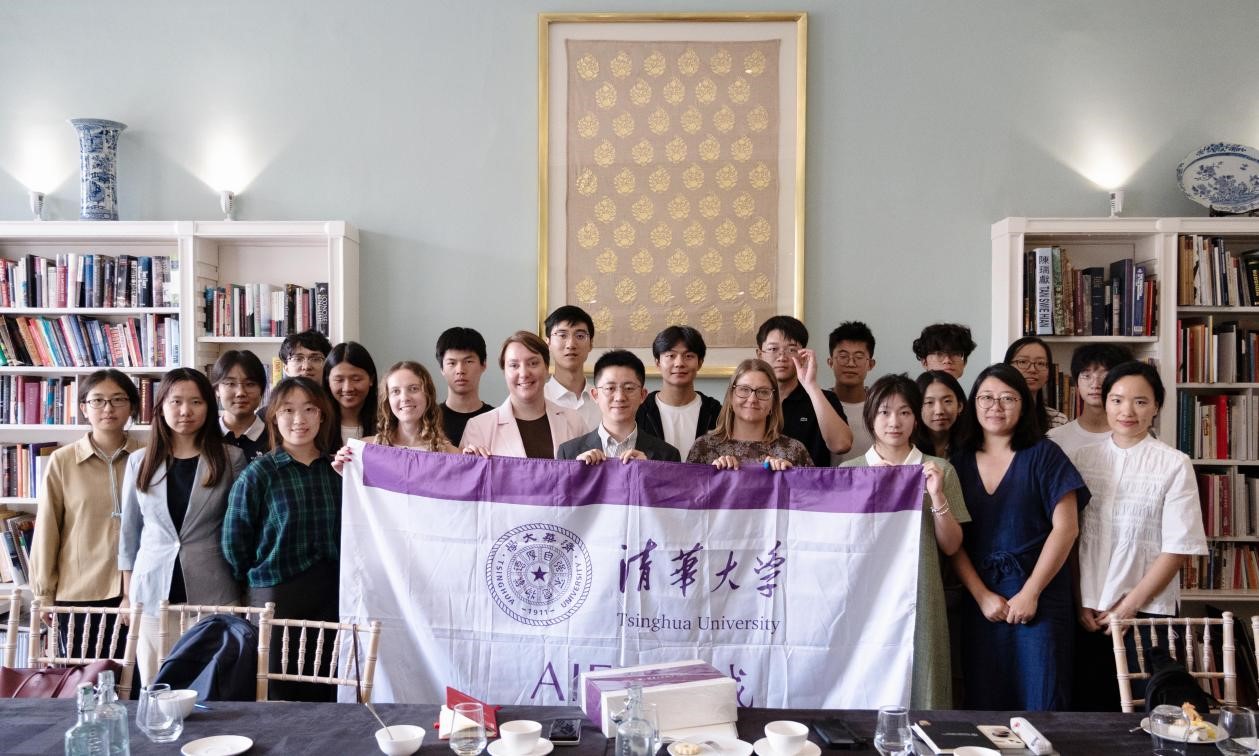
Sun Chenghao led a delegation to London for a symposium at Asia House with experts from the Great Britain-China Centre, Chatham House, and other institutions.
A new variable
Britain’s growing interest in global AI governance stems largely from concerns about an increasingly fragmented governance landscape. As China-U.S. technological competition deepens, AI governance is becoming increasingly multilayered. The EU AI Act, the G7 Hiroshima AI Process, the AI Safety Summit process initiated by the UK, ongoing discussions within the United Nations and China’s recently launched World AI Cooperation Organization, or WAICO, all represent important pieces of this evolving architecture. From the British perspective, the central question is no longer whether more governance mechanisms will emerge but whether these different frameworks can remain connected and mutually compatible.
It is against this backdrop that WAICO became a frequent topic during our meetings. At nearly every institution we visited, participants asked similar questions: How will WAICO operate? Will its membership expand? What types of cooperation will it prioritize? How will it relate to the United Nations, the OECD and the AI Safety Summit process? These questions suggest that British experts do not simply regard WAICO as another international organization initiated by China. Rather, they see it as an important indicator of how the global AI governance landscape may evolve in the years ahead.
At present, WAICO appears to be following a different trajectory from several governance initiatives led by Europe and the United States. While Western efforts have focused primarily on frontier AI safety, corporate responsibility, risk evaluation and regulatory standards, WAICO places greater emphasis on open-source collaboration, capacity-building and broader participation from the Global South. Its stated objective is to help more developing countries benefit from AI development and narrow the global digital divide. These differences do not necessarily represent competing visions of governance. Instead, they reflect different priorities. For many developing countries, AI governance is not just about mitigating risks but also about gaining access to computing resources, talent, digital infrastructure and opportunities for economic development.
From the perspective of many British experts, however, it’s unlikely that the UK will join WAICO in the near future. There are practical geopolitical considerations behind this assessment.
First, as Britain is the closest ally of the United States, its technology, security and China policies have become increasingly intertwined with those of the U.S. Joining a multilateral initiative proposed by China would inevitably require London to weigh the political implications of its relationship with Washington.
Second, Russia is one of WAICO’s founding members. Given the ongoing war in Ukraine and the continued political sensitivity surrounding Russia in British domestic politics and among its allies, participation in the organization would likely generate additional political constraints for the UK government.
As a result, British experts generally expect London to pursue more flexible forms of engagement—such as policy dialogues, joint research projects, technical cooperation or observer status—rather than seeking full membership in the short term.
That said, caution should not be mistaken for a lack of interest. On the contrary, throughout our discussions it was evident that British institutions are keen to maintain communication on different AI governance frameworks. For a country that increasingly sees itself as a bridge-builder in global governance, remaining absent from every major international platform would not serve its long-term interests. Early engagement provides opportunities not only to understand how new institutions evolve but also to help shape that evolution.
Another takeaway from this visit is that while China-U.S. competition in AI is likely to remain a defining feature of international politics for years to come, competition alone does not define the future of global AI governance. Deep differences will undoubtedly persist over issues such as military applications of AI and export controls. Yet there remains considerable scope for practical cooperation in areas including preventing the malicious use of AI by non-state actors, combating deepfakes, protecting children online, strengthening AI capacity building and talent training in the Global South and addressing other shared challenges of governance.
The UK may not become a third AI superpower alongside China and the United States, but it is well positioned to serve as an important bridge across different governance frameworks. For China, expanding the openness, inclusiveness, and practical cooperation of initiatives could encourage broader international participation. If the AI Safety Summit process championed by the UK and the WAICO initiative proposed by China can gradually develop stronger channels of communication and practical cooperation, the benefits would extend well beyond the principals. More important, such interaction would help provide much-needed global public benefits for AI governance.
