
The layering and reconfiguration of connectivity is underway. History warns that declaring the end of globalization too early obscures the institutional and regulatory restructuring processes that are already in motion.
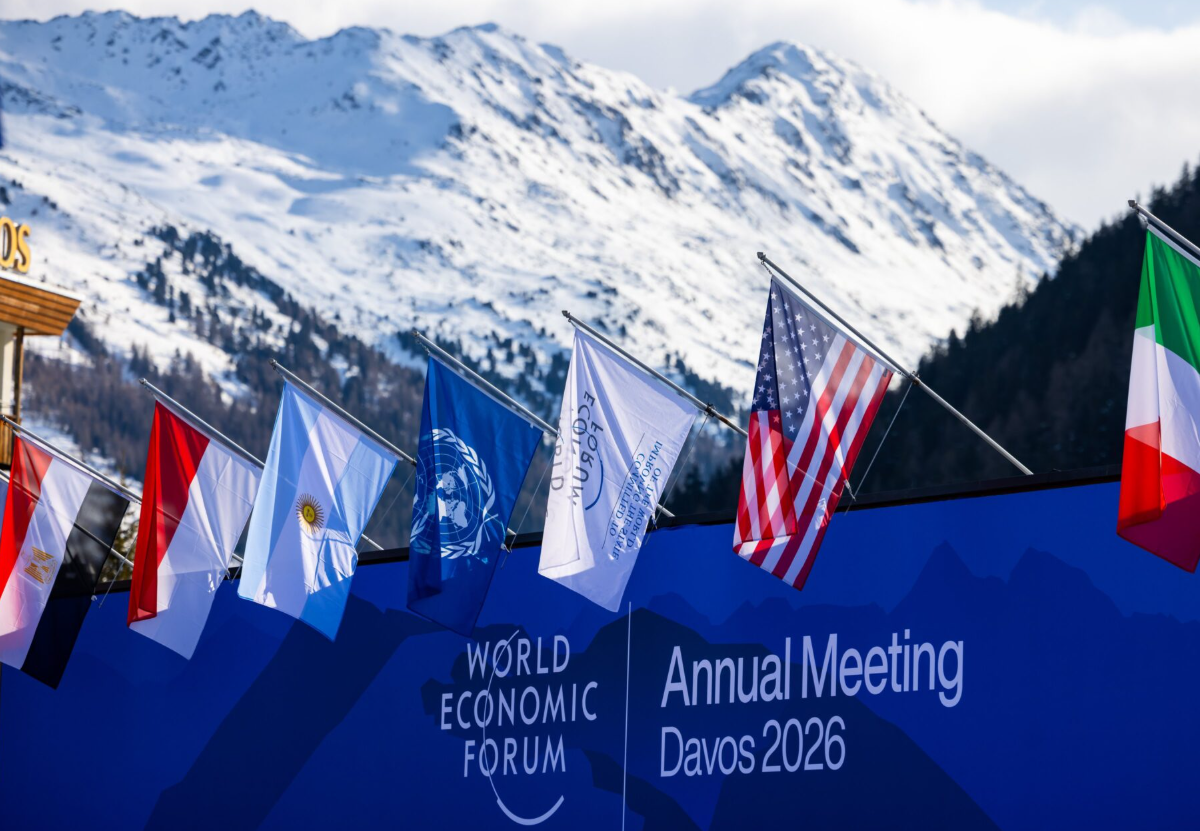
From Jan. 19 to 23, the World Economic Forum held its annual meeting in Davos, Switzerland. Davos has never been a place that produces definitive answers. It functions instead as a high-frequency diagnostic tool for the international system. Rather than resolving disagreements, it compresses the judgments, anxieties and power calculations of global elites into a single setting, forcing into view structural tensions that are often obscured by routine narratives of cooperation.
Once the meeting ends, what merits sustained reflection is not any individual speech but a broader and more consequential question: Has globalization reached its end, or is the way it connects the world undergoing a fundamental transformation? Is this a story of collapse, or of stratification? Of rupture or of reconfiguration? From this perspective, the key to understanding the present moment lies not in declaring globalization “over,” but in recognizing how global connectivity is being rewritten, ranked and re-embedded amid a broader reordering of power.
Observing from this perspective, the central message from Davos was not that the world is entering an era without cooperation. Cooperation persists and, in many domains, remains indispensable. What has changed are the conditions under which cooperation occurs. Barriers have risen, costs have become explicit and terms have been institutionalized. The earlier era—one that treated openness as the default, trust as a given and rules as neutral—has been fading. In its place is a form of conditional connectivity, where questions of risk allocation, benefit distribution and ultimate backstopping determine whether cooperation can even begin.
This shift is often described as “transactionalization” or “de-regulation” and is frequently taken as evidence that globalization itself is ending. Yet, this conclusion overlooks a more fundamental reality: Interdependence in the modern world is not a matter of sentiment or preference; it’s a structural condition. What is changing is not the existence of connectivity but the way it is organized, tiered and priced.
Changing preconditions for global connectivity
The transformation of global connectivity is first visible in the structure of the agenda itself. Compared with 10 or even five years ago, the grand narratives once associated with Davos have noticeably receded. The focus has shifted toward harder, more operational issues closely tied to national capacity and security constraints. Security, industrial policy, technology and financial stability now dominate discussions.
Issues such as climate change, development and global governance have not disappeared, but they increasingly struggle to stand on their own. Instead, they are framed in technical, operational and quantifiable terms, rather than as broad appeals to global public goods. This shift does not represent a downgrading of global challenges. On the contrary, it reflects their incorporation into more stringent national risk-management frameworks.
As a result, global connectivity has not vanished, but it has become visibly stratified. Some domains require tightly controlled engagement, others permit limited interaction, while still others move toward selective disengagement.
This evolution should not be read as a collapse of shared values. It is better understood as a form of systemic self-protection in an environment of rising uncertainty and declining trust. As risk becomes a constant, states increasingly seek to define their exposure before expanding cooperation. Cooperation becomes conditional, consensus becomes costly, and multilateral commitments become reversible. Crucially, this does not amount to a rejection of institutions. Rather, it reflects a reordering of how institutions function. National capacity becomes the entry ticket to cooperation. Different sectors and behaviors are governed by different levels of institutional constraint. Rules no longer primarily serve to promote universal openness; instead, they manage where connectivity can deepen, where it must be constrained, and where exit options must remain available.
The layering of global connectivity
A longer historical view makes clear that globalization has never followed a smooth, linear trajectory. It has advanced and retreated in waves shaped by conflict and innovation. The late nineteenth and early twentieth centuries saw unprecedented economic integration, which was widely believed at the time to be irreversible until war and political polarization abruptly disrupted it. The apparent closure of the 1930s gave way, after immense destruction, to a rebuilt postwar order and decades of renewed globalization.
A similar pattern emerged in the 1970s. The collapse of the Bretton Woods system, compounded by energy shocks and stagflation, was widely interpreted as a breakdown of global coordination. In hindsight, it appears instead as a period of institutional adjustment in which existing rules could no longer accommodate new realities.
History suggests that globalization’s true breaking points lie not in conflict itself but in whether new institutional arrangements emerge afterward. Viewed against this backdrop, today’s restructuring reflects a deeper structural mismatch: Shifts in power are occurring faster than the reconstruction of rules.
Technological diffusion and changes in industrial paradigms are reshaping competitive boundaries. Power balances between major states are evolving, while rule-based frameworks remain anchored in an earlier distribution of power. As a result, rules are no longer perceived as neutral infrastructure. They have become objects of dispute—tools to lock in advantage, shape constraints, reassess risk and redistribute gains.
At stake, therefore, is not merely rule compliance, but control over the architecture of connectivity itself. Who defines which domains remain open, under what standards, under what conditions connections can be severed, and who ultimately holds interpretive and enforcement authority.
Reconfiguring the path of globalization
Against this background, a “capacity first, rules second” logic has become increasingly prevalent. The transactional language heard in Davos is not a stylistic shift but an expression of structural change. Repeated emphasis on supply-chain resilience, critical minerals, technological boundaries, financial security and industrial policy all reflect the same underlying logic: Secure bargaining power and risk tolerance first, then negotiate institutional cooperation.
This does not imply the abandonment of institutions. On the contrary, periods of institutional strain often spur experimentation at new levels and in new domains. What is emerging is not a return to universalist globalization but a form of layered institutional design—different intensities of connectivity governed by different rule sets, operating in parallel.
Accordingly, the defining transformation of globalization today is not a binary shift from openness to closure but the management of connectivity intensity. In trade, comprehensive liberalization has slowed, while regional agreements and sector-specific arrangements deepen, often through near-shoring or friend-shoring frameworks. In finance, capital flows face tighter scrutiny, yet cross-border payments, clearing and investment networks persist with stronger safeguards. In technology, competition has intensified and become institutionalized, even as efforts continue around standards, interoperability and minimal cooperation. These developments point to a common conclusion: The world is not fragmenting into complete isolation. Instead, under higher risk conditions, it is searching for new connection points and reorganizing them through revised rules.
The logic behind this persistence is straightforward. The complexity and network effects of modern economic systems make full decoupling prohibitively costly in most areas. Global technological and capital chains cannot be cleanly severed, and many transnational challenges remain beyond the reach of unilateral solutions. Structural constraints, therefore, compel continued interaction, even amid heightened political caution. The critical distinction is no longer whether connections exist but how they are layered—which core connections must be preserved, which peripheral ones can be substituted, which high-risk linkages must be tightly controlled and where institutional “circuit breakers” must be built in.
In this context, Davos itself requires reinterpretation. It is no longer a factory of consensus but a testing ground for systemic reordering—where contradictions surface early, narrative boundaries are probed, and the direction of rule competition becomes visible. The tension in the room does not signal systemic failure; it suggests a system still functioning but operating through a different logic, shifting from universal connectivity toward managed, stratified engagement. The real danger lies not in transactional language but in the waning commitment to institutional reconstruction. If states dismantle old rules without investing political capital, resources and responsibility into new ones, global connectivity risks settling into a prolonged state of low-level integration in which connections persist but without institutions capable of stabilizing expectations or absorbing shocks.
Moving beyond the “end of globalization” narrative therefore requires a focus on two questions. First, how is global connectivity being layered—what is being strengthened, constrained, managed or replaced? Second, how is this layering being institutionalized—who sets the standards, who controls the thresholds, who holds interpretive authority and who provides ultimate guarantees?
The world that was revealed at Davos 2026 is undoubtedly more austere and more realistic. Yet, history suggests that international systems often recalibrate precisely in such moments. Rules do not automatically return, but neither do they disappear entirely in periods of disorder. Globalization has not ended. It is undergoing a profound structural transformation. The central question is not whether the world has entered a “transactional era” but whether, after transactions, there remain actors both willing and capable of re-embedding layered connectivity into institutions that keep competition within controllable bounds.
History never repeats itself simply, but it does offer us a warning: Declaring the “end of globalization” too early obscures the institutional and regulatory restructuring processes that are already underway.
