
Competitiveness in artificial intelligence is no longer defined solely by breakthroughs in individual technologies. Instead, it increasingly stems from a self-reinforcing system in which technological innovation, industrial deployment and governance reinforce one another, creating durable systemic capabilities.
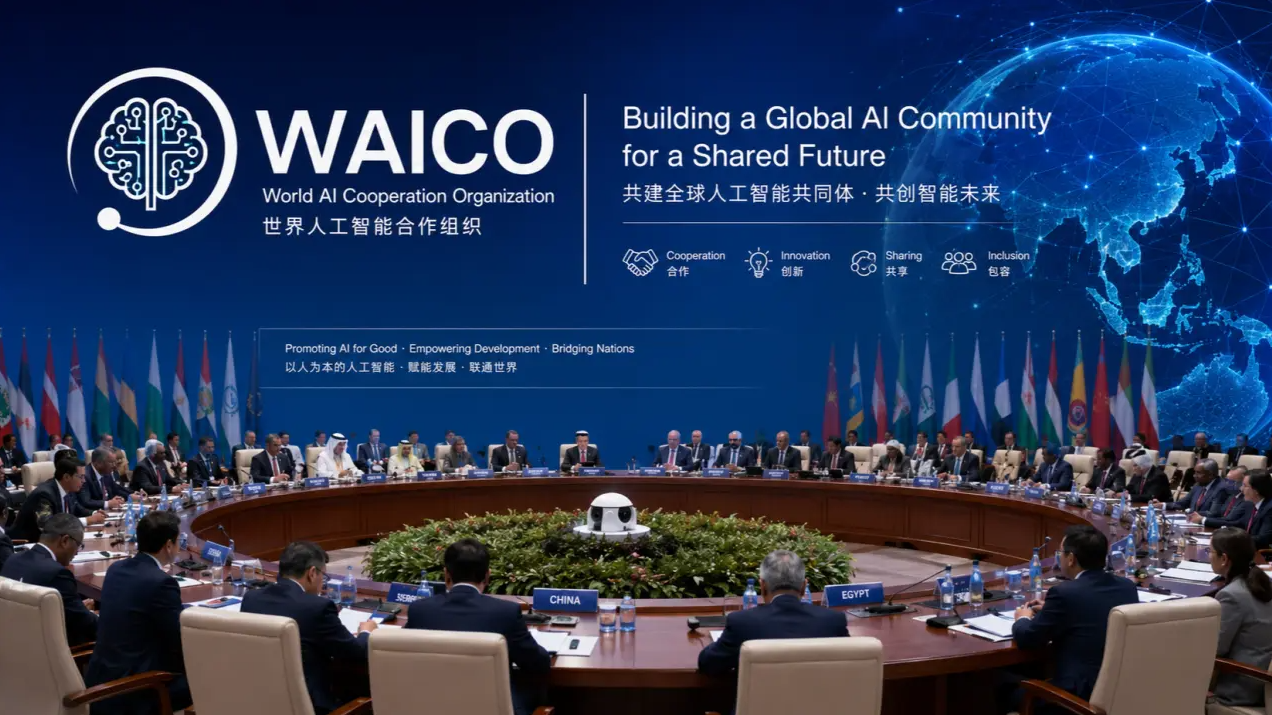
On 16 July 2026, representatives of 29 countries signed an agreement in China establishing the World Artificial Intelligence Cooperation Organization (WAICO).
In mid-July, the World Artificial Intelligence Conference took place in Shanghai, China, under the theme “Intelligent Partnership for a Shared Future.” More than 1,100 companies from around the world took part, showcasing some 4,400 exhibits, including 108 Chinese-developed AI chips and 261 large language models.
Over the past few years, international attention to China’s AI development has largely centered on a single question: Can China catch up with the United States in foundational models? As home-grown models such as DeepSeek and Kimi have advanced with remarkable speed and AI technologies have increasingly found commercial and industrial applications, a more consequential shift has begun to emerge. China’s competitiveness in artificial intelligence is no longer defined solely by breakthroughs in individual technologies. Instead, it is increasingly rooted in a self-reinforcing ecosystem in which technological innovation, industrial deployment and governance mutually reinforce one another, giving rise to a durable systemic advantage.
This systemic strength is underpinned by China’s steadily expanding capacity for technological innovation. In recent years, the country’s development of foundational models has entered a period of rapid acceleration. Homegrown models such as DeepSeek, Kimi, Tongyi Qianwen and ERNIE have continued to narrow the gap with the world’s leading AI systems, demonstrating strong competitiveness in reasoning performance, development efficiency and cost optimization.
In July, Moonshot AI unveiled its open-source Kimi K3 model. It outperformed Anthropic's Claude Fable 5 in long-context coding tasks and online information retrieval and matched OpenAI's flagship GPT-5.6 Sol in scientific reasoning. It sent ripples through U.S. equity markets.
Meanwhile, successive rounds of U.S. export controls on advanced chips have failed to derail China’s AI development; they have only accelerated the country’s drive for technological self-reliance. From the development of indigenous AI chips and the expansion of national computing hubs to the rollout of new digital infrastructure projects—for example, the “East Data, West Computing” initiative—China is steadily building an AI ecosystem that integrates semiconductors, computing power, electricity and data resources.
In the first half of this year, China’s output of integrated circuits by major industrial enterprises rose by 23.1 percent year-on-year to an average daily production of more than 1.5 billion chips. At the 2026 WAIC in Shanghai, Huawei unveiled its Ascend 950 Super Node, which links 1,024 Ascend processors through a high-bandwidth connection to deliver substantially greater computing power. The system has already reached performance parity with some of Nvidia’s leading AI platforms.
If technological innovation determines the upper limits of a country’s AI capabilities, large-scale deployment determines how much economic value those capabilities can ultimately create. In this respect, one of China’s distinctive strengths lies in its ability to translate technological advances into widespread industrial applications.
In recent years, China’s foundational models have been deployed across manufacturing, finance, healthcare, education and transportation, accelerating the digital and intelligent transformation of traditional industries. The country’s vast digital economy and extensive internet ecosystem have also provided fertile ground for AI experimentation and commercialization. From AI-generated video and intelligent office software to smart devices, embodied AI and humanoid robots, a number of innovative companies are building vertical applications on top of the models, steadily expanding the commercial frontiers of AI.
Meanwhile, the rapid improvement of open-source models is lowering barriers to adoption and enabling more small and medium-sized enterprises to develop industry-specific solutions based on mature AI platforms. As a result, AI innovation is spreading beyond a handful of technology giants into a much broader industrial ecosystem.
According to the International Data Corporation, China’s AI investment is projected to reach $26.69 billion this year, with spending on AI services expected to exceed $4 billion.
Finally, China's evolving AI ecosystem is underpinned by a steadily improving governance framework. While artificial intelligence is an increasingly important driver of economic growth, it also brings new challenges, including algorithmic bias, privacy breaches, misleading content, malicious use and disruptions to labor markets. Addressing these risks has become an integral part of China’s AI strategy.
At the WAIC event this year, President Xi Jinping noted that artificial intelligence “carries within it great opportunities as well as challenges to governance” and stressed the need to “take seriously the various types of inherent and secondary risks that AI may trigger.”
In recent years, China has consistently pursued an approach that gives equal weight to development and security. It has gradually strengthened the regulatory framework governing generative AI, deep synthesis technologies and recommendation algorithms, while building a more comprehensive governance system spanning technological innovation, industrial deployment and risk management.
At the same time, the country continues to expand investment in talent development, scientific research and long-term industrial planning. The outline of its 15th Five-Year Plan identifies artificial intelligence as a key area for seizing the opportunities created by the latest technological and industrial transformation. It calls for deepening the “AI Plus” initiative, strengthening systemic innovation capabilities, reinforcing the role of enterprises as the principal drivers of technological innovation and advancing the integrated development of education, sci-tech and talent cultivation. Together, these measures are intended to provide a stable policy environment, a stronger talent pipeline and sustained institutional support for the long-term development of AI.
China is also playing an increasingly active role in shaping global AI governance. As both a rising technological power and a member of the Global South, it has sought to balance two priorities: managing strategic competition and AI-related risks with other leading technology powers, particularly the United States, while addressing the widening AI divide between developed and developing economies and safeguarding the technological sovereignty of emerging countries.
At the opening ceremony of WAIC, President Xi announced that China would provide 5,000 AI training opportunities for participants from developing countries over the next five years and establish international AI cooperation centers with partners including the Association of Southeast Asian Nations, the League of Arab States and the African Union.
Since unveiling the Global AI Governance Initiative in 2023 and promoting international AI cooperation under the framework of the United Nations, China has steadily expanded technology training, capacity-building programs and digital infrastructure cooperation for developing countries. It launched the AI Capacity-Building Action Plan and this year established the World AI Cooperation Organization (WAICO). Through these initiatives, China aims to make the benefits of AI development more broadly accessible to developing economies.
Looking ahead, three trends are likely to shape the next stage of China’s AI development:
First, innovation will increasingly shift from advances in foundational models to deeper industrial deployment. Embodied AI, humanoid robots and other emerging applications are likely to become new engines of growth, while governments, investors and industry will continue to accelerate the integration of AI with the real economy.
Second, competition between China and the United States will enter a more complex phase. As Chinese models continue to improve, particularly with the rapid expansion of the open-source ecosystem, Washington’s strategy of building a small yard with a high fence around frontier AI technologies—together with its efforts to establish a coalition of leading AI powers—is likely to come under growing pressure. Competition will increasingly extend beyond model performance to encompass global markets, technical standards, developer ecosystems and international rules governing AI.
Third, AI will reshape not only the way economies produce but also employment patterns, labor relations and the broader social division of labor. Strengthening education and workforce training, adapting social protection systems and ensuring that the benefits of AI-driven growth are more widely shared will become central policy challenges as China moves toward a more intelligent society.
Ultimately, global competition in artificial intelligence will not be set by technological leadership alone. It will increasingly depend on which countries can build a complete AI ecosystem that combines technological innovation, industrial dynamism and governance resilience. China’s AI development is evolving from a strategy centered on catching up in individual technological breakthroughs to one focused on building enduring systemic capabilities. That may well prove to be the most consequential shift in China’s role in the next phase of global technological competition.
