
Evidence shows that the American model builds walls; the Chinese model builds bridges. One locks developing countries out of global governance; the other fights for their seat at the table.
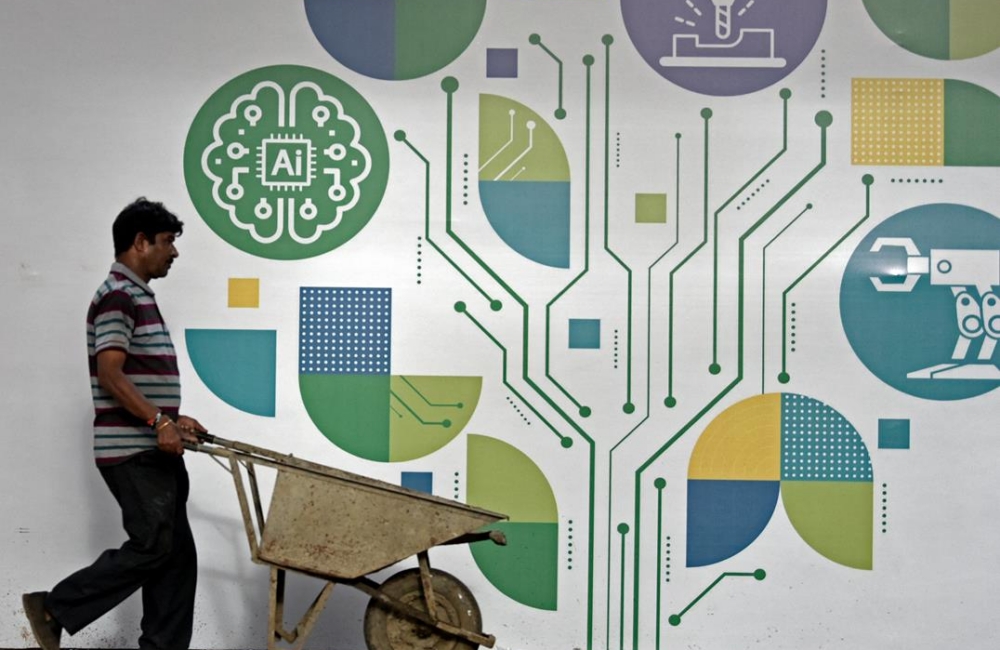
A worker pushes a wheelbarrow trolley and passes by a wall decorated with artificial intelligence signage at Automation Expo 2025 in Mumbai, India, on August 12, 2025. (Photo by Indranil Aditya /NurPhoto /The China-Global South Project)
For years, Washington has framed the U.S.-China artificial intelligence competition as a zero-sum game: One side’s victory is the other’s defeat, and the rest of the world is just watching from the sidelines.
That framing, however, misses a crucial distinction: A Chinese victory in AI—if there is one defined by the open diffusion of frontier models, local control in developing nations and their participation in global rule-making—would benefit not just Beijing, but the entire Global South.
The American tech playbook, from Microsoft Windows to Apple’s App Store, has always been successful at building global monopolies. Today, companies such as OpenAI and Anthropic guard their algorithms like state secrets. AI remains a luxury product, and billions of people in the Global South have been priced out of the digital revolution.
The World Bank lays bare the disparity. As of mid-2025, high-income countries accounted for 77 percent of global data-center capacity, while low-income nations held less than 0.1 percent. Africa, which is home to nearly one-fifth of humanity, has less than 1 percent of global data-center capacity and fewer than 1,000 GPUs fit for serious training. In this setup, “frontier AI” means, for most of the world, simply “AI for the rich.”
Washington’s strategy appears designed to lock in that advantage. Through export controls on advanced chips, it restricts who can build AI infrastructure. Through the CLOUD Act, it asserts the right to access data stored on foreign servers, turning the internet into an extraction pipeline for Silicon Valley. The result is a model that requires developing nations to submit to foreign clouds, foreign rules and foreign control. Export controls ostensibly aimed at China have the secondary effect of keeping developing nations dependent on expensive, black-box cloud services they neither own nor understand.
China is breaking that monopoly with a cheaper, more accessible approach. The release of DeepSeek-R1 in early 2025 proved that world-class reasoning models do not require a billion-dollar budget. By March this year, the performance gap between the best Chinese and American models had shrunk to just 2.7 percent, according to Stanford University’s AI Index. The United States still outspends China on private AI investment by a factor of 23, yet the technological lead has nearly evaporated.
The real disruption, however, is happening in the open-source community. On Hugging Face, the world’s largest model repository, Chinese models now account for 41 percent of global downloads, surpassing U.S. models. On developer platform OpenRouter, Chinese models handled roughly two-thirds of all global traffic as of July. The reason is simple: They are radically more affordable. DeepSeek’s V4 Flash costs 14 cents per million input tokens, compared with $5.00 for OpenAI’s GPT-5.5. Moonshot’s Kimi K2.6 delivers comparable performance at a fraction of the price.
This is a structural shift, not a temporary price war. China’s leading models are open-weight: downloadable, self-hostable, fine-tunable with local data and modifiable under permissive licenses. A derivative model can be trained for languages like Swahili, Tamil or Yoruba, can run inside a country’s own borders and never phone home. It is the difference between renting a car and owning the factory.
The practical impact is already visible. In Cambodia, shrimp farmers using Chinese drone-AI have tripled their income per hectare. In Pakistan and Ethiopia, China’s MAZU AI early-warning system predicts floods in local languages, saving lives without requiring a constant link to a server in California. This is AI that works in a monsoon, not just in a Manhattan boardroom.
On data sovereignty, the two powers diverge sharply. While Washington restricts the outflow of personal and government data on national security grounds, it simultaneously claims extraterritorial access to foreign-stored data through the CLOUD Act. Washington’s control of algorithms and infrastructure allows it to unilaterally impose sanctions on any country, much as it did with the SWIFT banking system. Analysts say that with “kill-switch” authority, the U.S. could order American companies to cut off services to Global South nations.
China, by contrast, champions every country’s right to govern its own data while supporting cross-border flows under secure conditions. The Chinese model offers other developing nations something the American model does not: the ability to own one’s own digital infrastructure, tweak it for local needs and keep your data at home.
The same divide also appears in global governance. The G7’s Hiroshima AI Process, launched in 2023, represents the interests of just 9 percent of the global population, leaving the vast majority of nations on the sidelines. As a result, some 180 countries are excluded from core AI governance conversations. Washington, together with Brussels, has built exclusive alliances to set global AI rules outside multilateral frameworks, while unilaterally deciding who gets access to advanced chips and who is locked out.
In contrast, China is walking a different path. At the 2025 World Artificial Intelligence Conference in Shanghai, Beijing released a 13-point Global AI Governance Action Plan emphasizing inclusiveness, open-source collaboration and support for developing countries. At this year’s conference, President Xi Jinping announced the creation of the World Artificial Intelligence Cooperation Organization, with 29 founding members, and pledged 5,000 AI training opportunities for the Global South over the next five years. For developing countries, this brings three tangible benefits: equal participation in rule-making, technical assistance to narrow the digital divide and a path to break free from technological dependence. Simply put, China’s approach is enabling developing countries to become the masters of their own houses.
Critics claim that China’s rise is merely geopolitical substitution—swapping one monopoly for another. The evidence suggests otherwise. The American model builds walls; the Chinese one builds bridges. One locks developing countries out of global governance; the other fights for their seat at the table.
If China wins by making frontier AI open, cheap, multilingual and self-hostable, pressuring U.S. labs to match that accessibility and enabling the Global South to get a seat at the table for AI rule-making, startups throughout the world will get margins, researchers will get reproducibility and citizens will get services. In that scenario, the scoreboard may say “China 1, United States 0,” but the ledger says “World +1.”
