
Moonshot AI’s Kimi is emerging as a Chinese competitor to Anthropic’s Claude, with increasingly comparable capabilities but notable differences in performance, personality and content restrictions. The comparison highlights how the two models reflect distinct technological approaches and regulatory environments as competition between the U.S. and China’s AI industries intensifies.
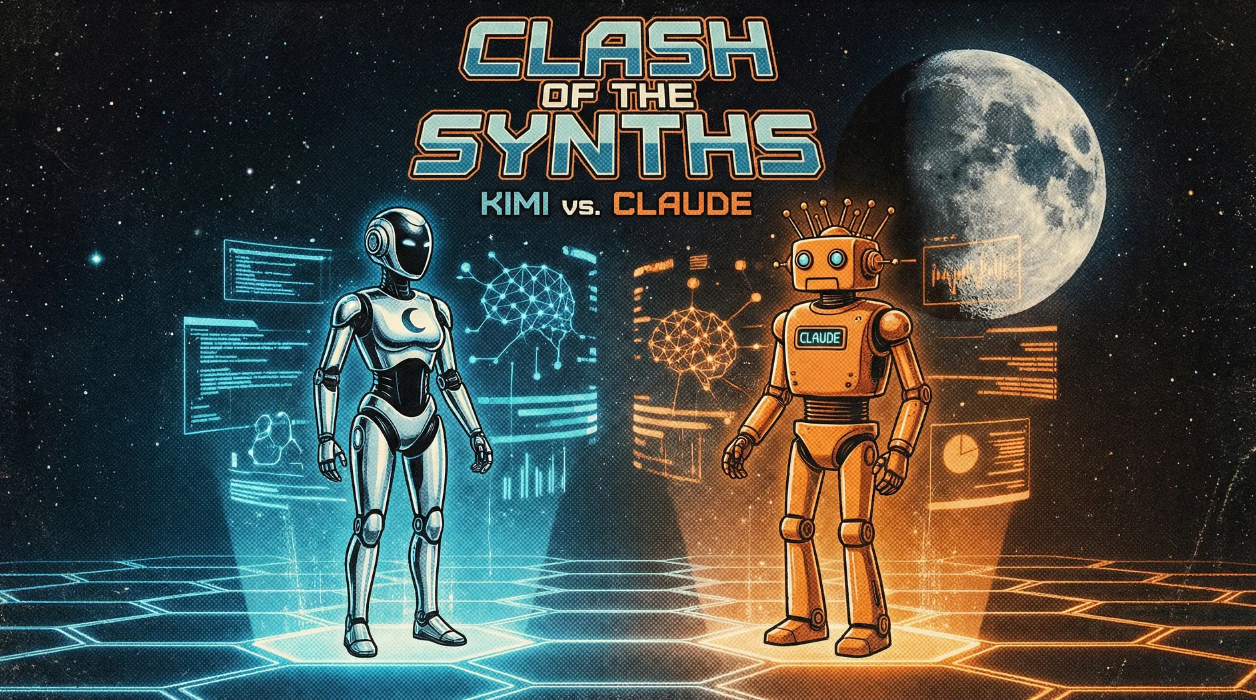
Claude vs Kimi (Graphic from Stackademic)
Kimi is the talk of the town, from Shantou, in south China where Moonshot AI wunderkind founder Yang Zhilin hails from, to London, Tokyo, New York. It’s the latest wave of creative disruption in the field of AI, shaking computer desks all the world over.
While here in Beijing, I thought I’d give China’s hot new AI property a whirl, to see how Moonshot AI’s latest shot compares to Anthropic’s Claude, an LLM so fabled it soon produced an ever faster bot known as Fable 5.
Anthropic’s super-skilled chat model is a multipurpose coder, designer and office assistant all wrapped in one. It’s a pretty high bar, and Kimi is said to have matched or exceeded it in some respects, making the escalating competition between Moonshot and Anthropic one to watch.
I signed up for a free trial on Kimi K3 in Beijing, accessible at kimi.com. It’s not the fastest version, but powerful enough to get a sense of where China’s answer to Claude is heading these days.
Playing around with the plain chat-box interface, my initial sense is that Kimi is very much like Claude, which is not a big surprise as Claude has been openly cited as an inspiration to Kimi, both in terms of aspiration and execution. If imitation is the highest form of flattery, then Kimi’s very existence speaks high praise of Claude as a model.
But it’s not a simple Claude clone, although there have been intimations to that effect. Anthropic claims that Kimi trained heavily on Claude models and large-scale distillation of Claude outputs to develop its comparable performance, a claim Moonshot disputes.
Moonshot says Kimi K3 is engineered differently, designed to sift through training data more systematically, and built on a “mixture-of-experts” architecture to keep inference costs down.
I tested Kimi and Claude on a few narrow topics related to writing to see if a specific band of questions would generate closely-related answers, and the answers varied to a greater degree than expected.
Then again, ask either one of them the same question twice, and there’s no guarantee you’d ever get the same wording again.
The first surprise was Kimi’s slow response time compared to Claude. Kimi’s sluggish responses were less a measure of what it could do, than a surge of people using the free program, certainly in the millions, all at the same time, especially during daylight hours.
When I did a similar trial of Kimi vs. Claude for speed at night, it was smoking hot, maybe faster even than Claude.
Claude is the first AI Chatbot I have encountered which not only boasts the usual high IQ, but has the simulacrum of EQ as well. It’s machine-driven communication, but it works for a writer in the same way that Apple’s Mac appeals to artists and creatives. It’s intuitive, thoughtfully constructed and uses natural speech patterns in a user-friendly way.
My appraisal of Kimi is that it has the brains but not the personality of Claude, based on the very limited range of things I consulted it for.
Perhaps Claude’s responses are more encouraging and sound “nicer” but what does that really mean? Has it been slyly trained, or is it perhaps teaching itself based on feedback, to be agreeable, even complimentary to the user. With metrics measured in clicks and eyeballs, there’s profit in hooking users through an appealing, if not addictive style of interaction. Faint machine praise may well be a prod to sign up for one of the paid programs.
Kimi has been described in news stories, blogs and substacks as a Claude clone.
In my Q&A with Claude on the topic, it was careful to hedge unproven accusations regarding the question of distillation and economic competition:
“If the distillation allegations are true, Moonshot may be pricing at parity with Anthropic while allegedly having offloaded a chunk of its R&D costs onto Anthropic's training pipeline.”
So it’s not a cheap version of Claude. It’s good because Claude is good and the reputation of one rides on another. The echoes of Claude-speak and information processing are uncanny, and if it isn’t illegal — which remains to be determined — maybe that’s not a bad thing.
And it’s making inroads into the U.S. market:
Cursor, a San Francisco-based AI coding agent, was built directly on top of Kimi to boost and burnish its own product. Its relationship with Moonshot is licensed but reluctantly acknowledged, and it was played down in corporate communication materials.
Cursor co-founder Aman Sanger admits as much:
"It was a miss to not mention the Kimi base in our blog from the start. We'll fix that for the next model."
One notable difference between the two is the guardrails; each company reflects sensitivities of its country of origin.
Here, in Kimi’s words:
“Kimi operates under Chinese regulatory frameworks (algorithmic recommendation and deep synthesis regulations). It is notably more restrictive on content related to Chinese politics, territorial issues, or historical events deemed sensitive within that regulatory environment. Claude, being US-aligned, is more restrictive on content related to hate speech, extremism, or child safety by Western standards.”
In this regard, Kimi reminds me of bookstores in Beijing —beautiful in design, generous in open space, colorful in counter display but lacking a diversity of books. U.S. bookstores, in contrast, are ‘free’ but, ravaged by changing market trends, are not looking so pretty these days. There are virtually no political limits on securing the book you want, but good luck finding a bookstore that carries it.
When I asked Claude about comparative guardrails of the two chatbots, it indicated the two have “different regulatory environments and training/safety priorities.”
Ask Kimi about Chinese politics and you feel a bit like you are in one of those brilliant Chinese bookstores with a cornucopia of information, from Chinese classics to Shakespeare, from George Orwell’s biting critiques of totalitarianism to anodyne self-help tomes, but ask for the wrong book and you get shut out.
And sometimes you don’t even know why.
“Sorry. I cannot provide this information. Please feel free to ask another question.”
Looking at comparative feedback from a topic I know well, I submitted my novel Beijing Unbound into the maw of both analytical engines, and invited them to chew. Claude gave me a well-rounded summary of the novel, strictly based on text.
I tried the same input with Kimi, with surprising results.
It chewed for a few thoughtful seconds, spewing out an instant stream of intelligent, well-formulated sentences, then choked and stopped flat in its tracks.
Task failed.
Subsequent tries over two weeks resulted in multiple invitations to ask “another question.”
Why did Kimi stall out and start to blush just as it began to describe the novel’s love interest?
I don’t know. The name Huamei is a portmanteau for China-America. She is a fictional character, with a back story of being sent-down to Inner Mongolia in the Cultural Revolution. But she manages to land on her feet and attends college in the States.
In my mind, Huamei’s relationship to narrator Jim corresponds loosely to Nick Carraway’s relationship to Daisy in The Great Gatsby. Jim watches from the sidelines as a torrid affair between two flawed but sympathetic characters flourishes, only to crash and burn.
Here is what Kimi said, or started to say:
“The friendship with Kirk is the novel’s most fully realized relationship….the scenes have natural momentum. The novel’s central mystery—who is this woman//////////////////////////////”
“Sorry. I cannot provide this information. Please feel free to ask another question.”
I tried again and again and got the same response.
Users of Kimi are free to ask questions and Kimi is free to dodge them:
“Sorry. I cannot provide this information.”
