
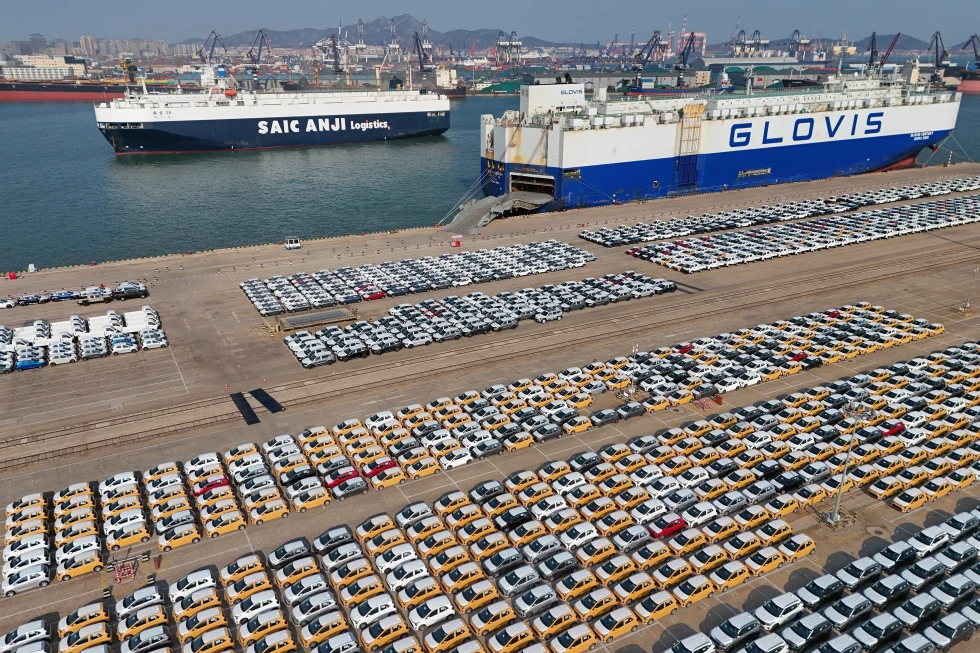
Vehicles and trucks for export wait for transportation from a port in Yantai in eastern China’s Shandong province on Jan. 2, 2025. (AP, File)
Two separate announcements tell how Trump’s tariffs left China’s exports unscathed while quietly taxing American households.
On 8 December, China’s General Administration of Customs (GAC) announced that in the 11 months from January to November 2025, China’s cumulative trade surplus crossed a record US$1 trillion. Most notably, China crossed the threshold despite targeted, punitive tariffs the second Trump administration had imposed and mounting geopolitical pressures. Bloomberg‘s heading, ‘China Shakes Off Tariff Scare to Stick With Export-Driven Growth’ captured the resilience of China’s economy against unprecedented tariffs. While Trump imposed tariffs on friends and foes alike, he in particular portrayed China as ‘raping our country’ and committing ‘the greatest theft in the history of the world’ in trade to justify punitive tariffs on Chinese goods.
Three days later on 11 December, Democrats on Congress’ Joint Economic Committee released a report that calculated that President Donald Trump’s sweeping taxes on imports cost American consumers’ share of the bill to nearly $159 billion — or $1,200 per household — from February through November.
The claim that tariffs would revive American factories and create jobs has so far yielded only modest, sector‑specific gains that fall far short of the broader reindustrialization promised.
Several sources have reached broadly similar conclusions about who ultimately bears the cost of these tariffs. For instance, the Board of Governors of the Federal Reserve System maintained that just as the 2018-19 tariffs on China were ‘passed through fully and quickly to consumer prices,’ the tariffs implemented on China in 2025 also impacted consumer prices. Similarly, the St. Louis Fed, the Yale Budget Lab, and the Observer Research Foundation America, among others, argued that Trump’s second-term tariffs largely passed through to U.S. importers and consumers, leading to elevated inflation and reducing real household incomes.
The tariffs also posed a big challenge to the US and Western investors in China. As the Financial Times reported, out of more than US$3.2 trillion of China’s exports in the first 10 months of 2025, nearly US$837 billion came from foreign-invested companies, or just over one-quarter of the total. This means that had there been setbacks to Chinese exports, a significant share of the pain would go to Western multinationals using China as their export base.
The impact of Trump’s tariffs went beyond material losses; they contradicted the US and the West’s repeated advocacy for free-trade principles and gains-from-trade globalization. For decades, the West had emphasized most-favoured-nation (MFN) status, free trade agreements, market economy norms, and adherence to the WTO and GATT’s rules. China emerged as morally victorious, as an upholder of international trade norms, a defender of multilateral rules, and a predictable and reliable partner. Analysts, therefore, termed these tariffs as being in tension with the spirit of the WTO system.
Given these contested and WTO‑inconsistent tariff hikes, China, as it did during Trump’s first term, approached the WTO by maintaining and updating its complaints (such as DS543) to challenge the legality of the renewed Section 301 – style tariffs and the 2025 “reciprocal” measures soon after they were announced in early 2025. Panels have already ruled against key elements of the US approach, but with the Appellate Body still paralyzed, Washington has effectively blocked final adoption.
An unintended advantage
In some ways, Trump’s tariffs proved a blessing in disguise. Without them, Chinese exports might not have been explored other markets as ambitiously as they were in the wake of the tariffs and might have continued to rely on the US as their largest export market. This rude shock prompted them to diversify their export markets to Southeast Asia, Europe, Latin America, and Australia. Furthermore, transferring billions of dollars of exports to new destinations in a short period also showed China’s formidable logistical and diplomatic capacity. As the US has explicitly labeled China as its prime competitor, an early and substantial reduction in reliance on the US market has put China in a more secure strategic position.
This strategic decoupling was accelerated by proactive Chinese diplomacy, notably through the expansion of the Belt and Road Initiative and regional trade pacts like the RCEP. By deepening economic integration with ASEAN, now its largest trading partner, China didn’t just find new markets—it began reshaping regional supply chains around its own economy. The urgency imposed by tariffs fast-tracked this pivot, reducing Beijing’s vulnerability to future U.S. economic coercion and enhancing its leverage in Asia, thereby turning a defensive trade measure into a tool of long-term geopolitical repositioning.
The Path Forward
What is the future outlook for China’s export-driven economy? Economists at Morgan Stanley predict that China’s share of global goods exports will not only be retained but increase from 15 percent to 16.5% by 2030. This resilience is rooted in Beijing’s entrenched lead in advanced manufacturing and what The Wall Street Journal describes as its "ability to anticipate shifting global demand trends and its willingness to mobilize resources to build capacity”.
This trajectory suggests that punitive tariffs, rather than crippling China’s export engine, have inadvertently reinforced its long-term strategy. The focus has shifted from volume to moving up the value chain – capturing greater market share in electric vehicles, renewables, and advanced electronics where Western dependence is increasing. Consequently, the fundamental dilemma for the U.S. and its allies remains unresolved: how to counter perceived the trade practices without imposing disproportionate costs on their own economies while compromising the very multilateral system they helped build. The legacy of the 2025 tariffs may thus be less about restoring the American industrial base and more about creating a reconfigured global trade order, one where China has shown its ability to adapt, withstand pressure, and emerge more strategically resilient.
