
The three-pillar structure—China, the United States and Europe—will remain in place, but the forces sustaining it will shift from shared growth and open cooperation toward mutual constraint and a shared aversion to systemic risks.
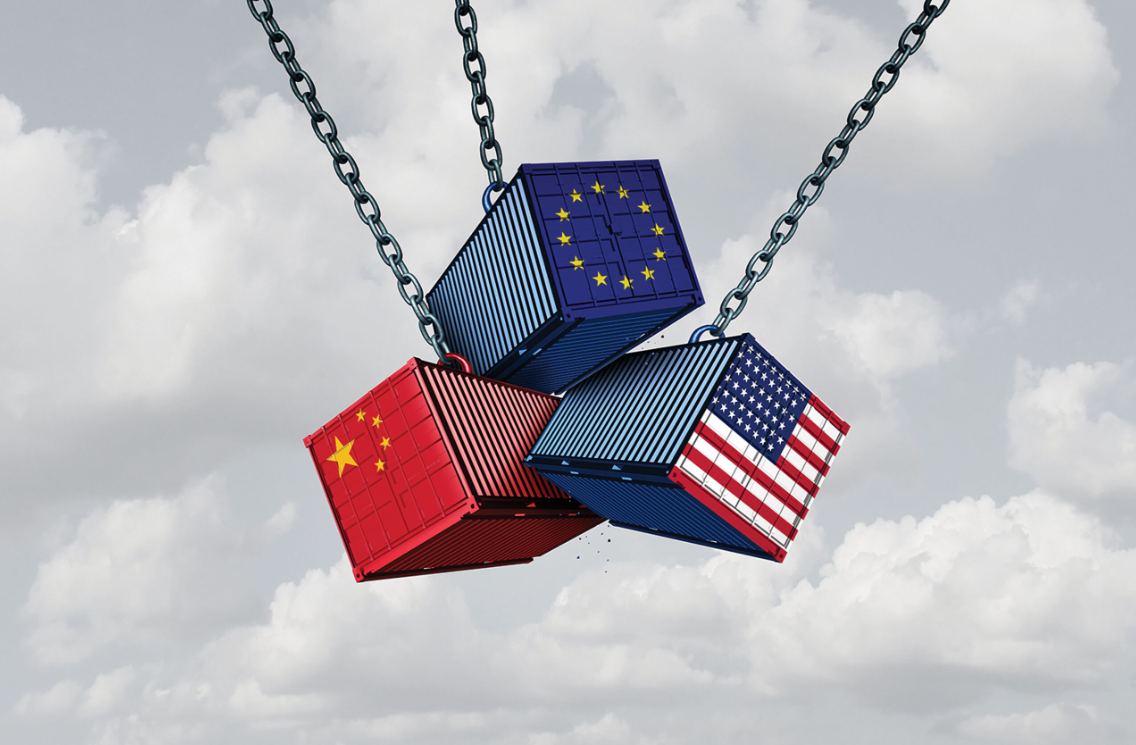
A broadly defined pattern in China-U.S.-Europe relations is now becoming increasingly clear: Mutual dependence has not disappeared, despite competition; instead, competition is becoming ever more deeply embedded in their coexistence.
Trade, investment, capital, technology and supply-chain ties remain essential foundations of the global economy, but the continued expansion of tariff barriers, industrial subsidies, investment screening, export controls and economic-security rules is changing the terms, costs and boundaries of these relationships.
I have previously argued that China, the United States and Europe are the three main pillars of the global economy. Recent field research in Europe and changes in the international landscape further suggest that their role as global economic pillars has not changed. Rather, the logic governing their interactions has gradually shifted from cooperation-led engagement to competitive coexistence.
The term “competitive coexistence” refers to a situation in which China, the U.S. and Europe have neither the ability nor sufficient will to sever their ties, yet all three seek to reduce their vulnerability to the other two through tariffs, subsidies, investment screening, export controls, technical standards and financial rules, while competing for influence over future global economic rules and industrial systems. Coexistence provides the practical foundation for all three, while competition determines the costs, boundaries and terms under which that coexistence operates.
Competition rising
China, the United States and Europe continue to maintain structural ties that are difficult to replace. The U.S. has deep capital markets, leading capabilities in fundamental innovation and a dollar-based financial system; Europe wields significant influence in advanced manufacturing, green finance, regulatory standards and global governance; China has a comprehensive manufacturing system, a vast domestic market and the ability to rapidly industrialize and commercialize technologies.
Each of the three commands critical resources. Finance and innovation, rules, advanced manufacturing, industrial scale and market conversion together shape the basic workings of the global economy and financial system. A structural rupture between any two would have consequences extending far beyond bilateral trade; it would ripple globally through financial pricing, technology standards, energy, investment and supply chains. Yet competitive forces are rising across the board and are gradually becoming the dominant force shaping how the three interact and coexist.
A pattern of “institutionalized negotiations alongside long-term strategic competition” has emerged between China and the United States. On one hand, the two sides have established intergovernmental mechanisms such as trade and investment councils to discuss tariff adjustments for certain non-sensitive products and trade imbalances. On the other, the United States continues to retain tariffs, export controls and economic security tools, explicitly treating trade facilitation and national security as separate issues.
A constructive relationship of strategic stability between China and the United States does not mean that their economic and trade ties will readily return to the old model of cooperation centered on market dynamics and efficiency. More likely, the two sides will settle into a layered form of stability, with greater separation in sensitive areas while maintaining transactions in non-sensitive ones.
China-EU relations likewise show a pattern of dialogue proceeding alongside efforts to mitigate risks. In June, the two sides formally established a trade and investment consultation mechanism, with four working tracks covering the balance of trade and investment, export controls, intellectual property and WTO reform. They agreed to hold another ministerial meeting this fall.
At the same time, the EU has revised its foreign investment screening rules requiring member states to cover sensitive areas such as critical technologies, critical raw materials, financial services, energy and transport within the minimum scope of future screening. In July, the EU imposed anti-dumping duties of 4.3 to 45.3 percent on Chinese passenger cars and light commercial vehicle tires, tightened its import monitoring mechanism and imposed anti-dumping duties of 60 to 67.6 percent on Chinese polyamide yarn.
As a result, China-EU relations display a pronounced duality: Europe remains dependent on the Chinese market and industrial supply chains but is placing greater emphasis on ensuring that investment serves local employment, technological progress and industrial competitiveness. Chinese companies still seek access to the European market but must shoulder higher localization and compliance costs, as well as greater political risks. Europe’s “de-risking” has not physically severed China-EU economic and trade ties, but it is reshaping how companies organize their entry into the European market and how the gains from that access are distributed.
The United States and Europe are not a stable and cohesive community of cooperation. Although the two sides remain closely coordinated on security and China policy, their differences on digital regulation, support for the aviation industry, industrial policy and market access are increasingly apparent.
In July, the U.S. Trade Representative publicly criticized EU regulation and penalties targeting American technology companies, arguing that they were undermining the stability of transatlantic trade. The United States also took Section 301 tariff action against 60 economies, including EU members, over alleged issues related to “forced labor”—showing that even within a security alliance, economic security and industrial competition are challenging traditional patterns of cooperation. U.S.-EU relations are therefore settling into a new normal in which security coordination coexists with economic and trade friction.
The reality of China-U.S.-Europe relations today is that it’s difficult for the three countries to replace each other; despite their differences, they must continue engagement with one another. At the same time, each side is maintaining channels of communication and seeking to put safeguards in place to prevent conflicts from spiraling out of control.
A changing triangle
Competitive coexistence is transforming the China-U.S.-Europe triangle from a relatively stable framework of interaction into a more complex structure of “interdependence amid issue-based coordination.” In the past, the triangle was often understood in terms of strategic balance. Today, the three sides are engaging in dialogue and cooperation around specific issues, while in practice creating a degree of mutual checks and balances and constraints on risk. Yet these interactions have not developed into an overall state of strategic stability.
In the security and high-tech sectors, the United States and Europe are seeking closer coordination with China, while on digital regulation, industrial subsidies and market interests, they are competing with each other. China and Europe have room for cooperation in upholding the WTO, addressing climate change and promoting green finance, but competition is intensifying over new-energy vehicles, critical raw materials and industrial subsidies. Constrained by the political structure of its member states, Europe is unlikely to emerge as an independent pole that can swing freely between China and the United States. It is better understood as a “conditional variable” with interests of its own, but constrained by its security dependence and limited capacity for internal coordination.
Second, competitive coexistence will further stratify globalization. China, the United States and Europe are unlikely to operate entirely behind closed doors, but they are already creating different levels of security within global markets through export control lists, investment screening, data boundaries, rules of origin and supply-chain traceability requirements. The separation of core technologies, military-related products and critical infrastructure is likely to deepen, while strong ties will remain in general manufacturing, consumer goods and some services. Green products, meanwhile, are more likely to see high levels of trade alongside high levels of friction. Multinational companies are responding by adopting strategies such as “in China, for China,” “in Europe, for Europe,” and “in the U.S., for the U.S.,” while regionalizing their supply chains, to reduce political risks.
Such stratification will not bring globalization to an end, but it will force companies to duplicate supply chains, increase spending on inventories and compliance and adapt to different technology, data and carbon-emissions standards. The localization and supply-chain restructuring that I observed during my recent visit to Europe are concrete examples of how market players are adapting to competitive coexistence.
Third, competition between the three will increasingly shift from trade in goods to institutional power. Going forward, China, the United States and Europe will compete not only for market share but also over who gets to define the rules for green products, trusted data, AI security, critical supply chains and fair subsidies. In July, the EU submitted three documents to the WTO, proposing further reforms concerning subsidies, industrial policy and rules-based constraints, reflecting how economic-security concerns are increasingly making their way onto the multilateral agenda.
This will make competition within the China-U.S.-Europe triangle more enduring. Tariffs can be adjusted through negotiations, but once institutions, standards and industrial ecosystems are established, they are far harder to change. The future stability of the three-way relationship will depend on whether effective boundaries can be placed around such institutional competition, preventing normal industrial policies and security measures from being expanded without limit.
It is also worth noting that competitive coexistence further confirms the objective reality of the China-U.S.-Europe triangle. The fact that the three sides are constantly adding new safeguards against one another is itself evidence of how deeply interconnected they remain and how costly a structural rupture would be. If the three could easily go their separate ways, there would be little need to devote so many policy resources to “de-risking,” screening and supply-chain adjustments. Competition has not dissolved the China-U.S.-Europe triangle; rather, it has transformed it from one driven primarily by cooperation into one jointly driven by interdependence and mutual precaution.
Friction and limited cooperation
For the foreseeable future, relations within the triangle are unlikely to return to comprehensive cooperation, but neither are they likely to descend into outright rupture. The three sides will probably settle into a long-term pattern of “more friction, limited decoupling and efforts to reconnect.”
Competition will first become increasingly institutionalized. China and the United States will continue to use trade negotiations and implementation mechanisms to manage issues such as goods purchases, tariffs and market access, while keeping chips, artificial intelligence and other critical technologies within the national-security framework. China and the EU have already established a trade and investment consultation mechanism, signaling an effort to bring disputes over trade balances, export controls and intellectual property into a more routine process of management.
The visit to China by a delegation from the European Parliament’s Foreign Affairs Committee in July also suggests that even as economic frictions and geopolitical differences intensify Europe still wants to preserve channels for political and policy dialogue.
Second, cooperation will shift from comprehensive engagement to a more modular approach. Although the three sides are unlikely to reach broad agreement on the overall economic order, limited cooperation remains possible in specific areas such as climate change, AI governance, financial stability, public health and WTO reform. There is considerable potential for China-EU cooperation in green finance, transition finance, the circular economy, third-country markets and industrial data compliance. Initiatives such as the Common Ground Taxonomy (CGT), green bonds and green infrastructure projects in third-country markets could combine China’s industrial and engineering capabilities with Europe’s capital, standards and operational expertise.
Third, Europe will continue to pursue limited strategic autonomy. Its security dependence on the United States is unlikely to change fundamentally in the short term, but U.S. tariff policies, digital disputes and the repatriation of industrial capital will push Europe to seek greater autonomy in trade, regulation and industrial policy. Europe will neither simply pivot toward China nor fully embrace America’s economic strategy. Its China policy is therefore likely to remain a balancing act between greater risk prevention, continued engagement and the pursuit of its own interests.
For China, stabilizing the China-U.S.-Europe triangle is less about pushing Europe to side with China or the United States than it is about increasing the tangible benefits of cooperation between Europe and China. Chinese companies should be encouraged to move beyond simple exports toward localized production, joint research and development, local financing and supply-chain cooperation. China should also address European concerns over export controls, data flows and industrial subsidies by improving policy transparency and the predictability of rules, while developing a range of verifiable and sustainable cooperation projects in areas such as green finance, the circular economy and third-country markets.
I firmly believe that the three-pillar structure of China, the United States and Europe will remain in place, but the forces sustaining it will shift from shared growth and open cooperation toward mutual constraint and a shared aversion to systemic risks. Competitive coexistence is not a transitional phase in relations but is likely to become the defining pattern for a considerable time to come. It is more fragile than comprehensive cooperation, yet more resilient than outright confrontation.
Over the long term, the key to maintaining stability in the global economy is not whether the three sides can eliminate competition but whether they can acknowledge their interdependence and establish the necessary constraints and de-risking mechanisms around security boundaries, industrial competition and competition over rules.
