

Changing demographics relating to the economy have raised righteous concerns in stories about China, Japan, even the United States. Europe hasn’t come under the same scrutiny, but a closer look reveals adjacent hurdles coming in the next decade. Europe seems unprepared for these changes and remains focused on restoring its former global standing rather than adapting to a new reality in which other powers continue to pull ahead.
Europe’s falling share of the world economy gets treated as evidence of economic failure. Since 2000, the EU’s share of global output measured at purchasing power parity has fallen from 22-23 percent to 14-15 percent. A continent that now accounts for one-twentieth of humanity cannot expect to command the share of global production it held when much of Asia and Africa were still marginal in world trade. Much of what seems European decline in the data is the rest of the world catching up and filling in.
The central assumption behind Europe’s competitiveness debate against America and China is mathematically impossible. The demographic and economic conditions that once allowed Europe to command a much larger share of world output no longer exist. Much of the decline in Europe’s economic weight reflects the transformation of the rest of the world rather than merely a collapse in its own performance, making the past a poor guide for policy.
This will profoundly alter the balance of China-EU relations in China’s favour. Yet Europe is doing little to prepare, preoccupied with Russia, another declining power. China is therefore better placed to define the relationship’s future. Europe risks forfeiting its chance to shape that future with Beijing while it still has the weight to influence China.
None of this makes competitiveness or leadership secondary concerns. Europe’s productivity growth has slowed; its energy policy left it exposed first to a hostile supplier and now to a fickle one. And the political class has often mistaken activity for strategy, seeking to undertake reforms at the European level as domestic reforms often proved too difficult to implement. Yet much of Europe’s competitiveness debate proceeds as though stronger productivity growth alone could restore global weight, treating demography, and immigration, as background noise rather than a binding constraint for economic development.
We describe the underlying relationship as the “prosperity premium”: a region’s share of world output equals its share of the world’s population multiplied by its income per person relative to the global average. In 2000, the EU accounted for 7.3 percent of the world’s population while producing three times the global average income per person. By 2023, its population share had fallen to 5.6 percent, while its prosperity premium slipped modestly, from 3.0 to 2.6.
Europe therefore remained one of the wealthiest regions even as its share of global output declined: the change occurred in its demographic weight rather than in its relative prosperity. Real incomes have continued to rise since 2000. Life expectancy, educational attainment and material living standards improved despite the global financial crisis, the eurozone debt crisis and the energy shock that followed Russia’s invasion of Ukraine. However, recovering its former share of world output under today’s demographic conditions would require Europeans to become—an unreachable—51 percent richer relative to the rest of the world than they already are.
The UN expects European population share to keep falling to around 4.5 percent by mid-century, while the world population climbs toward 9.7 billion. Simply holding today’s reduced 14-15 percent share of world output through 2050 would require the prosperity premium to rise from 2.6 to 3.2, a 23 percent that is not realistic.
This does not absolve Europe of its own policy failures, rather, it accentuates the necessity of implementing drastic reforms. Productivity growth has slowed, frontier technologies have underdelivered, fragmented capital markets impede the emergence of firms comparable to America’s tech giants, and defence planning reflects security assumptions that no longer hold.
A deeper failure sits underneath: European leaders have failed to diagnose the problem correctly in the first place. The 2024 report on European competitiveness catalogues the innovation deficit and investment gap in detail, yet still implicitly measures success against recovering a share of world output that demographic arithmetic places out of reach.
Japan illustrates where demographic arithmetic leads a wealthy society left to run its course. Its GDP share peaked at 7 to 8 percent of world output in the early 1990s, with a prosperity premium of 3.3; by 2022, Tokyo’s GDP share had fallen to 4 percent and its prosperity premium to 2.5. With fertility siting near 1.2 and the population on course to drop by close to a quarter by 2060, Japan is still rich and technologically sophisticated, but a narrower workforce means a narrower tax base, weaker leverage in economic negotiations, constrains defence spending and limits the capacity to convert wealth into geopolitical influence.
The U.S. tells the same story from the opposite direction. American productivity outperformed Europe’s in relevant sectors, while demographics and fertility rates magnified that advantage. Subtract that immigration and birth rates, and the American population and its slice of world output would look much like Europe’s. Deeper capital markets and stronger firms explain part of Washington’s edge, but so does population that has kept growing; while Europe’s has not.
China completes the picture and complicates it over a longer horizon. In 1950, Chinese income per person stood at one-fifth of the world average; by 2023, it had converged almost to parity, with a prosperity premium of 1.05. Applied across a population of 1.4 billion, that convergence reshaped the global economy, perhaps the greatest episode of poverty reduction in history.
But China’s own demographic reckoning is now approaching: fertility has collapsed to around one child per woman, and the manufacturing-productivity convergence gains behind its rise from 1980 to 2015 has slowed. That timing bites harder for China than for Europe, and the prosperity-premium equation shows why.
Europe’s premium—2.6, meaning two and a half times average world income per head—is high enough that a shrinking population still leaves Europeans wealthy. China’s premium sits on the world average. A shrinking population without a bigger jump in relative income would shave China’s share of world output down through the same arithmetic as Europe’s; except from a much lower starting income.
China recognises this urgency, and is responding with measures ranging from symbolic pro-natalist policies to structural reforms such as raising the retirement age and accelerating automation with robots and new technologies in manufacturing and health care. Whether China ends up managing the transition as Japan had, ageing from a position of real strength, or follow the decline that began under the Qing, when its share of world output fell from about 30 percent in 1800 to under 10 percent by 1914, despite its large population. By then, China’s GDP share fell to 9 percent with 26 percent of global population, a prosperity premium of just 0.34.
That collapse sits close to the surface of how China’s own leadership narrates its modern history, and it helps explain the urgency behind the country’s push for technological self-reliance and industrial upgrading. Demography is not quite destiny for China any more than it is for Europe, but Beijing has far less room for error.
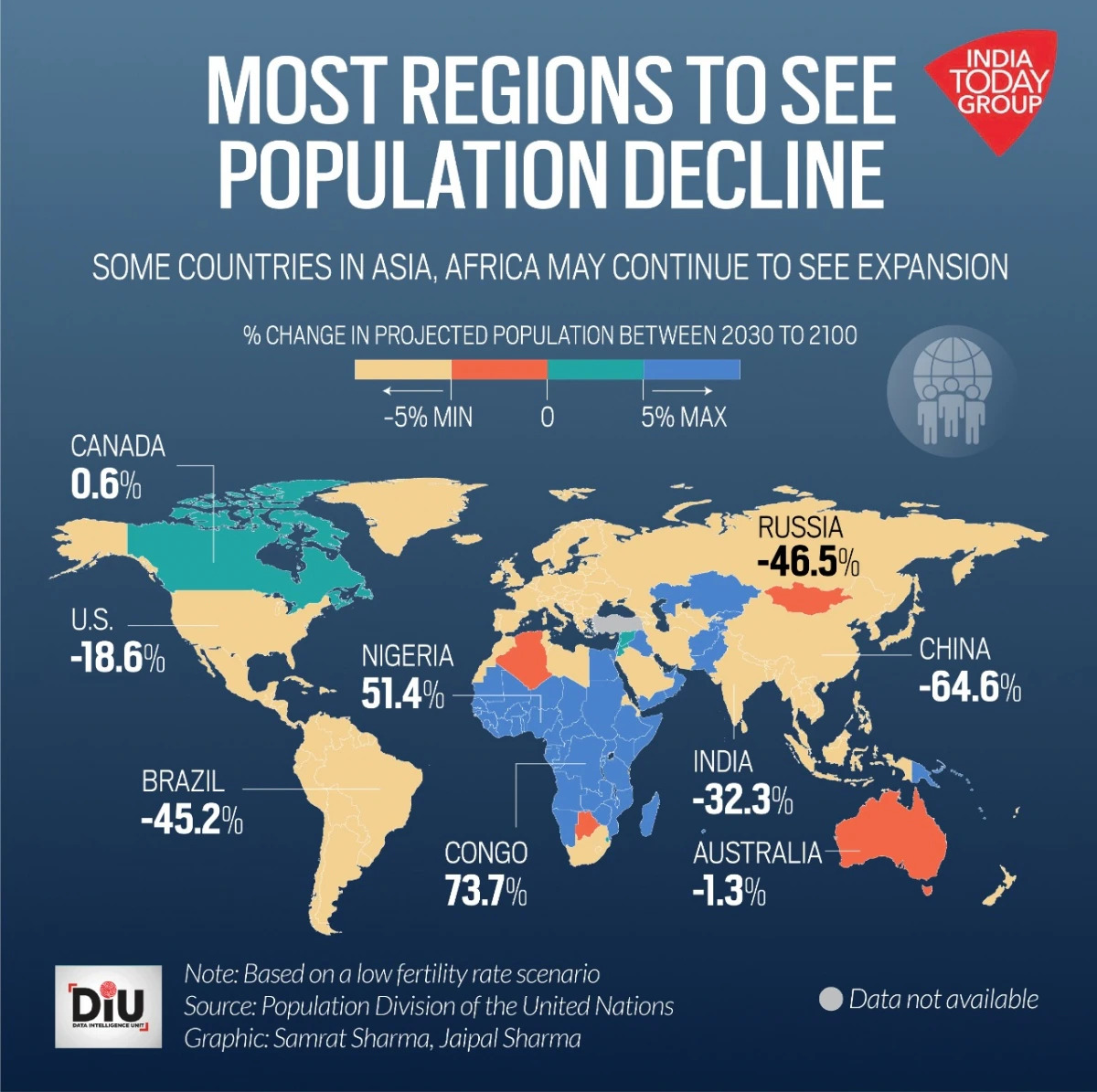
That turns this issue from a two-sided European story into a three-way split. The U.S. remains the outlier, still gaining demographic ground through immigration and high birth rates. Europe and China, for different reasons and on different clocks, are both converging on the same underlying bind: shrinking, ageing populations that demand ever-larger gains in productivity just to stand still. That is a geopolitical fact as much as an economic one: in the near term, the effect will be more friction. As China's own population ages and domestic demand cools, its manufacturers, competing less on cheap labour and increasingly automated, are moving further into the same high-value industries where Europe has long held an edge: cars, machinery, renewable-energy equipment.
It’s here that the two diverge. China is unlikely to turn to immigration to offset its demographic decline, and Europe has that lever, capable of altering the trajectory within a relevant timeframe. China can also sustain labour supply and productivity by accelerating rural-to-urban migration and moving workers into more productive jobs. In Europe, economically, the case appears more compelling: working-age migrants expand the labour force, sustain pension systems and ease shortages. The political arithmetic is, however, far less forgiving: strengthening share of the global population would require immigration on a scale far beyond what contemporary electorates are willing to accept.
A more targeted alternative would be to compete for highly skilled migrants, who file patents and start businesses at above-average rates, following the example of Canada and Australia. Selective immigration can strengthen the prosperity premium on which the EU’s influence depends.
Europe cannot recover past demographic conditions. Measuring success against a vanished baseline condemns every competitiveness debate to disappointment because the benchmark has become unattainable. The same is becoming true of China, whose weight will be shaped by a fertility collapse sharper than Europe’s own, without Europe’s cushion of high income per person and without much of an immigration safety valve either. Meanwhile, the U.S. drifts further away from both demographically.
For Europe, improving requires a focus on economic and security interests; a wealthy, shrinking continent can still command rather than chase a share of world output it no longer can achieve. For China the task is to convert the scale it has built into lasting strength before its own demographic ceiling closes in; in other words, to grow rich before it grows old. Two giants, ageing on different clocks, chasing the same arithmetic while a still-growing America pulls further away from both: that contest will also define this century.
