
The European Union’s China policy is trapped in a glaring contradiction. Officially, Brussels frames China as a “partner, competitor and systemic rival.” In practice, however, the rivalry narrative has overridden all other dimensions and eroding the foundation of cooperation.
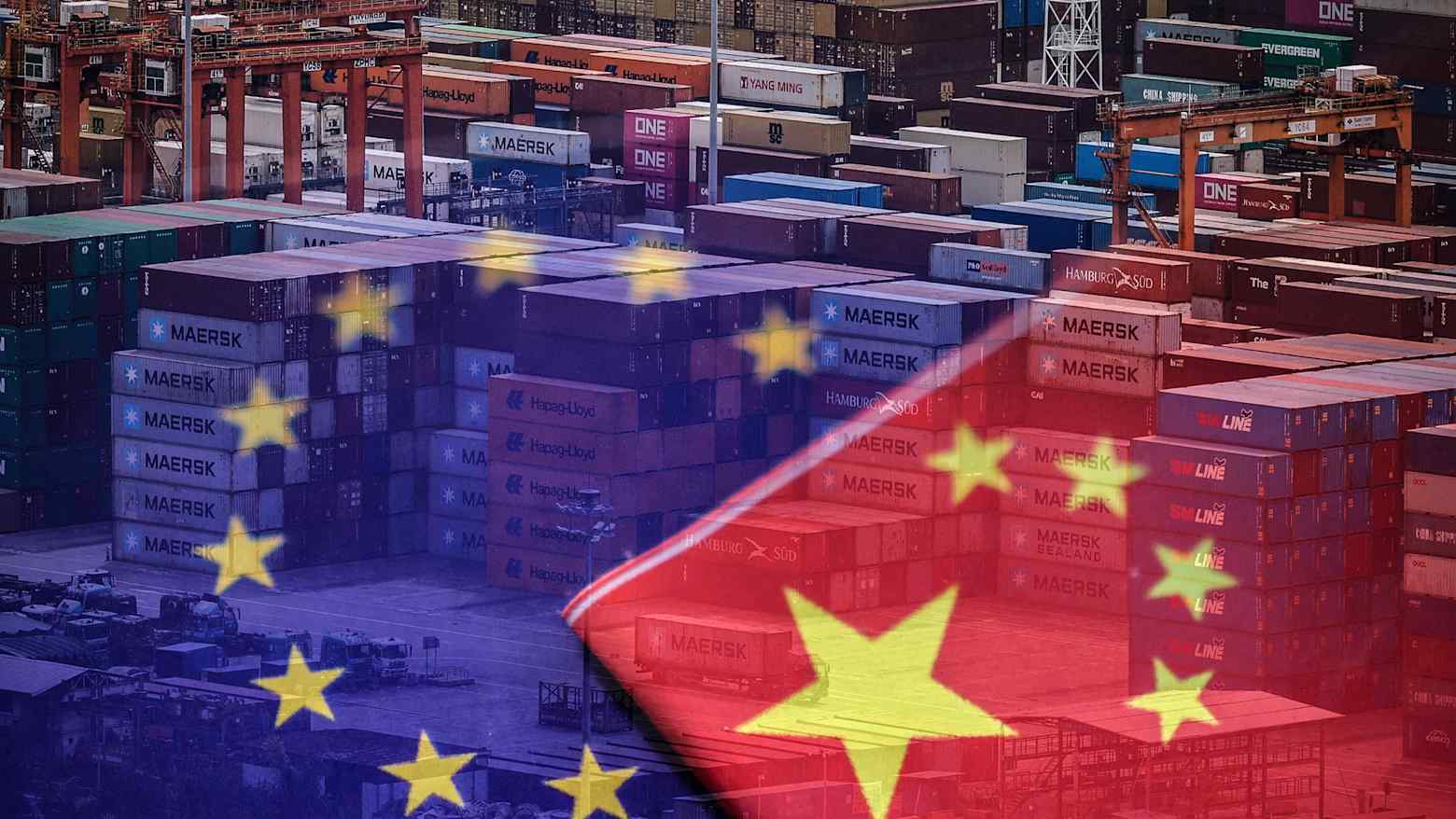
As 2026 unfolds, a rational, objective assessment lays bare a critical strategic misjudgment: the European Union’s greatest challenges in its relationship with China are entirely self-inflicted.
Brussels frequently accuses China of failing to offer a level playing field and of imposing restrictive market access for European companies. While cross-border regulatory disparities do create operational challenges, hard data tells a far different story: The EU’s stagnant performance in the Chinese market stems from its eroding industrial competitiveness, not Chinese market barriers.
China-EU economic integration remains deep, robust and mutually beneficial. For more than a decade, China has been the EU’s second-largest trading partner, with bilateral trade sustaining approximately 3.5 million European jobs as of 2023. German automakers and French luxury brands rely heavily on the Chinese market. This is an organic, deeply intertwined economic partnership built on complementary strengths.
And yet, officials point to the EU’s underwhelming export growth relative to China’s economic expansion as evidence of unfairness. Between 2018 and 2025, the bloc’s growth of exports to China grew only 9 percent. The country’s increase in GDP was 43 percent. Worse, according to Eurostat, the EU’s exports to China as a share of the bloc’s global exports fell their lowest level in 15 years—from 11 percent in 2018 to 8.3 percent in 2025.
However, a granular look at trade flows reveals a more mundane truth: European products are losing their edge. Between 2018 and 2025, the EU’s share of China’s total imports shrank from 13.7 percent to 9.1 percent. In early 2026, as China’s overall imports surged by 19.6 percent, the imports from the EU grew at a slower 14.6 percent.
Moreover, a symptom of a broader trend was present: The EU’s share of global exports has been in steady decline, dropping from 14.7 percent in 2018 to 10.7 percent in 2025, according to the World Trade Organization.
This underperformance is not a Chinese plot. While China’s market expanded, European exporters lost ground to more agile and competitive rivals from elsewhere. The evidence suggests that the EU is not being shut out by some opaque barrier but is being outcompeted in price, innovation and speed-to-market in one of the world’s most demanding and dynamic consumer arenas.
Addressing this issue will require some painful but necessary introspection and innovation at home, not finger-pointing abroad.
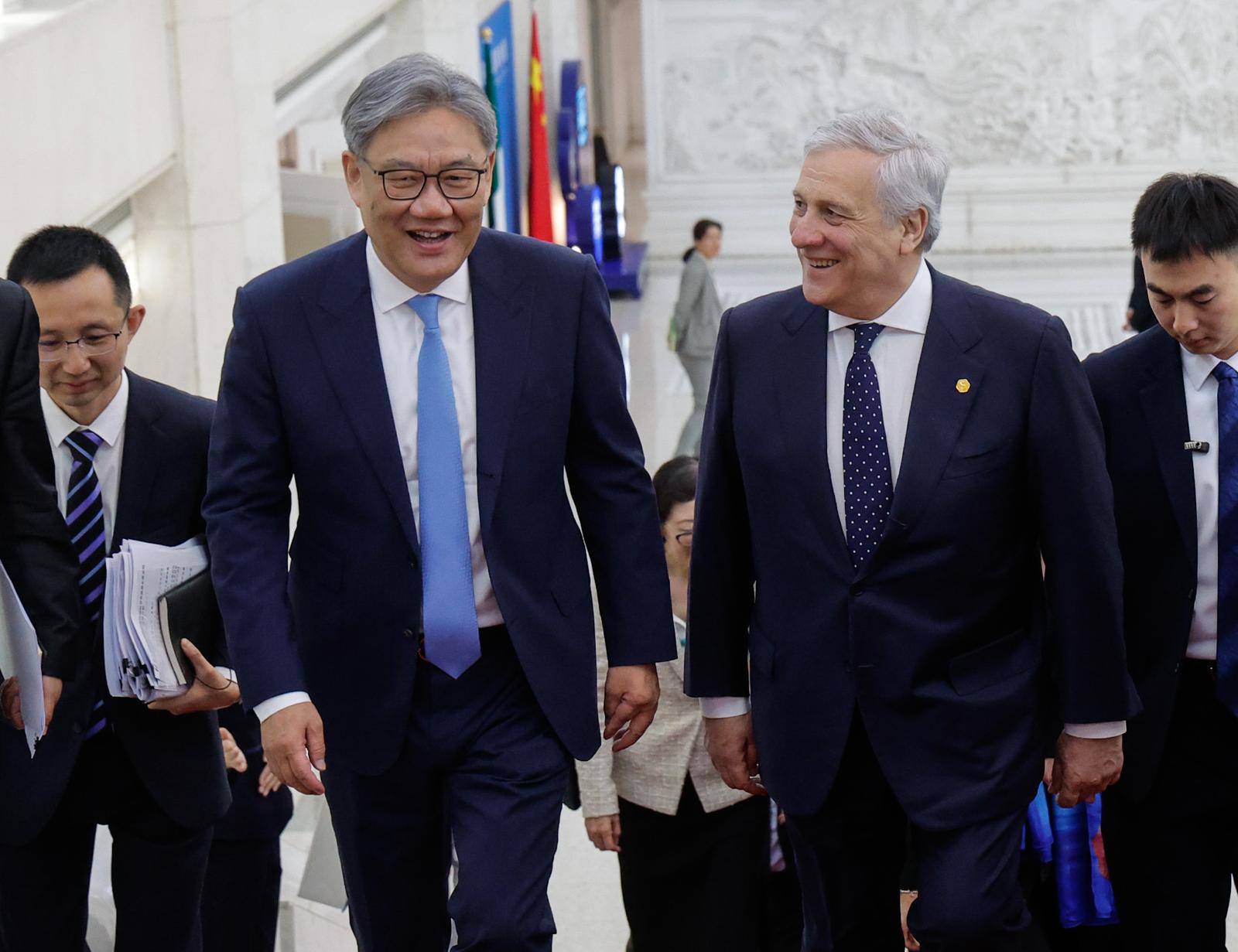
China’s Commerce Minister Wang Wentao (left) and Italy’s Minister for Foreign Affairs Antonio Tajani attend a meeting at the Ministry of Commerce in Beijing on April 16, 2026.
The leveraged diplomacy fallacy
Some in Brussels cling to the belief that the EU holds meaningful, asymmetric leverage and can play hardball without consequence. This mindset is evident in recent regulatory moves, from the proposed Cybersecurity Act 2.0—which thinly veils the targeting of Chinese technology in critical sectors—to the expanded use of sanctions and anti-subsidy investigations. This calculus is fundamentally flawed, however. It rests on a 20th-century view of power that ignores 21st-century interdependence.
China-EU ties are defined by complex, deep-rooted mutual dependency. The EU is a critical supplier for many high-value Chinese imports, from machinery to pharmaceuticals. Conversely, China is the linchpin in green technology supply chains, a source of affordable consumer goods that curb inflation and a primary supplier of critical raw materials.
A recent report by the Mercator Institute for China Studies found that a full exclusion of Chinese suppliers from 18 critical sectors in the EU would cost the bloc up to 840 billion euros over five years. Meanwhile, the European Central Bank has estimated that broader decoupling could raise costs for European consumers by 200 billion euros annually. Jens Eskelund, president of the EU Chamber of Commerce in China, recently noted: “No one really knows if Europe can still produce toothpaste if China’s supply chains are weaponized”.
At the same time, the EU’s policy of excluding Chinese collaboration in key research areas under the Horizon Europe program is an act of self-sabotage. In fields such as artificial intelligence, quantum computing and clean-energy research, China is not just a participant but a leading frontier innovator. Last year, Chinese research accounted for 35.2 percent of the world’s top-cited AI papers, compared with 22.1 percent for the EU. In quantum computing, Chinese researchers have publicly demonstrated manipulation of 113 photons, a significant lead. Erecting walls around the European research ecosystem will only isolate European scientists from the cutting edge, ensuring they work with older data and slower timelines.
Defying this reality, the market has voted decisively with capital investment. Last year, new direct investment in China by German companies surged by approximately 55 percent from the previous year. According to the EU Chamber of Commerce, the number of new EU enterprises established in China in 2025 more than doubled the number of those leaving. Further, about 25 percent of European companies in China are shifting more production there—a proportion twice that of companies relocating production elsewhere. Clearly, European industry, which lives and breathes the practical realities of global commerce, has little appetite for the political project of divorce.
Member states, which are accountable to their national economies, are more pragmatic. Over the past six months, a succession of national leaders from France, Ireland, Finland, Germany and Spain have visited Beijing to expand bilateral ties. They seek concrete commercial and diplomatic gains, not merely rehearse Brussels’ confrontational talking points.

Italian Deputy Prime Minister and Minister of Foreign Affairs and International Cooperation Antonio Tajani visit China on April 16-18, 2026.
From partner to rival
This misadventure stems from the fundamental conceptual error of importing a foreign geopolitical framework. By looking at relations through the confrontational lens of the United States and, “de-risking” under that framework, economic interdependence itself presents an unacceptable vulnerability. The EU has proactively made an adversary out of a former partner. The 2019 “systemic rival” designation was a rhetorical pivot with profound consequences. It provides the bureaucratic and political fuel to reframe mutually beneficial commercial exchanges as national security threats and to see every Chinese investment as a potential Trojan horse.
This paradigm creates its own reality: By treating China as a threat, defensive, restrictive policies are incentivized that inevitably provoke reciprocal responses, thereby manufacturing the very rivalry that was feared.
China’s strategic position, in contrast, has been notably consistent. Beijing has long expressed support for European integration and EU strategic autonomy. It views a strong, unified EU as an essential counterweight in a multipolar world, a necessary check on unilateralism, and a vital partner in addressing global challenges, from climate change to public health. China’s desire for a stable, prosperous Europe is rooted in a hard-nosed strategy based on the notion that a fragmented, declining Europe aligned wholly with Washington serves no one’s long-term interest—least of all Beijing’s. The EU, in this calculus, is a crucial piece of the global stability puzzle.
Thus, the EU’s current predicament is largely self-imposed. Having chosen to redefine a complex partner as a systemic adversary, Brussels has sown the seeds of the very insecurity and tension it now claims to want to manage. This path is a political choice, not an economic or strategic inevitability. If the EU ceases to view every interaction with China through a zero-sum security lens, the overblown rationale for much of its de-risking agenda would evaporate, allowing for a clear-eyed focus on genuine limited risks, rather than on broad-brush decoupling.
Crucially, a persistent, almost nostalgic, hope in some European capitals awaits a post-2028 U.S. presidential election that returns America to a supposed “old normal” of harmonious transatlanticism. This is a dangerous fantasy.
U.S. policy, irrespective of administration, is now unshakably founded on “America first” principles. The chaotic Afghanistan withdrawal, the disruptive AUKUS deal that sidelined EU allies and the blatantly protectionist subsidies of the Inflation Reduction Act all broadcast the same signal: Washington will unapologetically prioritize its own interests, leaving allies to manage the fallout.
But aligning Europe’s entire China policy with a U.S.-led containment strategy does not bolster European sovereignty. Rather, it mortgages it. It risks turning Europe into a dependent economic satellite, simultaneously stifled by American protectionism and severed from the primary engine of global growth in Asia.
Correcting the vision
Differences over trade, values and geopolitics are real and must be addressed through steadfast dialogue, not confrontation. Defining the relationship solely as a strategic rivalry is a historic miscalculation. It would impoverish Europe economically, cripple its ability to address shared global challenges and ultimately diminish its desired strategic autonomy. This alternative is a luxury Europe cannot afford. Being self-inflicted, the wounds will not heal by blaming Beijing.
China’s trajectory is tied to European growth. Its vision of a multipolar world requires a strong, independent EU. Endless rivalry only promises mutual loss. A clear-eyed partnership is the only path to a future where Europe remains secure, prosperous and truly sovereign. The right call is for clarity, not confrontation.
