
Brussels is retreating from the very multilateral order it once championed. The challenge now is enabling European companies to thrive within a competitive environment. True strategic autonomy will not be achieved through protectionism disguised as regulation.
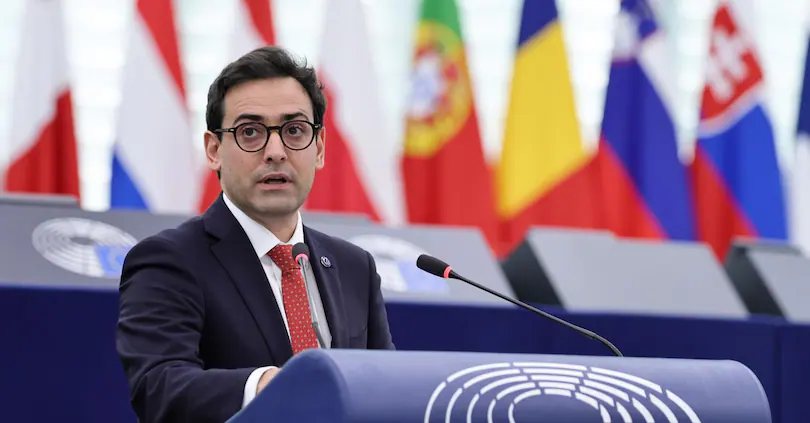
European Commission Executive Vice-President for Prosperity and Industrial Strategy Stephane Sejourne speaks during a debate on "Council and Commission Statements - Effective use of EU trade and industrial policy to address China's export restrictions" at the European Parliament in Strasbourg.
I was struck recently by news that the European Union plans to impose new preconditions on Chinese investment. Under the forthcoming Industrial Accelerator Act, which is expected in December, Chinese companies that invest in certain sectors, such as the EV supply chain, would be required to share technologies and know-how with European companies.
The move mirrors the very concerns the EU itself raised in 2019, when it launched a WTO case accusing China of pressuring European companies to transfer technology as a condition of market access. Beijing denied that such requirements were embedded in its laws and later introduced legislation explicitly prohibiting forced technology transfers. That Brussels is now considering measures resembling the practices it once condemned signals a profound shift in its approach to global trade governance.
For decades—until roughly the past 10 years—the EU championed a rules-based global trading system. It argued that such a framework supported stability and shared prosperity, and even today it continues to invoke multilateralism in its rhetoric, calling for the restoration of the WTO dispute-settlement mechanism and promoting negotiations on digital trade and climate-related rules.
Yet in pursuing what it now calls “open strategic autonomy,” the European bloc has drifted from its traditional free-trade stance. It has adopted protectionist measures and increasingly judged right and wrong according to its own strategic interests. WTO rules are cited when convenient, but sidelined when they conflict with European ambitions.
In this spirit, the EU has stepped outside the WTO framework to create new international trade instruments: the Foreign Subsidies Regulation, the Carbon Border Adjustment Mechanism (CBAM) and the Anti-Coercion Instrument. These unilateral tools—which are unprecedented globally—have been broadly criticized as protectionist. CBAM, for instance, faces strong objections from the United States, China, India, Brazil, South Africa and others, who view it as “green protectionism”—a trade tool designed to shelter EU producers under the guise of climate policy.
More broadly, many countries see these tools as symptomatic of a shift in EU trade strategy—away from a multilateral, rules-based system and toward a unilateral, autonomous regulatory posture. By embedding key WTO functions into its own domestic law, the EU is circumventing rule-making by consensus and state-to-state dispute settlement. Instead of negotiating new rules collectively, it now sets its own standards—on carbon pricing, subsidy control and trade retaliation, for example—and imposes penalties without first demonstrating a WTO violation. This blurs the line between legitimate regulation and protectionism and encourages other major economies to adopt similar unilateral measures. The result is a weakened WTO and a more fragmented global trading system.
At the same time, the EU has increasingly embraced plurilateral and bilateral approaches and is pushing for new free trade agreements. In a move that could further fragment global commerce, it is reportedly considering building a new global trading framework alongside the CPTPP as an alternative to the WTO.
Even more damaging, the EU concluded a trade deal with the United States in July that has inflicted lasting harm on core WTO principles. Under the so-called Turnberry System, the EU granted zero tariffs to most U.S. imports without extending the same treatment to other WTO members, violating the multilateral trading system’s most-favored-nation requirement.
Moreover, contradicting the WTO’s tariff-setting rules, Brussels agreed to an additional 15 percent U.S. tariff on European exports. As U.S. Trade Representative Jamieson Greer put it, “The new economic order, solidified at Turnberry, is emerging in real time.” For much of the world, however, this emerging order stands in direct opposition to multilateralism.
Underlying this turn is economic anxiety. In recent years, the European bloc has lagged behind other major economies. Between 2020 and 2024, its GDP grew by just 11 percent, compared with 23 percent in China and 15 percent in the United States. The IMF forecasts EU real growth of only 1.2 percent in 2025—again trailing both the U.S. and China.
Despite the European Commission’s narrative, the sluggish EU growth stems less from external pressures than from a loss of global competitiveness. Its traditional strengths—automobiles, petrochemicals, machinery—are eroding. Equally worrisome for Brussels is that it largely missed the wave of the Fourth Industrial Revolution, which was driven by the internet and digital technologies. Not a single European company ranks among the world’s top 20 internet players. In frontier sectors such as AI, quantum computing and semiconductors, the EU is no longer in the same league as the United States or China.
Trade performance tells a similar story. From 2017 to 2024, the EU’s share of global exports fell from 13 percent to 10.8 percent. In China, while overall imports grew by 40.8 percent, EU exports to China rose by only about 10 percent—an indication of Europe’s own competitiveness challenges rather than evidence of restricted market access.
In this light, Europe’s turn toward unilateralism and protectionism is a prescription for the wrong medicine. Shielding domestic manufacturers from external competition will not make them stronger—any more than a flower grown in a greenhouse can withstand a storm. This path risks cementing Europe’s status as a permanent also-ran behind the U.S. and China in a race to master transformative technologies. The EU’s experience in the solar panel industry should be warning enough.
In addition, retreating from trade multilateralism threatens Europe’s own prosperity. Few economies are as dependent on the global market: EU exports of goods and services account for roughly half of the bloc’s GDP, compared with 35 percent for China and just 11 percent for the United States. As former EU Ambassador to China Nicolas Chapuis noted in Beijing about four years ago, more than 80 percent of Europe’s future growth was expected to come from outside the European Union. The EU thus relies fundamentally on a predictable, stable and globalized trading environment. Turning its back on multilateralism would be nothing short of killing the goose that lays the golden eggs.
The EU stands at a crossroads. It can continue down a path of unilateral economic defensiveness, relying on regulatory power to compensate for waning competitiveness. Or it can reinvest in the principles of openness, innovation and multilateral cooperation that has underpinned Europe’s prosperity for decades.
The challenge for Brussels is not protecting European companies from global competition. Rather, it is enabling them to thrive within a competitive environment. After all, true strategic autonomy is built through competitiveness, innovation and engagement, not through protectionism disguised as regulation.
