A world order without the United States has been discussed widely. One example relates to reform of the World Trade Organization, whose dispute settlement mechanism has been paralyzed by the U.S. since 2019. Now there could be a solution.
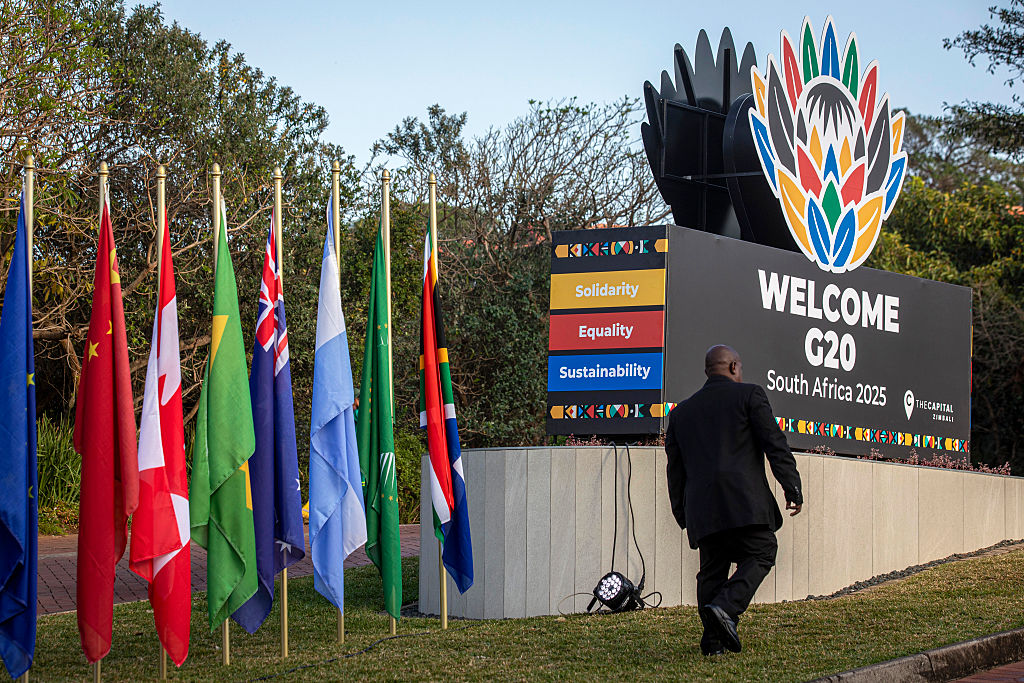
Leaders of the G20 summit in Johannesburg, South Africa, adopted a declaration last weekend despite opposition from the United States in absentia. The event was an unprecedented game-changer, as the world order evolves—now faster than ever.
The declaration came about by “sufficient consensus,” a term invented by the host country, as opposed to the G20 tradition of decision-making by unanimous consensus, meaning no objection arising from any member in attendance. The United States and Argentina, whose president is a close ally of President Donald Trump, declined to endorse the declaration.
Trump had boycotted the event, criticizing South Africa for alleged—and unproven—discrimination against the white minority, but his attempt to politicize the premier forum for international economic cooperation failed. In the end, Washington’s effort only tarnished its own reputation—all the more because the U.S. had played a major role in initiating the forum in 2008 to coordinate global recovery from the financial crisis.
Consensus, a common decision-making practice in many international organizations and institutions, is achieved not when everyone actively agrees but when no member present and participating formally objects to a decision.The term “sufficient consensus” was introduced in Johannesburg and technically fits that definition because the U.S. had boycotted the summit.
This new framing at the G20 could set a precedent, and even develop into customary international law, if sufficient consensus is practiced generally by states. After all, the world has to move on amid critical global challenges, such as climate change, even when the U.S. retreats.
A world order without the United States has been discussed widely, including among intellectuals and policy-makers in countries allied with America, such as those in Europe. A vivid example is discussion of reforming the World Trade Organization, whose dispute settlement mechanism has been paralyzed since 2019 because the U.S. refused to endorse the appointments of appellate body members.
Consequently, a subset of WTO members decided to try a new type of negotiating mode—the so-called plurilateral initiative—which contemplates the establishment of an appellate arbitration mechanism as an interim alternative to the dysfunctional appellate body. Plurilateral initiatives break away from the consensus decision-making practice of all 166 WTO members.
The alternative appeal mechanism, without the Washington’s participation, fits within the WTO system. Advocates hope to inspire even more plurilateral initiatives under the WTO framework, without having to seek the consensus of all members. Meanwhile, consensus-seeking is still feasible in the WTO if decision-making authority is delegated from the current members o a newly established board of 20-25 members—a Bretton Woods institutional practice.
This smaller professional and collegial group expects to have a decision-making process that is much more efficient and effective. As John Maynard Keynes once commented, “The common love of truth, bred of a scientific habit of mind, is the closest of bonds between the representatives of divers nations.”
Given the vacuum in world leadership left by the U.S. at this juncture, a saying has become almost cliche: “The U.S. won’t and China can’t.” But this must be debunked, as China has consistently shown robust willingness and capability to be a responsible stakeholder on the global stage.
In the multilateral trading arena, for example, China initiated the investment facilitation discussion, winning an overwhelming membership support in the WTO and potentially reaching the threshold of sufficient consensus needed to become WTO law. It is also China, alongside the EU, that formulated the aforementioned appellate arbitration system to guarantee the continuity of WTO dispute settlement.
More recently, China has pledged not to seek new special treatment in the WTO, a privilege reserved for developing countries. This demonstrates its willingness to play a leadership role in the multilateral trading system.
China contributes generously to funding the WTO, committing to capacity-building for the Global South in areas of investment facilitation and E-commerce, among other things, where China’s own development experience excels. The country is showing more confidence in helping to reshape the world trade order.
