
U.S. policy elites have not abandoned their criticisms, but they recognize the advantages of China’s capital organization, demand creation, engineering commercialization and large-scale manufacturing.
Click to read the full article
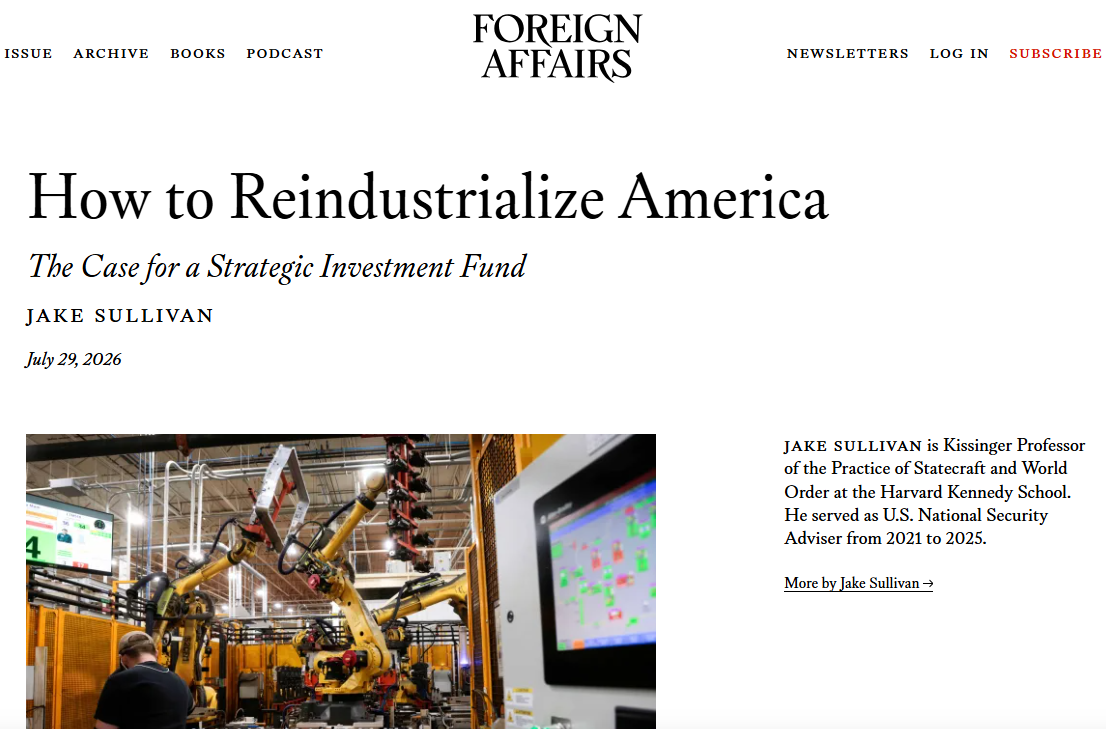
On July 29, former U.S. National Security Adviser Jake Sullivan published an article in Foreign Affairs titled “How to Reindustrialize America: The Case for a Strategic Investment Fund.” In it, he proposed the establishment of a national strategic investment fund with an initial capitalization of $50 billion.
The fund would have its own independent balance sheet and make comprehensive use of instruments including loans, guarantees, convertible debt and quasi-equity investments, with a focus on strategic industries such as semiconductors, advanced computing, biotechnology, robotics, critical minerals, nuclear energy and advanced manufacturing. The United States should, he suggested, establish a presidential Cabinet-level coordination mechanism to bring public investment, government procurement, tariffs, taxation and regulatory policies within a unified industrial strategy framework.
What makes the article truly worth watching is not that the U.S. government will adopt the proposal anytime soon but its shift in policy thinking. For a long time, Washington has tended to characterize China’s industrial planning, government-guided investment funds, policy finance and government procurement as forms of market distortion or even unfair competition. Although the policy elites have not abandoned their normative criticism of China’s institutional arrangements, they are increasingly willing to selectively draw on policy functions that have been tested and shown to be effective in China’s development experience. In this sense, the U.S. policy approach with respect to China is shifting from outright rejection toward a combination of criticism and functional adoption.
State and market boundaries
The starting point of Sullivan’s argument is that the United States has the world’s most developed capital market, a highly dynamic venture-capital ecosystem and a number of globe-leading universities and companies when it comes to innovation. Yet these advantages have not automatically translated into semiconductor fabs, critical-mineral processing facilities, production lines for advanced materials, nuclear power infrastructure or advanced robotics manufacturing capacity. Financial markets can allocate conventional commercial capital relatively efficiently, but they are less capable of directing long-term capital in line with the demands of state-level strategic competition.
There is a clear mismatch between the capital requirements of strategic industries and the investment logic of Wall Street. Semiconductor fabs and advanced manufacturing facilities require large amounts of capital and long construction periods, while policy, technological and market risks are often intertwined. Private investors tend to favor projects with predictable cash flows, relatively rapid capital turnover and clear exit opportunities. They are often cautious about strategic industries with longer investment horizons and significant positive externalities. Such choices may be commercially rational for individual investors, but from the perspective of national competition they can result in chronic underinvestment in critical industries.
Based on this assessment, Sullivan argues that the United States needs to turn capital into capability. The government should use public capital to share the risks associated with early-stage investment, while using long-term procurement agreements and demand commitments to stabilize market expectations—which in turn will attract more private capital to strategic industries. This approach overlaps, in certain respects, with some of the functions served by China’s strategic industrial policies. In areas that bear directly on national competitiveness, technological security and the resilience of industrial supply chains, market prices may not fully capture the strategic value of investment. The state therefore needs to play a role in organizing capital, sharing risk, cultivating demand and providing strategic direction.
Of course, this does not mean that the United States has only just begun to pursue industrial policy. In recent years, Washington has used subsidies, tax incentives and government procurement to encourage the reshoring of strategic industries. What is new about Sullivan’s proposal is its attempt to consolidate fragmented public investment, financial instruments, trade policies and demand-side support into a more durable mechanism for organizing capital. The aim is to move U.S. reindustrialization beyond project-based support and toward long-term capital allocation and cross-sector policy coordination.
In this sense, U.S.-China competition is increasingly taking the form of a contest over the capacity to organize industries, the completeness of industrial ecosystems and the effectiveness of institutional implementation.
Reintegrating manufacturing
Sullivan’s reflection on the traditional U.S. model of innovation is equally noteworthy. After the end of the Cold War, the United States gradually developed a model of global specialization in which high value-added activities such as technological research and development, product design, standard-setting and finance remained in the United States, while manufacturing was distributed globally in light of cost and efficiency considerations. As long as the U.S. continued to control patents, brands and core technologies, the relocation of production abroad was not seen as a threat to its technological and economic lead.
This assessment has been increasingly challenged by developments in the real economy, however. The offshoring of manufacturing has not only taken away factories and jobs but also skilled workers, supplier networks, process know-how, quality-control systems and hands-on engineering experience. As R&D and production have become increasingly separated, designers have found it more difficult to receive continuous feedback from the factory floor, while laboratory breakthroughs have become harder to translate rapidly into industrial products that are stable, reliable and cost-effective.
In complex industries such as semiconductors, new-energy vehicles, robotics and biomanufacturing, innovation does not end when a technological invention is completed. It continues through pilot stages, process improvement, supply-chain coordination and mass production.
China’s experience in developing industries such as new-energy vehicles, photovoltaics and communications equipment reflects this logic of innovation. Over the course of their development, these industries have gradually built interconnected chains linking R&D, engineering validation, supply systems and market application. Their competitive advantages do not stem from any single technology or particular cost condition but from a combination of indigenous innovation, accumulated engineering expertise and the sustained investment, experimentation and iteration of companies, engineers and industrial workers over the long term.
Technological achievements can become stable, reliable and replicable only after they have gone through absorption and assimilation, engineering transformation and large-scale validation. Such capabilities are rooted not only in a complete industrial system and a vast market but also embody the process know-how and coordination experience accumulated over time on the production floor. From process improvements on the production line to the continuous iteration of supply-chain companies around cost, performance and reliability, the competitiveness of Chinese manufacturing is the product of the combined influence of institutional conditions, market mechanisms, accumulated labor and entrepreneurship.
Sullivan specifically highlighted the development of Shenzhen’s new-energy vehicle industry in his article. Local governments created early market demand by promoting the electrification of buses and taxis, helping companies secure stable cash flows and obtain feedback from real-world applications. This, in turn, accelerated the clustering of battery manufacturers, electronic-component suppliers, charging infrastructure providers, software developers and engineering talent. The case reveals the mutually reinforcing mechanism linking demand creation, industrial clustering, large-scale production and technological learning.
Large-scale manufacturing is not the end point of innovation; it is a critical process through which know-how is developed, production costs are reduced, technological problems are identified and products are continuously refined. In some advanced manufacturing sectors where production has been extensively offshored, the United States has long faced a structural gap between strong frontier R&D and relatively limited capabilities in engineering commercialization and large-scale manufacturing. What it is now seeking to rebuild is precisely the critical link between technological breakthroughs and industrial capabilities, and between laboratory achievements and large-scale commercial application.
Therefore, the reindustrialization Sullivan advocates is not primarily about bringing more factories back to the United States or creating more manufacturing jobs. Rather, it is about rebuilding the feedback loop connecting R&D, engineering, production and supply chains. U.S. policymakers are increasingly recognizing that the continued erosion of large-scale manufacturing capabilities can end up constraining technological innovation.
Recasting institutional forms
Sullivan emphasized the central role of private companies, capital markets and professional investment institutions. He also proposed using an independent board of directors, publicly disclosed investment criteria, professional decision-making, audit oversight and investment-return requirements to ensure that his proposed fund operates in a relatively market-oriented and professional manner. This suggests that he is not advocating a replication of China’s specific institutional arrangements but rather is seeking to build, within the existing U.S. institutional framework, an industrial-support mechanism with similar functions.
From the perspective of policy functions, Sullivan’s proposal overlaps with China’s experience in three main respects. First, it would use instruments such as loans, guarantees, convertible debt and quasi-equity investments to leverage public capital and draw private capital into strategic industries. Second, it would use multi-year procurement contracts, offtake agreements and demand commitments to cultivate initial markets and stabilize investment expectations. Third, it would strengthen policy coordination across investment, trade, taxation, regulation and government procurement, helping to align the development of R&D, production, infrastructure and supply chains.
Sullivan also proposes support for so-called trusted ally companies in establishing manufacturing facilities in the United States, suggesting that Washington is seeking to link its industrial-support mechanisms more closely with localized production and its alliance system.
Public investment, government procurement and development finance are by no means unique to China; the United States itself has a deep-rooted tradition of industrial policy. It is therefore more accurate to say that the U.S. is not copying China’s institutional model but rather reviving its own industrial-policy tradition while selectively drawing on the policy functions demonstrated by China in capital organization, demand creation, engineering commercialization and large-scale manufacturing.
The influence of China’s experience lies not in providing an institutional template that can be directly replicated but in demonstrating through real-world industrial performance that, in strategic industrial competition, the state can improve the efficiency of long-term capital formation and the commercialization of technological outcomes by coordinating market-based instruments with public policy.
Institutional confidence
The shift in U.S. policy thinking offers, from one perspective, further evidence of the practical value of China’s approach to developing strategic industries, while also underscoring the resilience and vitality of China’s institutional model and its development path.
In recent years, China has continued to leverage public capital to guide investment in basic research, major technological breakthroughs, the upgrading of industrial foundations and the development of critical infrastructure. This has encouraged social, financial and industrial capital to increase their support for strategic emerging industries and industries of the future. As the advantages of China’s vast domestic market and its large pool of real-world application scenarios, complete industrial supporting systems and rapid technological iteration are increasingly brought into play, the pathways for translating technological advances from R&D into engineering development, industrialization and large-scale application have continued to expand. China’s competitive advantages in the commercialization and large-scale deployment of new technologies have consequently continued to strengthen.
A complete industrial system and a highly skilled workforce form an important foundation for China’s participation in international industrial competition. It has the world’s most comprehensive industrial system, a vast pool of engineering and technical talent and industrial workers and highly coordinated, efficient and resilient industrial and supply-chain networks. These advantages are the result of long-term accumulation and sustained investment. They are deeply systemic and endogenous, making them difficult to replicate quickly through short-term subsidies or any single policy instrument.
High-standard opening-up is also providing China with sustained momentum to consolidate its industrial advantages and expand its space for development. Its industrial policies not only serve its own modernization but also provide global markets with a wide range of high-quality products, green technologies and infrastructure. As international cooperation continues to expand and as industrial and supply-chain integration deepens and channels for sharing technological advances become increasingly diverse, China’s industrial capabilities are providing greater support for global economic growth, the green transition and the modernization of developing countries.
