The upcoming BRICS summit offers India an opportunity to expand its diplomatic space in the Global South. With mounting geopolitical conflicts and disorder in global governance, the summit will allow BRICS countries to demonstrate their capacity for reshaping the international order.
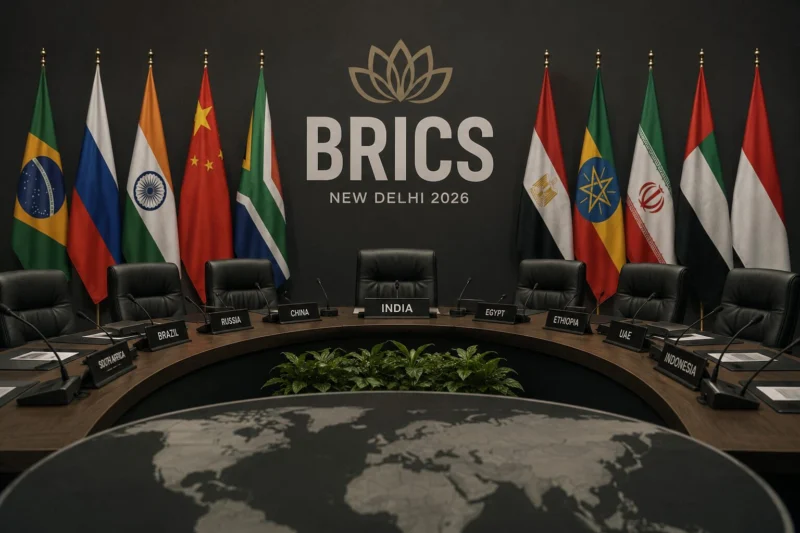
The 18th BRICS Summit will be hosted by India on September 12-13, 2026.
The 18th BRICS summit, scheduled for New Delhi, India, on Sept. 12 and 13, carries particular significance for both BRICS and its host. It marks 20 years since the founding of the organization and provides an opportunity for India to expand its diplomatic space in the Global South at a time when relations between India and the United States are cooling. More important, in light of international conflicts and disorder in global governance, the summit gives member countries an opportunity to demonstrate their capacity for reshaping the international order.
India on home court
The BRICS summit is a major platform for emerging economies to strengthen coordination amid profound shifts in the international landscape. Each summit gives member and partner countries an opportunity to voice their positions and put forward proposals in response to new global developments. In addition to addressing such hot-button issues as shipping through the Strait of Hormuz, this year’s summit is also expected to feature topics and highlights shaped by its host’s priorities.
But there are a few question marks. First, will the “Greater BRICS” turn up in full force? Since taking over the chairmanship, India has treated the summit as its most important multilateral diplomatic event of the year and has sought to cultivate an atmosphere of internal unity and cooperation. Cooling relations with the United States have forced India to recalibrate its foreign-policy priorities, giving BRICS greater weight. With the BRICS New Development Bank’s South Asia Regional Center operating smoothly in Prime Minister Narendra Modi’s home state of Gujarat, and with the “BRICS dividend” and “BRICS opportunity” narratives gaining traction in the country’s political and academic circles, calls for India to leave BRICS have dropped off markedly.
Against this backdrop, India is working to bring the leaders of all BRICS member and partner countries to the summit, hoping to take a “Greater BRICS” family portrait with Modi in the center, thereby highlighting India’s convening power and leadership in the Global South. In fact, given that Saudi Arabia has repeatedly denied that it is a BRICS member, the absence of Crown Prince Mohammed bin Salman would not be a surprise. Russia and Iran, meanwhile, are both deeply embroiled in geopolitical conflict, making the attendance of their presidents a matter of particular international interest. Media in India have reported that, given China’s influence within BRICS and its international standing, the Indian government hopes that President Xi Jinping will attend.
Second, will the summit produce substantive measures on BRICS financial cooperation? Such cooperation has long been seen as a potential breakthrough for BRICS in its efforts to rebalance global governance. After Russia proposed establishing a “BRICS Bridge” payment system, Brazilian President Luiz Inácio Lula da Silva called for the creation of a BRICS currency. Meanwhile, political and academic circles in member countries have put forward proposals for a BRICS monetary fund and other initiatives.
Yet establishing a BRICS payment system is no easy task when member countries have divergent policy priorities and the bloc lacks both an anchor currency and the backing of authoritative financial institutions and information. In recent years, BRICS summits have done little more than task finance ministers and central bank governors with assessing the feasibility of a payment system, leaving their reports for the next summit to consider. If building a payment system has proved to be a slow and difficult process, a BRICS currency and a BRICS monetary fund would be even more ambitious.
With U.S. President Donald Trump threatening to punish BRICS countries for “de-dollarization,” the ways India as host can give substantive momentum to BRICS financial cooperation will be one of the summit’s biggest challenges and also one of its main points of interest.
Third, will BRICS expand its ranks once again? After several rounds of expansion, BRICS has grown into a “Greater BRICS” grouping of around 20 member countries and partners. But how to make the bloc stronger after making it larger has become a subject of debate. To avoid the chronic problem of multilateral mechanisms becoming “big but weak,” Russia, during its year as BRICS chair, announced a pause in further expansion.
Moreover, in Trump’s universe, BRICS is an anti-American alliance that seeks to compete with the West for power and influence. Yet this misperception has not stopped countries in the Global South from gravitating toward BRICS. The leaders of Iraq and Madagascar, among others, have expressed interest in becoming BRICS partners, while Malaysia, which is already a partner, has voiced its desire to become a full member. As a result, the question of whether BRICS will expand once again at this year’s summit has become a focus of media attention.
Fourth, what new initiatives will China and India put forward at the summit? The international community largely regards China as the main driving force behind BRICS, with some international media going so far as to say that without China, there would be no BRICS. India, however, has long resented China’s leading role in the organization. At the height of tensions between the two countries, it even brought their bilateral disputes into the multilateral grouping, often acting as a spoiler on BRICS agenda-setting and cooperation by opposing China at every turn.
As China-India relations return to a more normal course, the two countries have pledged to support each other’s BRICS chairmanships this year and next. But that does not mean India will ease its competition with China within BRICS. Still less will it pass up the opportunity afforded by hosting this year’s summit to expand its influence in the Global South. At successive summits, China has put forward new cooperation initiatives that have won broad support and were quickly implemented. India will not want to be left behind. At the Goa summit, India proposed the creation of a BRICS rating agency—an idea that generated considerable interest in the international media at the time. At this year’s New Delhi summit, seeing how China and India will work together on the BRICS stage will be another point of interest.
Where BRICS puts its weight
Over the past 20 years, BRICS has produced a wide range of common positions and initiatives, but its overarching focus has remained the pursuit of international institutional rights commensurate with its overall economic weight. Take the distribution of power in international finance, for example. Although BRICS countries, acting collectively, secured a breakthrough in the International Monetary Fund’s 2010 quota reform, they remain on the margins of global financial governance.
BRICS’s aim, therefore, is to push for reform of the Bretton Woods system, which has been in place for more than 80 years, to make it more inclusive and equitable. At the IMF, the core institution of global financial governance, the 16th General Review of Quotas made no adjustment to quota shares, leaving the voice and representation of emerging economies and the Global South still inadequately reflected. BRICS countries will therefore step up their efforts during the 17th General Review of Quotas and urge the IMF to adopt a new quota formula that better reflects the distribution of economic power around the world.
Today, the digital economy, the green economy and artificial intelligence are gaining momentum, while governance of new frontiers such as cyberspace and outer space is also rising on the international agenda. These emerging fields will not only reshape countries’ positions in global supply and production chains but also redistribute the roles of global rulemakers. Against this backdrop, BRICS is building on traditional economic and trade cooperation while turning its focus toward these emerging areas.
In digital economy cooperation, BRICS has put forward the concept of a “digital transformation of manufacturing” and pursued cooperation through mechanisms such as the Digital Economy Working Group and the Digital BRICS Task Force. In the green economy, BRICS countries use energy research cooperation platforms to exchange expertise on biofuels, hydropower and low-emission technologies and processes, while working to build green energy supply chains and industrial chains. In artificial intelligence, member countries are expanding cooperation with partners around the world. India held the fourth AI Impact Summit in February, while China hosted the World Artificial Intelligence Conference in July and established the World Artificial Intelligence Cooperation Organization, with plans to build an international AI application cooperation center for BRICS, ASEAN and the Arab League.
It’s no surprise that ach BRICS summit attracts broad international attention. This suggests that BRICS has shed the “talk shop” label long associated with multilateral mechanisms and is challenging the center-periphery structure of the international system through specific actions. By making better use of existing resources, identifying new areas of growth and stepping up efforts in emerging economies and the governance of new frontiers, BRICS is moving toward the center of global affairs as an increasingly dynamic and vibrant Greater BRICS.
