
Back-to-back China-Russia coordination is a response to the growing turbulence in the international system. While their strategic collaboration enhances bilateral strategic predictability, it also signifies that major-country competition is becoming more protracted and complex.
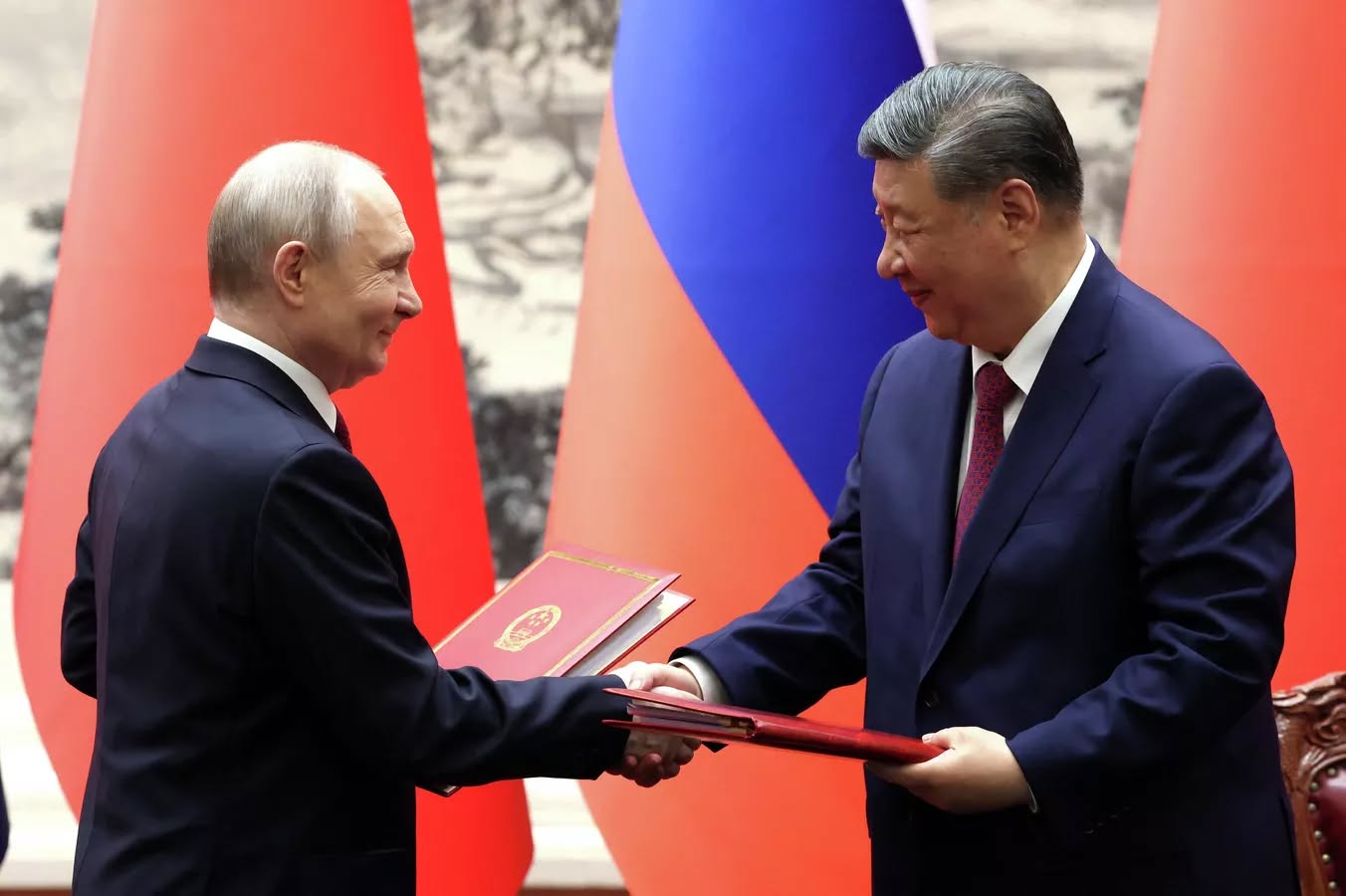
Chinese President Xi Jinping (R) and Russian President Vladimir Putin sign a joint statement on further enhancing the comprehensive strategic coordination and deepening good-neighborliness and friendly cooperation between the two countries at the Great Hall of the People in Beijing, China, May 20, 2026.
During Russian President Vladimir Putin’s visit to China, the two countries marked the 30th anniversary of their strategic partnership of coordination and renewed the Treaty of Good-Neighborliness and Friendly Cooperation. China said that amid profound changes in the international landscape, the world risks sliding back into a “law of the jungle” dynamic. Against this backdrop, the two countries pledged to uphold the spirit of the treaty and further strengthen back-to-back strategic coordination.
This statement goes beyond routine diplomatic rhetoric and reflects a profound adjustment in contemporary major-country relations. Against the backdrop of ongoing geopolitical crises, a new round of strategic recalibration in China-U.S. relations and the gradual weakening of the global arms control regime, China-Russia relations are evolving from a traditional partnership into a strategic collaboration that is more stable and pragmatic.
On the day of Putin’s visit to China, the Russian newspaper Nezavisimaya Gazeta commented that the close strategic relationship between Russia and China “plays a vital stabilizing role on the international stage” and noted that both sides “act not against anyone, but for peace and universal prosperity.” This sentiment echoes Beijing’s call for back-to-back coordination, underscoring the fact that the two countries regard each other as key strategic pillars in a constantly evolving international landscape.
In major-country relations, a nation’s destiny hinges not only on the interconnectedness of security interests but also on the depth of ties in non-military domains. Unlike the Cold War era, which emphasized military alliances, modern major-country relations increasingly rely on capabilities of long-term coordination and durable forms of comprehensive connectivity. To a certain extent, China-Russia relations reflect this broader transformation.
Treaty as cornerstone
Signed in 2001, the Treaty of Good-Neighborliness and Friendly Cooperation is the institutional foundation of contemporary China-Russia relations. The treaty enshrines several core principles: lasting friendship, non-alignment, non-confrontation, not targeting third parties and mutual respect for sovereignty and development paths. Over the past decades, bilateral relations have maintained a notable degree of stability despite repeated international turbulence, due in large part to this institutional framework.
Unlike traditional military alliances, China and Russia emphasize strategic coordination. This model preserves the independence of both sides’ foreign and security policies while reducing the risk of entanglement in each other’s conflicts. From the perspective of Washington, however, their deepening strategic collaboration is extending beyond a conventional partnership. In recent years, the U.S. strategic community has increasingly characterized China and Russia as substantive rivals that constrain America’s global strategic advantages.
Some major American media interpreted Putin’s visit to China as underscoring Beijing’s balancing role in China-U.S.-Russia trilateral relations. In discussions of the so-called new maritime Cold War, some American scholars argue that China-Russia relations have reshaped the global balance of power and poses a major challenge to the United States.
The foundation of contemporary China-Russia relations lies less in short-term exchanges of interests than in a shared response to pressures from the international system. This structural underpinning explains why repeated efforts by the United States to drive a wedge between the two nations have yielded only limited results.
Coordination expanding
The China-Russia comprehensive strategic partnership of coordination represents an evolving extension of the spirit embodied in the original treaty. As Washington frames the two countries as key strategic competitors, their collaboration is seen as a coordinated response to external pressures. From this perspective, it may serve to diffuse U.S. strategic attention while enabling mutually beneficial cooperation between the two countries, without entangling them in each other’s conflicts. This is a strategic choice that adapts to the current international system.
Amid the ongoing conflict in Ukraine, Russia has deepened its reliance on this partnership, which helps alleviate wartime economic pressure and enhances national resilience. A good example is the proposed Power of Siberia 2 natural gas pipeline project. Having lost substantial access to European energy markets, Moscow has shown a stronger willingness to advance the project, seeking to finalize agreements more quickly to stabilize revenues and sustain its energy exports.
China, meanwhile, has adopted a pragmatic and prudent approach, prioritizing pricing, contract terms, and long-term commercial sustainability. This underscores that China-Russia cooperation is not unlimited but rather is a realistic choice shaped by each country’s core national interests.
Putin has reinforced his commitment to the bilateral relationship through sustained personal diplomacy. He emphasized that the Treaty of Good-Neighborliness and Friendly Cooperation has laid a solid foundation for strategic relations and that he will continue to support the deepening of this partnership.
In a broader context, the deterioration of the international security environment is a key driver behind the continued enhancement of China-Russia relations. Back-to-back coordination serves not only as a form of mutual security support but also as a mechanism contributing to strategic stability.
U.S. strategic anxiety
Deepening China-Russia relations have added to the strategic pressures faced by the United States. Its National Defense Strategy and the China Military Power Report frame China and Russia as a “simultaneous problem” and warn that their closer coordination could stretch U.S. strategic resources across Europe and the Indo-Pacific.
Beneath this anxiety lies a deeper issue: the steady erosion of the post-Cold War global arms control regime. From the gradual collapse of the Treaty on Conventional Armed Forces in Europe to the formal termination of the Intermediate-Range Nuclear Forces Treaty and the expiration of the New Strategic Arms Reduction Treaty in February this year, the global arms control system is beset with its most severe crisis since the end of the Cold War. At the same time, European countries, NATO and Indo-Pacific nations are bolstering their military capabilities, drawing major powers back into a renewed cycle of the security dilemma. Thus, back-to-back China-Russia coordination should not be seen as an isolated phenomenon but as a response shaped by growing turbulence in the international system.
The risk of the world reverting to the law of the jungle is no idle warning. While China-Russia strategic collaboration enhances bilateral strategic certainty, it reflects a broader trend in which major-country competition is becoming more protracted and complex. Rebuilding mutual trust amid competition and reshaping the global arms control framework will, therefore, constitute a major test for China, the United States and Russia.
