
Labeling China as part of an “Axis of Chaos” misrepresents its strategy by overstating its alignment with other U.S. adversaries and wrongly implying that it seeks global instability. China’s power and the challenge it poses to the United States instead stem primarily from its deep integration and central role in the global economy, not from fostering chaos or acting as part of a unified anti-U.S. bloc.
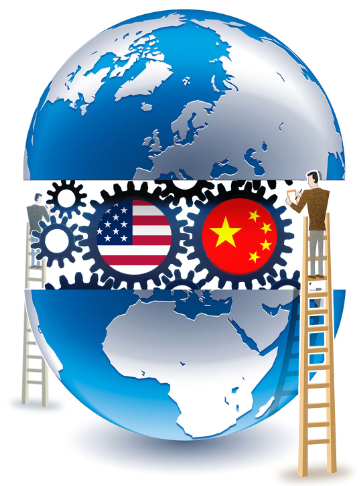
The latest round of conflict in the Middle East has led to a surge of interest in how China views the region and a flurry of commentary about its support for Iran and other adversaries of the United States. It is increasingly common to hear China linked to the current war as well as the war in Ukraine through its alleged membership in a network of American adversaries: Russia, Iran, North Korea, and sometimes also Venezuela and Cuba. In this framework, China, together with its counterparts, form an “Axis of Chaos,” sometimes also called an “Axis of Upheaval,” committed to undermining the international order.
There is no denying that China cooperates with each of the aforementioned countries in ways that counter American interests, and that China seeks to insulate itself from foreign—and chiefly American—pressure, meaning that it can benefit from the diminishment of American power. China also routinely engages in destabilizing conduct, including “gray-zone” tactics, to advance its territorial claims in the Taiwan Strait and South China Sea. More recently, its dominance in refined rare earths has raised concerns about its ability to disrupt the global economy.
But associating China with an “Axis of Chaos” mischaracterizes Beijing’s interests and strategy as well as the sources of its power. Moreover, while exponents of the “axis” concept tend to portray themselves as especially alert to the threat China poses to American interests, this framework underestimates the scope and complexity of the challenge China represents. Unlike its putative comrades for chaos, Beijing’s power derives principally from its integration and centrality in the international economic system rather than its ability and willingness to generate instability—making China an even greater strategic challenge than the “axis” framework suggests.
Both key words in the phrase “Axis of Chaos” are misleading in ways that can muddle American strategic thinking.
Let’s start with “axis.” This term overstates the amount of group-level collaboration among the alleged axis members. In fact, as even the champions of the “axis” framework are quick to note, most collaboration between these countries is bilateral. Moreover, there are latent tensions between them. For example, as Beijing continues to make inroads in Central Asia and the Arctic, its pursuit of its own economic and security interests may strain its mostly cooperative relationship with Moscow. In addition, although China and North Korea have a mutual defense pact (this is China’s only such agreement), Pyongyang’s destabilizing brinkmanship is a source of anxiety for Beijing, which would be on the front lines of any conflict or refugee crisis on the Korean peninsula.
The term “axis” also exaggerates the centrality of the alleged member countries to China’s strategy and position in the international system. Good relations with Moscow and Pyongyang are useful for Beijing because they free up resources and bandwidth to devote to managing the challenges posed by the numerous American security partners in the region (South Korea, Japan, Taiwan, the Philippines, and Thailand) and to building up its navy and strengthening its position in the eastern Pacific and Southeast Asia. However, avoiding conflict and cooperating with “axis” powers are necessary but not sufficient conditions for these priorities, which also require trade and economic growth and access to technology and materials sourced from all over the world. As for Iran, the Middle East remains a secondary region in terms of China’s core interests, and Tehran is hardly Beijing’s most important regional partner (compared to Saudi Arabia and the United Arab Emirates)—it is just a country that is highly dependent on China and with which several other powers have limited or no formal engagement.
More broadly, the essence of China’s strategy is diversification of partnerships and supply chains to achieve strategic autonomy and economic autarky. Its engagement with Iran and Russia—importing cheap energy, exporting a range of low- and high-value manufactured products, including dual-use technology—needs to be understood in the context of its far more lucrative trade with other Asian and Western states. If we want to associate China with groups of countries defined by particular political and ideological positions, then the “Axis of Chaos” is just one of many candidates: Beijing can be classified as a free trade champion, a Global South leader, and a permanent member of the United Nations Security Council, among other categories.
In other words, China is integral to multiple international blocs, not just the one defined in terms of opposition to the United States. Any assessment that fails to recognize China’s economic centrality across blocs or that distorts the significance of a single set of partnerships inevitably underestimates China’s ability to challenge American interests.
Now, to “chaos.”
The idea that any country desires more instability probably warrants a good deal of scrutiny. This is even more the case for the claim, advanced by prominent advocates of the “Axis of Chaos” framework, that Xi Jinping has admitted that he is deliberately fomenting chaos. This conclusion rests on a selective interpretation of two sources: a speech in January 2021 in which Xi said that the state of the world and the “great changes” underway can be summed up with the word “chaos,” and then a remark by Xi to Vladimir Putin in March 2023 that “we are the ones driving [these changes]” (this is a widely used English rendering of the original Chinese, which I would rather translate as “let’s drive [them] forward together”). It’s worth noting that the comment about “chaos” in the 2021 speech is followed by a mix of confidence (“time and the trends are on our side”) and caution (“the entire Party must proceed modestly and cautiously, struggle arduously…”)—not exactly a bold declaration of a “policy of fostering global chaos.”
Rhetoric aside, the notion that China seeks to foment chaos is belied by the logic of Beijing’s pursuit of power. For entirely self-interested reasons, Xi and the rest of China’s leaders want less chaos, not more. The reason is simple: their grip on power at home and expanding reach abroad depend largely on trade. More specifically, they depend on the ability to import energy, food, and various natural resources and export a host of increasingly high-value manufactured goods. Stoking chaos that makes foreign countries less able to buy and import Chinese goods and potentially—as we are seeing with Iran and the Strait of Hormuz—more willing to weaponize chokepoints in the global economy is bad for China.
This logic relates to a more fundamental problem with the “Axis of Chaos” framework as applied to China: it obscures the greatest source of Beijing’s power. This is the most important respect in which China is qualitatively different from the other alleged axis members, which to varying degrees leverage their ability and willingness to destabilize the regional and in some cases global order. North Korea does so through nuclear-backed brinksmanship and unpredictability; Iran through proxies and the threat of nuclear escalation—and more recently, weaponization of an economic chokepoint in the Strait of Hormuz. Russia also derives considerable power from its capacity and willingness to breach international norms, including through assassinations and wars of conquest, though it also leverages its established position within the international system, including through its seat on the United Nations Security Council and its vast energy reserves, which give it considerable leverage over Europe.
But here China stands in a league of its own: the critical source of its power is its integration and centrality in the global economy. China is the top trading partner of over 120 countries around the world. It has made itself indispensable to many other countries’ development, decarbonization, and modernization of governance through massive investments in infrastructure, export of cheap solar panels and electric vehicles, and provision of digital technology and training. These partnerships are often opaque and politically unscrupulous and in some cases have been associated with heightened corruption and environmental problems. Many governments recognize both the opportunities and risks that come with partnering with Beijing, but especially as the United States cuts back on aid and development, global reliance on China is increasing.
In the long run, the asymmetry of a world that depends on exports from an autarkic China is not sustainable. Industrialized countries are already straining under pressure from China’s growing economic dominance in key sectors, and developing countries will not be content to forever be commodity exporters and manufacturing hubs for industries dominated by foreign companies, Chinese or otherwise. But the solution to these complex, structural challenges does not lie in treating Beijing like a pariah regime that can be isolated. On the contrary, it lies in building international consensus over how to maximize the benefits and minimize the harms of engaging China and in collaboratively leveraging Beijing’s dependence on trade to advance those goals.
