
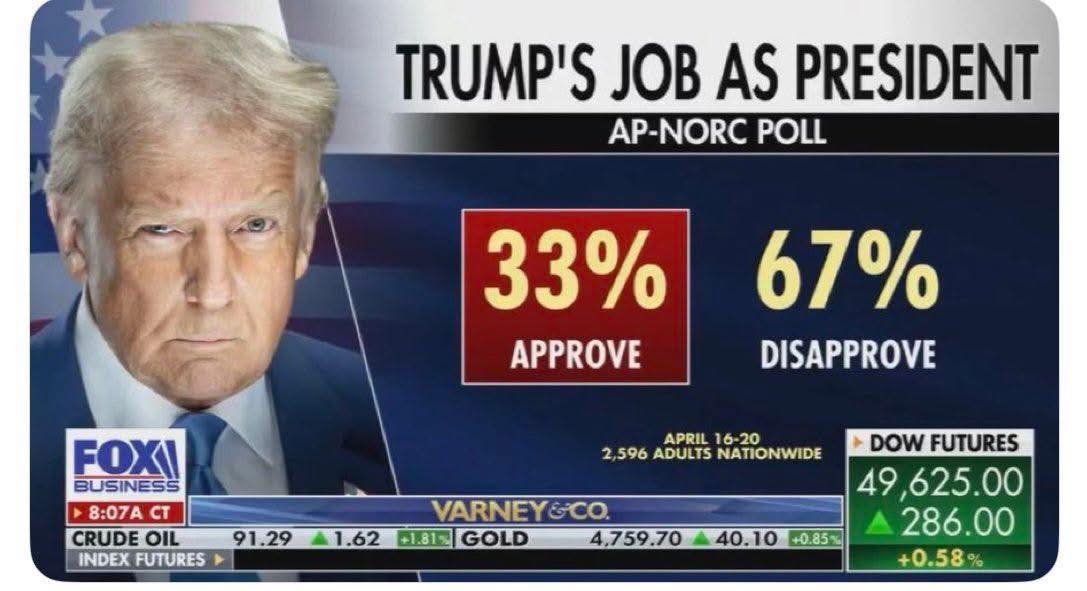
Donald Trump’s approval rating has dropped to 34 percent among the American people, the lowest level of his second term. Given the U.S. war against Iran, the growing internal divisions within his administration and the rising inflationary pressure at home, Trump now has juggle a lot at once.
(FoxNews)
U.S. President Donald Trump’s approval rating has fallen to 34 percent, the lowest point of his second term, according to a public opinion poll released by Reuters and Ipsos on April 28. Confronted with the war against Iran, internal divisions within his administration and accelerating domestic inflation, Trump’s presidency is under severe strain. With his policy agenda facing obstacles, Republican elites are increasingly concerned that he could become a political liability in the upcoming congressional midterm elections.
Trump has sought to build a loyalty-driven administration in his second term, appointing several close allies to key cabinet positions. However, internal turmoil has intensified recently. Former Labor Secretary Lori Chavez-DeRemer resigned over scandals, including alleged abuse of power and misuse of public funds. She became the third cabinet member to step down since Trump took office last year. Previously, in March, Kristi Noem was dismissed as secretary of Homeland Security, and Attorney General Pam Bondi was removed in early April. All three were seen as staunch Trump loyalists. Notably, Secretary of War Pete Hegseth is also under growing pressure, clashing with multiple senior military commanders and service chiefs. As the U.S. maintains a maritime blockade against Iran, Navy Secretary John Phelan left office because of strained relations with Hegseth, who resented Phelan for frequently communicating directly with Trump without going through him. Army Secretary Daniel Driscoll, a close associate of Vice President J.D. Vance, has also repeatedly quarreled with Hegseth.
Another hallmark of Trump’s second term is his challenge to the independence of federal agencies. In particular, he has been highly critical of Federal Reserve Chairman Jerome Powell, even attempting to direct the Justice Department to launch a criminal investigation into him. Powell stated that the threat of criminal charges stemmed from the Federal Reserve’s refusal to set interest rates in line with the president’s preferences. The move to investigate Powell drew widespread criticism at home and was ultimately halted under congressional pressure.
Further, many of Trump’s policies have encountered legal challenges, with the U.S. judicial system acting as a significant check on executive power. Since returning to the White House in January last year, Trump has issued more than 400 executive orders (as of April 20). Yet roughly one-third of those have been challenged in court, spanning areas such as immigration, tariffs, healthcare, education and reductions in the federal workforce. Notably, in February, the Supreme Court ruled that the sweeping global tariffs imposed by the administration under the International Emergency Economic Powers Act were illegal, finding that the president lacked authority to impose such duties unilaterally. In response, Trump invoked Section 122 of the Trade Act of 1974 to announce a 15 percent tariff on most global products. In March, 23 states filed a lawsuit in the U.S. Court of International Trade, seeking to block new tariffs.
Tariff policy is a centerpiece of Trump’s second-term agenda, yet its domestic costs have been considerable. An analysis by the Federal Reserve Bank of New York found that roughly 90 percent of tariff costs last year were borne by domestic consumers and businesses. It characterized Trump’s tariff policy as economically detrimental.
The primary driver of Trump’s declining approval rating is the widespread perception that he has failed to address the cost-of-living crisis, a situation exacerbated by the military campaign against Iran. Surging energy prices are fueling inflation and living costs for ordinary Americans. Former Representative Marjorie Taylor Greene, once a Trump supporter, has accused him of betraying the “America first” agenda and sharply criticized his war on Iran and his failure to ease the financial pressures being felt by domestic households. In the United States, average gasoline prices have jumped above $4 per gallon, and the Personal Consumption Expenditures (PCE) Price Index rose 3.5 percent year-on-year in March, up from 2.8 percent the previous month. It was a four-year high that further narrowed the Federal Reserve’s room to cut interest rates.
For the first time since 2010, U.S. voters favor Democrats on economic issues, according to recent polling. President Trump’s approval ratings on core issues—inflation, immigration and foreign policy—are all weak, with more than half of Republicans expressing disappointment with his handling of inflation. Ahead of the November midterms, Democrats are seeking to highlight Trump’s neglect of domestic issues and link it to the quagmire of the Iran war. Senior officials have disclosed that the war has cost more than $25 billion to date—and actual spending is believed to be higher. Meanwhile, the administration is pushing Congress for hundreds of billions of dollars in special appropriations.
A recent survey by The Washington Post and other outlets found that 61 percent of Americans believe the military strike on Iran was a mistake. As the unauthorized military campaign continues, the political costs for Trump continue to mount.
Trump appears increasingly focused on building his political legacy ahead of the 250th anniversary of U.S. independence, insisting that economic volatility stemming from the war is a necessary price for long-term U.S. security. But several Republican lawmakers concede that high energy and consumer prices have become a critical electoral vulnerability. With about five months until the midterms, which will determine control of Congress and state governorships, some Democrats predict a “blue wave” similar to 2018. Should Democrats retake the House or even both chambers of Congress, Trump risks seeing his policy agenda effectively stalled and could potentially face impeachment.
He is now attempting to push the SAVE America Act through Congress as he seeks to mobilize greater support to restrict voting rights. At the same time, some Republican lawmakers are advancing housing legislation to signal their attention to livelihood issues in hope of winning votes. In states such as Texas and Florida, Republicans are attempting to shore up their electoral position through partisan redistricting, a move that has sparked legal disputes and interparty tensions.
In short, Trump is politically on the defensive. He faces steep challenges in managing the economic turmoil exacerbated by the Iran war, alongside widening rifts within his administration and the wider Republican Party. He has long relied on shaping media narratives to influence the economy or divert public attention by manufacturing new crises, but these tactics are less effective lately. His self-crafted image as a perpetual winner is now being met with growing skepticism.
