
The current U.S. policy toward Southeast Asia is generating a range of negative effects. If the United States fails to adjust its competitive, confrontational and self-serving foreign policy, its influence in the region is likely to face further decline.
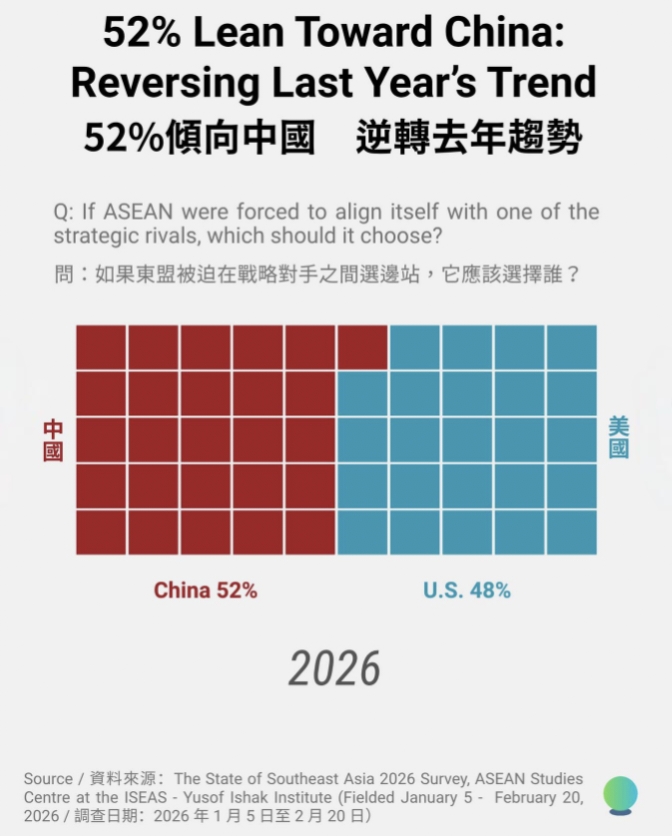
Instability in the Middle East is having a profound impact in the Western Pacific region. The latest State of Southeast Asia: 2026 Survey Report, released by the ISEAS-Yusof Ishak Institute in Singapore, now sends a potentially unsettling signal to Washington: When forced to choose between China and the United States, a growing share of respondents now lean toward China—52 percent—once again surpassing those favoring the United States. This shift is not the result of a diplomatic push by Beijing but of the inevitable outcome of years of gradual drift in Washington’s policy toward Southeast Asia.
As one of the regions that are most dependent on Middle Eastern oil and liquefied natural gas, Southeast Asia quickly faced disruptions to energy supplies and a sharp rise in import inflation following the heightening of tensions in the Strait of Hormuz. Some countries even experienced energy crises, prompting responses such as fiscal subsidies, reduced working hours and, in some cases, declarations of states of emergency. The Middle East conflicts are not of Southeast Asia’s making, yet the region has to bear their severe spillover costs. America’s policy choices, driven by its own strategic priorities, are exerting a substantial negative effect on the economic development and social stability of Southeast Asian nations.
As Washington continues to shift its strategic focus, military deployments and resource commitments toward the Middle East, a strong sense of strategic neglect has taken hold across Southeast Asia. Even more concerning for countries in the region is the increasingly transactional and punitive nature of U.S. foreign policy. Although Washington has reached largely superficial agreements with some Southeast Asian nations through so-called “reciprocal” trade deals, the Trump administration’s Liberation Day tariffs imposed last year and the launch of an aggressive Section 301 investigation shortly after a U.S. Supreme Court ruling that the tariffs were illegal, have yielded a notable result: The United States is no longer seen as a leader that upholds regional collective interests and fulfills the responsibilities of a major power, but is rather a self-interested actor ready to wield trade measures against allies and partners in pursuit of its domestic agenda.
Distrust of the United States across Southeast Asia doesn’t stem solely from the recent war in Iran; it is the result of a long-term process. The U.S. reputation and credibility in the region have steadily declined, according to the latest State of Southeast Asia Survey released by the institute. It found that more than half of respondents identify “U.S. global leadership” as their top geopolitical concern, surpassing even the South China Sea issue.
This shift carries important symbolic weight, as it reflects deep-seated doubts about the predictability of U.S. policy and the durability of its commitments. Further, in a binary choice between China and the United States, the 52 percent of respondents currently favoring China, with 48 percent favoring the United States, indicates that the U.S. has lost its previous narrow advantage. Meanwhile, perceptions of U.S. economic influence in the region have dropped markedly, with only about 15 percent of the respondents regarding the U.S. as the most influential economic power. In short, perceptions of the United States across the region have shifted from “important and reliable” to “important but unstable,” and are increasingly evolving toward a view that sees America as a source of risk.
Evidently, the current U.S. policy toward Southeast Asia is producing a range of negative consequences: It exacerbates regional economic pressures through military actions and geopolitical conflicts, erodes cooperative trust through policy uncertainty and deepens regional divisions amid major-power competition. This approach, which prioritizes unilateral strategic interests, is steadily eroding Washington’s long-term influence in Southeast Asia.
Against mounting external pressures, countries in Southeast Asia have widely recognized the importance of enhancing their strategic autonomy. On one hand, they prioritize strengthening the centrality of ASEAN and seek to leverage regional mechanisms to manage major-power competition and external shocks. The 2026 survey found that ASEAN is still regarded as the most effective platform for safeguarding regional resilience and collective capacity for action.
On the other hand, ASEAN’s internal coordination is beset with severe challenges. More than one-third of the respondents believe the organization is slow, inefficient and unable to respond to rapidly changing circumstances. In some crises, Southeast Asian countries have increasingly chosen to act alone, and regional cooperation has shown signs of fragmentation. This tension reflects a structural dilemma: While aspiring to strengthen bargaining power through collective action, the region struggles to forge unified positions on critical issues. Amid intensifying major-power competition and global risks, this fragmentation is likely to intensify, weakening ASEAN’s ability to address key challenges. Despite efforts to pursue strategic autonomy and regional integration, countries remain constrained by reality, unable to coalesce through effective collective leverage and ultimately have been compelled to respond individually to complex circumstances.
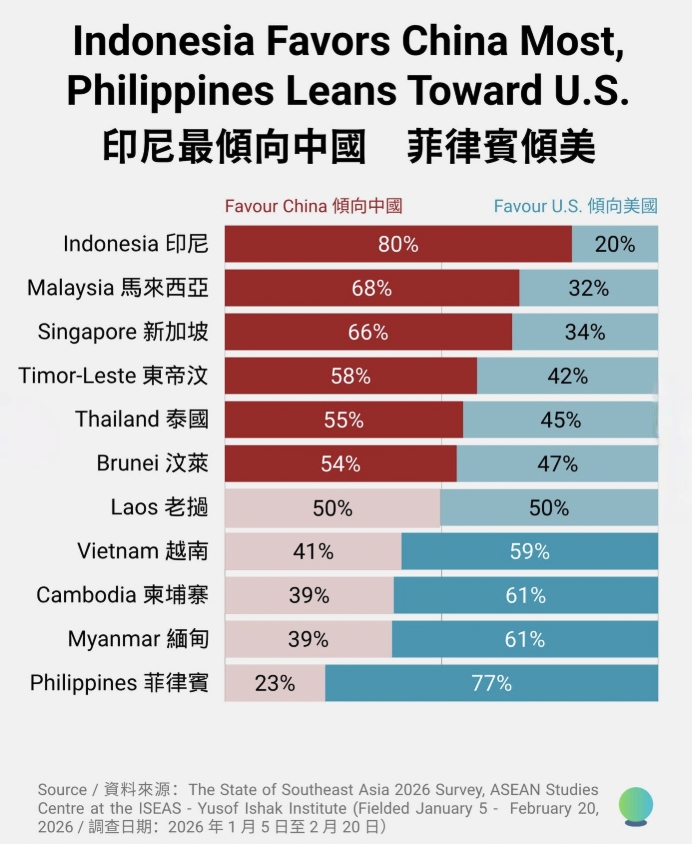
It should be noted, however, that regional distrust of the United States does not automatically translate into full trust of China. In fact, the survey reveals persistent concerns about China’s influence, particularly with regard to the South China Sea and its growing regional clout. Nevertheless, compared with the erratic shifts in U.S. policy, China has demonstrated greater stability and predictability in regional economic and development cooperation, thus gradually earning recognition as a “more reliable partner.” Survey data indicate that China has been ranked as the most influential economic power in Southeast Asia for years and also tops the list in strategic relevance.
Amid a highly uncertain international environment, Southeast Asian nations are recalibrating their perceptions of major powers and increasingly favoring partners with stable policies and predictable behavior. Against this backdrop, China-ASEAN relations have maintained steady growth. China’s vision of multilateral cooperation, openness, development and common security aligns closely with these countries’ pursuit of stability and development.
Contrasting with the U.S. approach, which emphasizes competition and confrontation, China highlights development through cooperation and certainty through stability, an approach that has significantly boosted its appeal. Despite lingering challenges, deeper economic and trade ties and improved cooperative mechanisms will continue to highlight China’s stabilizing role in the region. It has thus come to be seen as a stabilizing anchor for regional order.
Going forward, Southeast Asian countries’ perceptions and choices regarding major powers will be guided by three core criteria: stability, predictability and development gains. If the United States fails to adjust its competitive, confrontational and self-serving foreign policy, its influence in the region is likely to face further decline.
