
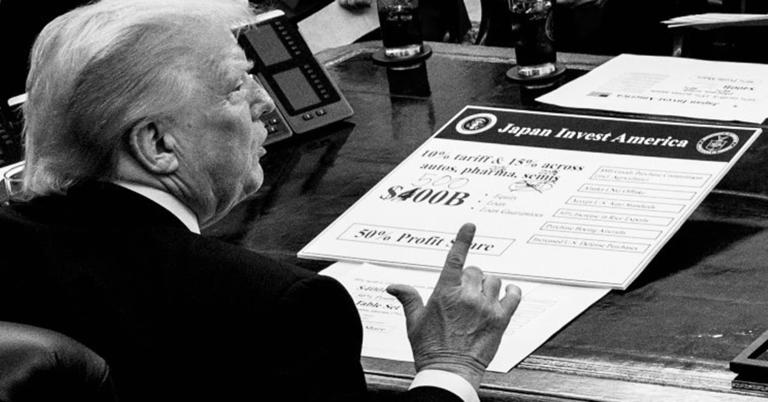
President Donald Trump discussing a U.S.-Japan trade agreement with a Japanese delegation and top White House aides in the Oval Office, July 22, 2025.
By January 2026, the first year of the second four-year—and constitutionally final—term of U.S. President Donald Trump was complete. This initial quarter of his tenure has jolted the world, unnerving the global community on economic, trade, and security matters while weakening the post-war international order. The resulting shocks reverberate across the international system, amplified by the scale of U.S. power and global entanglement. This disruption is unfolding in real time.
This disruption lies in Trump’s personal leadership style and worldview, combined with a U.S. political system that empowers a president with substantial authority over foreign policy and security matters. Although the system incorporates checks and balances, when a norm-breaking president is elected and wields his discretion against established rules and institutions, the resulting instability resonates globally.
Trump is not the first presidential norm-breaker. Several predecessors asserted expansive power, primarily in the security realm: Harry Truman during the Korean War; Lyndon Johnson and Richard Nixon throughout the Vietnam War; and George W. Bush in launching the ‘War on Terror’ and invading Afghanistan and Iraq. Trump’s distinction lies in his targets: he directs his challenge not only against adversaries but also against long-standing allies.
Trump and the disruption of global international norms
After taking oath in January 2025, Trump’s policies have sharply challenged and disregarded international norms across several critical domains: security and alliance structures, global trade and economic governance, multilateral institutions and diplomacy, climate and environmental agreements, and the established legal frameworks governing the use of force and economic coercion.
Trump’s disdain for multilateralism and international institutes is evident from the fact that by January 2026, his administration has announced withdrawal from 66 international organizations, including 31 UN‑related bodies and 35 non‑UN organizations and arrangements, terming them contrary to U.S. interests. Two factors explain this disruption: Trump's personal authoritarianism and a U.S. political system that empowers the president with substantial foreign-policy decision-making authority.
The most pervasive of these measures, with global-scale effects, is the levying of tariffs on friends and foes alike, starting from April 2025. These tariffs in particular hit mid‑ and low‑income countries harder, affecting a large portion of the world’s population. In many cases, these tariffs were in violation of established international trade rules under the WTO framework, including core obligations on bound tariff rates and non‑discrimination.
Trump has primarily weakened U.S.-led security alliances through his transactional approach questioning U.S. commitments to allies in Europe and the Indo‑Pacific. This has especially affected NATO and key Asian alliances with Japan, South Korea.
He consistently downplayed climate change and prioritized fossil fuel expansion, withdrawing the U.S. from the Paris Agreement and dismantling many domestic climate regulations and clean‑energy programs. His administrations have questioned or rejected mainstream climate science, rolled back CO₂ emissions standards for power plants and vehicles, and treated higher greenhouse gas emissions as an acceptable cost of “unleashing American energy”.
In some ways, Trump even compete with his predecessor norm breakers. Earlier U.S. administrations mainly invaded and occupied ‘others’; they refrained from openly threatening territorial grabs against Western allies. Trump repeatedly stated taking control of Greenland, which is under Danish sovereignty, and asked Canada should become the 51st U.S. state. Moreover, except for President George H. W. Bush, who in 1989, ordered to depose General Manuel Noriega of Panama, and brought him to Miami to trial for drug charges, most other administrations pursued regime change through local proxies or invasions, as in Iraq and Libya. Trump set an audacious precedent by ordering a military operation that removed Venezuela's sitting president, Nicolás Maduro, at the beginning of 2026 and transferred him to the U.S. to face criminal charges. This audacity is mainly due to Trump’s personal leadership style and the U.S. political system which empowers huge authorities to the executive.
The Personal as Political: A Deal-Maker's Worldview
There is a consensus that Donald Trump’s deep-seated behavioral traits, impulsive nature, business background, personal worldview, and leadership style have greatly shaped his norm-breaking policies. His business background further informs a behavioral pattern in which he employs threats and ultimatums as tools of negotiation. He approaches international relations not as a statesman but as a dealmaker—a title he proudly claims and whose roots trace back to the 1980s and his co-authored book, The Art of the Deal. In it, he argued that one should negotiate from a position of maximum strength, exerting extreme pressure on the other side to secure desired outcomes. He has applied these principles to international relations by prioritizing transactional policies over building trust and pursuing long-term goals.
Furthermore, he is a power-oriented, authoritarian, and egocentric person who abhors constraints on the use of his authority. As international law, treaties, and norms impose such restrictions, he considers them to be shackles and moves to withdraw from them.
The Enabling Architecture: Presidential Power Unleashed
Trump’s personal traits were emboldened and facilitated by the U.S. political system, which vests significant authority in the president. While this system is designed with checks and balances, they function most effectively under norm-abiding presidencies. In Trump's case, the primary operation of these checks and balances was on his domestic agenda. For instance, federal courts blocked his attempts to end birthright citizenship, halted policies affecting transgender prisoners, and struck down efforts to freeze federal grants. Even some of his signature "reciprocal" tariffs faced constitutional challenges in federal courts. Ultimately, however, the system's most consequential restraints pertained to domestic policy, with limited substantive outcomes. In the realms of foreign policy and national security, presidential discretion remained vast, rendering him largely unchecked. This unfettered capacity has projected instability onto the global stage, challenging the predictability and normative foundations of the international order which the U.S. and its allies created to serve their interests and advocate to the world.
The 22nd Amendment to the U.S. Constitution, ratified in 1951, limits a president to two elected terms. This provision ensures Trump’s tenure will conclude in 2028. Yet, if the past twelve months are any indication, the coming three years are likely to entrench global instability, perpetuate uncertainty, and accelerate the erosion of international norms and institutions. Only one-quarter of the ordeal is over; three-quarters remain.
