
A potential candidate for president in 2028, Rubio appeared to be using the speech to show American conservatives that Trumpism can transcend Trump’s personal style—that it can be inherited and carried forward by establishment elites.
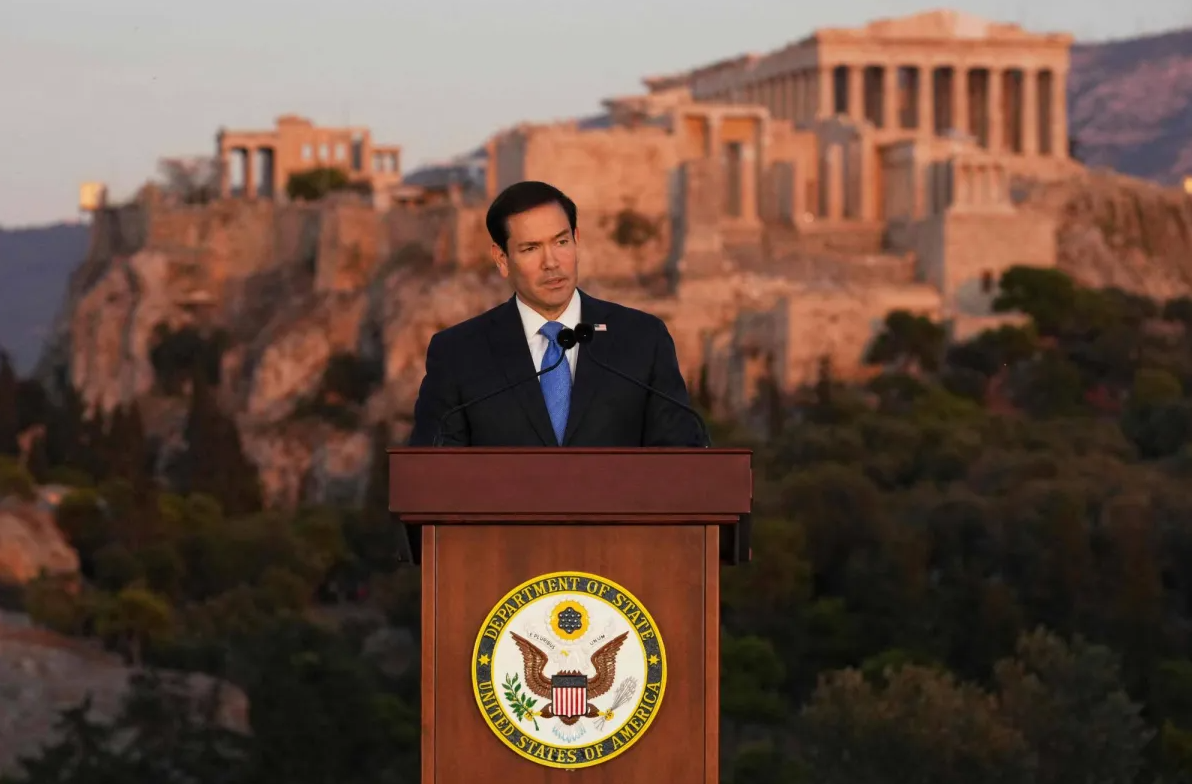
On Oct. 7, U.S. Secretary of State Marco Rubio delivered a speech in a city steeped in historical symbolism and regarded as the origin of Western civilization—Athens, Greece. He laid out the Trump administration’s strategic thinking in a systematic way. The speech gave Trumpism some rhetorical polish and a measure of theoretical refinement. It signaled that the MAGA movement, originally characterized by populist slogans and intuitive policymaking, seeks to move toward a more fully articulated and systematized ideological form, with “America first” elevated into a political platform imbued with historical narrative and civilizational significance.
Trumpism emerged during the 2016 presidential election, with “Make America Great Again” as its central slogan. It was a backlash against the liberal ideals and globalist foreign policy that had shaped the United States in the post-Cold War era. At the end of that, America’s mainstream elites adhered for decades to liberal internationalism, advocating the use of multilateral institutions and alliance networks to advance globalization and spread Western-style democracy. They believed that the United States could sustain its hegemony by continuing to shoulder global responsibilities.
But decades of this approach brought industrial offshoring, a widening of domestic inequality and endless overseas wars, fueling deep discontent within American society. Trump capitalized on these social divisions and rose to power on an anti-establishment, anti-globalization and nationalist platform. He championed the notion of America first, arguing that the United States should no longer bear global responsibilities unconditionally and that its foreign relations should instead take a transactional approach and the emphasize the primacy of power.
During Trump’s presidency, Trumpism was expressed primarily through fragmented policies. It lacked a coherent theoretical framework and a unified narrative of values. It was often marked by shifts in direction and internal contradictions and was widely seen more as an electoral strategy or political opportunism than as a stable governing ideology.
The significance of Rubio’s speech in Athens lay in its attempt to fill this gap, provide a logical justification for Trump’s policies and give Trumpism a more fully defined ideological form.
Rubio carefully chose the Pnyx as the venue for his speech. This is the site of the ancient Athenian Assembly, which is regarded as the birthplace of Western democracy. Tracing the legacy of ancient Greek civilization, Rubio emphasized that modern America inherited from Athens a spirit of individuality, daring exploration and republican virtues.
But he also also argued that Western civilization stood at a historic crossroads, facing grave risks of “atrophy, servitude and decline.” He attributed this crisis to the self-negation brought about by globalism: Western countries, he said, were tearing down historical monuments, denouncing their own traditions and instilling a sense of civilizational guilt through education. Nationalism was being stigmatized, industries outsourced on a massive scale, border controls allowed to fail and national strength steadily depleted. In this narrative, globalism was not a triumph for the West but the source of Western civilization’s own disintegration.
Rubio’s line of argument elevated Trumpism from a form of economic nationalism to a civilizational narrative of defense and contestation. Traditional Republican neoconservatism seeks to export democracy and reshape the world through universal values. Rubio’s version of Trumpism, by contrast, shifts the focus to civilizational self-defense and consolidation. In this view, the West must first safeguard the foundations of its own civilization, put an end to openness without limits, abandon relentless self-criticism and reorganize alliances around a shared civilizational narrative.
Unlike Trump, who has repeatedly berated and threatened America’s European allies, Rubio’s proposal in Athens was to reinvigorate the transatlantic civilizational community. He called on Europe to “awaken from its long slumber,” increase defense spending and join the United States in countering external challenges. This suggests a new phase for Trumpism: Rather than undermining alliances, Rubio was attempting to reshape the existing alliance system around a shared civilizational identity, so that allies share the costs according to rules set by the United States and serve its broader foreign policy objectives.
Rubio views world politics as a power struggle of civilizations, implicitly drawing on the logic of the “clash of civilizations” thesis. In his historical account, he cast ancient Persia as an occupying power from outside, embedding contemporary geopolitical competition in a narrative of age-old civilizational confrontation. This narrative reduces great-power competition to a clash of civilizations and downplays such globalist elements as economic interdependence and multilateral governance. It aligns with Trumpism’s zero-sum view of the world.
At the policy level, Rubio reiterated Trump’s long-standing positions: Diplomacy should be results-oriented and reject the “empty talk” and proceduralism of multilateral institutions; alliances should rest on a balance of strength and shared responsibility, with only strong allies deserving American protection; and the primary goal of U.S. foreign policy should no longer be to promote democracy but to safeguard American sovereignty, security and core interests.
From the perspective of U.S. domestic politics, the speech also carried a strong personal political dimension. As a potential 2028 presidential candidate, Rubio appeared to be using the speech to demonstrate to American conservatives that Trumpism can transcend Trump’s personal style and be inherited and carried forward by establishment elites. It would no longer belong to Trump alone but would evolve into an enduring ideological current within the Republican Party, continuing to shape U.S. policy even after Trump leaves the political stage.
In this sense, the consolidation of Trumpism signals a structural shift in the strategic orientation of U.S. foreign policy. It would continue to challenge the global governance system, transatlantic relations and the broader configuration of great-power relations, making it a major variable in international politics that could not be ignored in the years ahead.
