
China and Canada are cautiously rebuilding relations based on shared economic and strategic interests, though deep-seated mistrust, domestic political constraints, and geopolitical pressure from the United States will continue to limit a broader rapprochement.
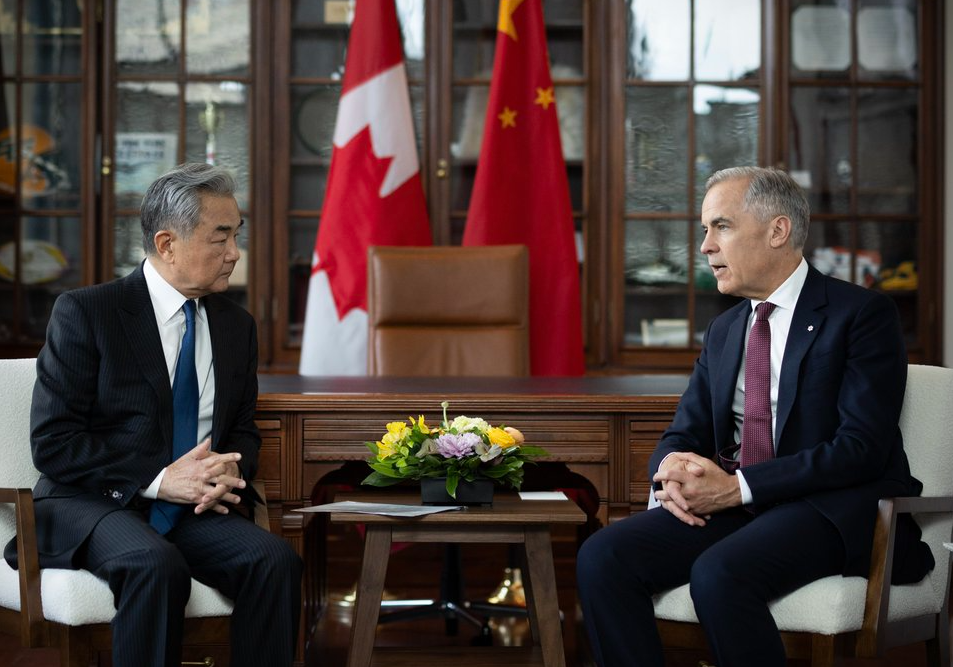
Canadian Prime Minister Mark Carney meets with China’s Minister of Foreign Affairs Wang Yi at his office in Ottawa, Canada, May 29, 2026.
At the end of May, Chinese Foreign Minister Wang Yi paid Ottawa a visit – the first in a decade for the country's top diplomat to do so, and a remarkable sign of how Sino-Canadian relations have purportedly recovered from the nadir reached in the interim. The past ten years have been by no means easy on those navigating between the two states, with the tumultuous "Three Ms" (Meng Wanzhou and the two Michaels) episode in 2018 - 2021, allegations and suspicions over purported technology theft and espionage, the COVID-19 pandemic, and surging domestic resentment towards China in Canada all contributing towards a significant deterioration in relations.
During his meeting with the Canadian Prime Minister Mark Carney, Wang explicitly credited Carney's visit to China last year as pivotal in setting the relationship "back on course and onto the right track". Such remarks should be interpreted as the diplomat's tactical attempt to affirm Carney's nascent foreign policy doctrine whilst driving a rhetorical wedge between his and his predecessor's China policies.
At the bilateral meeting, Carney reiterated his backing for the "new Strategic Partnership" – paying important (albeit rhetorical) service to the kind of discourse for which Beijing has developed a penchant. The particular nomenclature here is no mistake – it harks back to Carney's Davos pledge to adopt a "value-based realist" approach to engaging with governments with political and economic constellations that are dramatically divergent from Canada's. Of course, his intentional pursuit of a reset - at least on the leader-to-leader and sentimental level – has not come without controversy, with domestic critics lambasting him for purported capitulation and a failure to extract dividends for the vast majority of Canadian citizens.
For its part, Beijing has clearly learnt over the years that engagement with the Global North requires an appreciation of domestic perceptions, as well as the acknowledgment of the constraints and complex considerations afflicting politicians in robust democracies - especially one that takes as much pride in its own relative stability and openness as Canada. To demand from the freshly elected Prime Minister a drastic one-eighty reorientation in policy and rhetoric would not only be unrealistic, but downright detrimental to the fragile goodwill that has been built up over recent years.
An Old Friendship Gone Awry?
Some context is imperative. The strategically ambiguous and rhetorically dexterous stance espoused by Carney's Ottawa is by no means new. A few years ahead of its Southern neighbour and counterpart's historic breakthrough via President Richard Nixon's visit to Beijing, the Canadian leadership, under Prime Minister Lester Pearson, resolved to establish emphatic backchannels with the People's Republic of China, on grounds that isolating the country would be counterproductive towards "world peace and the integrity of the post-war collective security system embodied in the UN". With his successor Pierre Trudeau at its helm, Canada was subsequently amongst the first Western nations to formally recognise Beijing's status in 1970, marking a then-break and subsequent first amongst many of its developed economy peers. Till this day, not an insignificant component of the Canadian strategic community remains convinced that in the absence of fundamental territorial and strategic interest divergence, Ottawa should take a more pragmatic approach towards the economic powerhouse with whom it shares access to the Pacific Ocean.
Yet since the early 2010s, the various flashpoints delineated above indubitably clouded such dynamics. A growing chorus of national security and defense-oriented voices in Canada has pointed to ostensible signs of Chinese meddling with domestic politics, which - coupled with a more trenchant and defiant posture adopted by many of the country's diplomats between 2018 and 2023 – fuelled the impression that Beijing was bent on projecting its power across the Pacific. Select Chinese authorities had also developed a "systemic heuristic" typecasting Ottawa as a pliant follower of Washington on its pivot to Asia during Barack Obama's tenure and trade war under Donald J Trump. Such developments were in turn compounded by a global shift towards securitisation of supply chains, with Beijing's instrumentalisation of rare earths and the renewable supply chain at large triggering newfound concerns amongst Canadian diplomats of being squeezed by a country on which their economy was fundamentally dependent.
The veracity of such fears aside, the seeds of mistrust had been sown. Towards the end of Justin Trudeau's increasingly invidious tenure, the relationship was trending towards a free fall - even despite the valiant efforts of individuals such as Ambassador Dominic Barton, who secured a resolution to the 3Ms through his extensive experience and intricate understanding of doing business in and with China.
Another Leader, Another Destiny?
So what explains the recent drive for rekindling bilateral trust? An oft-cited explanation is the erratic, self-serving, and pugnacious posture adopted towards Canada by U.S. President Donald Trump. From threats of tariffs to taunts of Canadian sovereignty, Trump has made disliking himself (and by extension, the American state) extremely straightforward for many in Canada. Indeed, Carney's triumph over his opponent in the recent general election has perhaps been in part the result of the perceived (albeit by no means verified) links between his rival and Trump.
Yet I hold a view that differs partially from this mainstream interpretation. As an Oxford-trained technocrat, Carney is well aware that Canada's future growth must come from strengthening its global goods market access, broadening the appeal of its service exports (such as higher education), and accruing greater bargaining capital vis-a-vis the U.S., European Union, other long-standing partners, but also emerging powerhouses such as India and ASEAN. China, as a high-potential (albeit reticent) market for Canadian goods, and as a vital component of global manufacturing supply chains, cannot be omitted from the picture. Bolstered by the political mandate he had been given through his definitive victory in the election, Carney perceives himself to be in a position to prioritise economically centered "hard decisions" over avoiding the predictable ire from the most ferociously ideological sceptics and security hawks towards China. His gamble, of course, rests on Beijing's actual reciprocation - beyond the offering of mere words and promises.
Symmetrically, Beijing is keen to set a floor to the bilateral relationship. With intensifying American tariffs, the prospects of a U.S.-led containment strategy directed towards China under President Joe Biden, and the gradual awakening to the fact that China cannot decouple from the Global North just yet, the leadership has assumed a more restrained diplomatic demeanor (even whilst accruing greater confidence and self-assurance in practice) vis-a-vis most of the G7 economies. Even whilst Sino-Japanese relations remain fraught in the wake of Sanae Takaichi's comments and Beijing's vociferous protests, there has been a period of relative stability over the past year. Paradoxically, even whilst Beijing has benefited in soft power terms from the diabolical disruptions induced by Trump, the Sino-Canadian relationship has indubitably benefited from the breathing room fostered by the leader-to-leader de-escalation and dialogue between Presidents Xi and Trump. A more China-friendly U.S. administration may not become thereby more appealing to its neighbours, but has certainly created more room for maneuvering by third-party states, including but not limited to middle powers such as Canada.
The Structural Roadblocks Ahead
The voyage ahead will by no means be smooth-sailing. There are clear and grounded concerns about the imbalance of trade between China and Canada, and Canadian companies would likely be seeking more enduring and comprehensive copyright and business interest protections when operating in China. Diplomats and technocrats in Ottawa must also face and stare down the populist voices advocating a more systemic delinking between the two economies, on the grounds of security risks or ideological dissonance between the two.
China, on the other hand, must genuinely come to terms with the fact that in a multi-aligned world order, countries would be increasingly choosing to engage and work with both itself and others, including its foremost geostrategic rival. To the extent Beijing is adamant and intently bent on ensuring independence from foreign suppliers of technology, it should also cultivate and exercise strategic empathy in understanding Canada's worries about being over-reliant upon China for critical raw materials and other vital ingredients for the modern economy. In the wake of growing pressure from Washington – especially at the upper-middle levels of the Assistant, Principal Deputy, and Deputy Secretaries of State and in more technocratically minded departments such as Commerce and State – Ottawa must learn to contend with a new normal where both parties, especially its Southern neighbour, will ask it to choose sides.
For how long can Canada continually play both sides of the aisle, short of securing its own autonomy vis-a-vis and through ample critical stockpiling, remains a thorny question that only its leadership knows best, and can accordingly answer best.
