

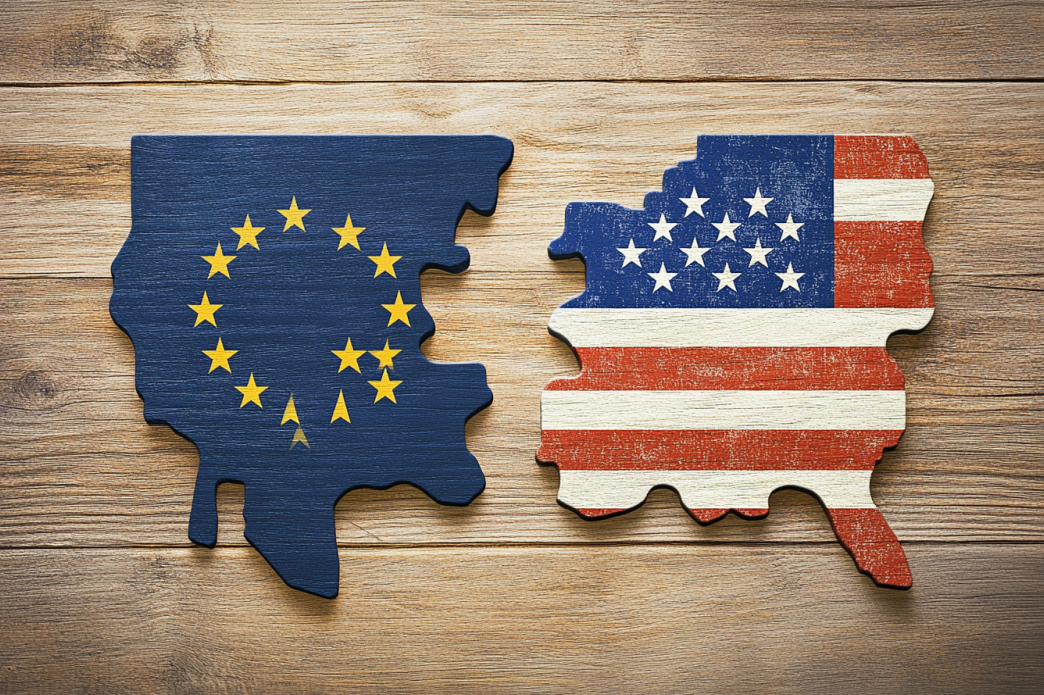
The Trump administration’s 2025 National Security Strategy reframes the U.S.-Europe relationship from a partnership based on law and institutions into one judged through identity, heritage, and demographic loyalty. This “Trump Corollary” marks a decisive break from the post-1949 transatlantic order and deepens the risk of a lasting rift between Europe and the United States.
Michel Houellebecq’s Submission was never about Islam. It captured Europe’s fear of its own reflection, a continent unsure of the ground beneath its political order and uneasy about whether the next election will still speak in a familiar voice.
A decade later, Trump turns that literary provocation into his new ideological creed. The 2025 National Security Strategy elevates that anxiety from fiction into policy, casting the same fear of internal drift onto the continent. Washington now treats Europe not as partner but as territory to be examined, shaped, and disciplined through American identity politics.
The geopolitical shift rests on a wider vision of a Western Hemisphere placed under U.S. control, presented as the natural domain of American authority, with Europe reduced to an auxiliary instrument that sustains U.S. power. Although not spelled out, this framework pushes the Indo-Pacific down the hierarchy of commitments, creating the groundwork for a “de-pivot to Asia.” What looks like a simple reordering becomes a redefinition that signals the end of the transatlantic partnership as understood since 1949.
The NSS abandons law and institutions as the anchor of the Alliance and replaces them with lineage. Trump is accurate to highlight the EU’s lack of unified military capacity, the absence of credible leadership among its heads of government—precisely emphasized by their obedient acceptance of the 5 percent NATO demand and the ignominious Turnberry pact—, and their feeble sense of direction. Yet the document’s focus on ethnicity and religion is jarring, because it shifts the critique from governance and capability to identity, recasting the alliance on grounds that unsettle the very basis of post-war cooperation.
The document’s vocabulary is not the language of cooperation but of biological guardianship, ancestry, and a tight, exclusionary civilisational frame. It portrays demographic change as political decay, treats diversity as dilution, and introduces loyalty tests rooted in the composition of electorates, all lifted from white supremacist discourse in the United States. The European voter becomes an object of Washington’s scrutiny, not for policy divergence but for race.
Page 27 contains the core accusation: “certain NATO members will become majority non-European,” followed by speculation about “whether they will view their place in the world, or their alliance with the U.S., in the same way as those who signed the NATO charter.”
The implication is direct: a diverse Europe will be a disloyal Europe. The NSS questions whether states with changing populations can remain reliable partners, anticipating they will not. Europe faces actual pressures from unmanaged migration flows that strain welfare systems, unsettle local politics, and fuel polarization, yet these are not the issues the document elevates.
It claims instead that demographic evolution itself endangers alliance cohesion more than Europe’s actual security vulnerabilities. Constitutional legitimacy is redrafted as dependent on racial continuity, and migration is turned into an existential threat rather than a governance challenge—or opportunity.
Consider the hypothetical that fuels this fear. Germany, France, the U.K., Spain, the Netherlands, Belgium… already elect Muslim representatives, an outcome that follows directly from constitutional legitimacy and the authority of the ballot box. The NSS illustrates this as civilisational collapse by asking whether states with evolving populations can remain loyal NATO members. The message questions who is allowed to embody European authority.
This logic dissolves on contact with consistency. Türkiye, a NATO member since 1952, is not a Christian country, yet its membership has never been examined on that basis. Would Washington propose expulsion for the same reason? The NSS offers no answer, because its assumptions cannot withstand scrutiny. Imagine if European capitals applied the same test to the U.S., treating MAGA as a threat to democratic order warranting external intervention.
The document demands that Europe must “remain European” and recover its “civilisational self-confidence,” portraying the continent as a locus of loss—identity, sovereignty, purpose, birthrates. These assertions betray an American nostalgia for a Europe that may never have existed. Yet the U.S. faces comparable demographic change. What is the American birthrate? Does the White House see its own population shifts as a threat to its Americanness?
Framed this way, the NSS is less a reading of Europe than a projection of American unease. A nation still wrestling with its own democratic fractures—unresolved questions over inclusion, equality, rule of law, and separation of powers, haunted by segregation, racism, police violence, and systemic exclusion—now appoints itself prefect of European identity.
The fixation echoes arguments once dismissed as alarmist. The claim held that democracies erode from within, veering toward authoritarian forms. The NSS enacts a distilled version of that logic: power justified through civilisational rhetoric, distrust of plural electorates, and the primacy of heritage over constitutional norms.
This ideological turn is amplified by Washington’s portrayal of European integration. The EU’s system of transnational governance is depicted as a threat to liberty, dismissing seven decades in which integration stabilized the continent, boosted growth, and more importantly, curbed conflict. What unsettles Washington is not governance itself but European autonomy: a cohesive Europe challenges Trump’s hemispheric vision, hence European identity is recast in American terms.
Although both the U.S. and Europe are societies reshaped by migration and evolving identities, the NSS treats these changes in Europe not as natural evolution but as a test of future loyalty. Identity becomes the metric of alliance commitment. Urban diversity, plural electorates, free elections, and political renewal are declared liabilities. Where postwar partnership relied on law, sovereignty, and agreement, Trump replaces these foundations with heritage, ethnicity, and blood purity.
Indeed, we coined the term “Trump Corollary” in early January 2025 in this same outlet, days before his second term began. Contrary to the dominant narrative of an America turning inward, it anticipated that Trump would revive an interventionist playbook with global reach, pursuing resource competition, confronting rivals, and molding American leadership as dominance. We predicted that he would not confine himself to the Americas but would elevate geopolitics into a doctrine of supremacy.
Recently, the 47th U.S. President adopted the term himself. On December 2, 2025, he issued the “America 250” proclamation: “My Administration proudly reaffirms this promise under a new ‘Trump Corollary’ to the Monroe Doctrine: That the American people—not foreign nations nor globalist institutions—will always control their own destiny in our hemisphere.” The NSS now extends this doctrine to Europe, turning a hemispheric claim into a tool of transatlantic oversight— “Enlist and Expand”—while projecting U.S. insecurities onto the continent.
A decade earlier, Europe confronted its own projection. The publication of Submission on January 7, 2015 coincided with the Charlie Hebdo massacre that morning. A novel imagining France electing a Muslim president became entangled with an act of terror committed in the name of a distorted vision of Islam. What began as literary provocation became a mirror of Europe’s anxiety, seized by those insisting the continent was unraveling.
That anxiety now resurfaces as American policy. The NSS states demographic evolution as a geopolitical threat, enshrining the same fixation that turned Houellebecq’s fiction into a battleground: Europe becomes unrecognizable the moment its electorate no longer reflects the mythic Christian European of earlier centuries.
If the Charlie Hebdo attack exposed Europe’s vulnerability to ideological violence, the NSS turns that apprehension into a doctrine of preservation. Rather than safeguarding Europe through law and shared interest, Washington claims authority over a civilisational essence that never was. Europe responded by defending its freedoms; America’s response, a decade later, is to lecture Europe on defending itself from its own population.
Will this NSS, with its overtly biased and interventionist agenda, push European governments further from the U.S.? The complacency of EU leaders in 2025 has been dishonorable, echoing moments in history when hesitation invited catastrophe. Every sign points to a widening rift. Yet the deeper threat lies in the power that now claims the authority to define what Europe must be—and against that, Europe must finally assert itself, as it has in its most decisive hours.
