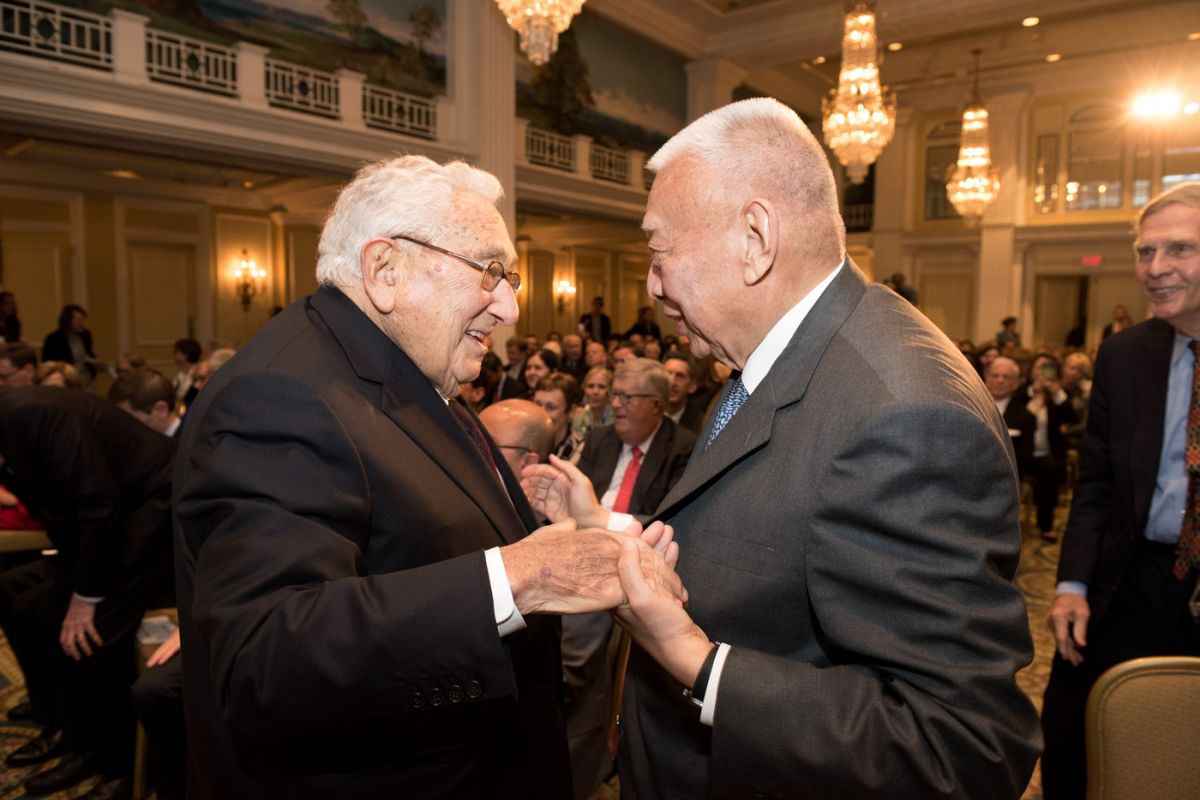
On October 6, 2016, Mr. Tung Chee Hwa shakes hands with Dr. Kissinger at the founding ceremony of Henry A. Kissinger Center for Global Affairs. (Photo: CUSEF)
My first in-depth interaction with Tung Chee Hwa came at a time of crisis. In April 2001, an American EP-3 spy plane had just collided with a Chinese military jet and was forced to make an emergency landing in Hainan Island. At the time, I was running a Morgan Stanley investment tour of China for about fifteen of the world’s most prominent and deep-pocketed investors, most of whom had never been to China before.
Our carefully orchestrated field trip was quickly in shambles. Many of our meetings on the Mainland were downgraded or canceled as a demonstration of protest by the Chinese government over the spy plane incident. Fortunately, that was not the case at our final stop in Hong Kong, where we were warmly greeted by Chief Executive Tung.
He quickly focused on three aspects of this crisis: He apologized for any inconveniences that had disrupted our carefully planned schedule. He also underscored his deep admiration for the United States, not just for its values as the bastion of Western democracy but also the birthplace of his three children. Lastly, he noted that while this incident will surely blow over, it should also be taken as a warning of more trouble to come if Washington and Beijing were not more attentive to the complexities of their vitally important relationship.
It was an uplifting end to our trip and as I shepherded the investors out of the room, Tung Chee Hwa asked me to stay behind. He encouraged me, and by inference our influential group, to play a more active role in resolving this crisis. I was a bit aghast over this suggestion but asked him if he had any advice on a course of action. His quick response was a name — Paul Wolfowitz, newly installed U.S. Deputy Secretary of Defense and one of America’s leading hardline neocons. Mr. Tung knew this was more of a military than a diplomatic issue and suggested we should get in touch with Wolfowitz to press our case. He urged me to fill him in on the outcome. He also insisted that henceforth I call him “CH.”
I drafted a letter to Wolfowitz on the plane trip back to the U.S., and much to my surprise he quickly accepted our meeting request. In the end, there was a last-minute conflict that forced him to send a substitute. That turned out to be a most fortuitous adjustment. We ended up meeting with the legendary Andy Marshall, Director of the Pentagon’s Office of Net Assessment who ran a civilian strategic think tank for the U.S. military. When I chatted with CH a few days later and told him of this meeting, without revealing the substance of the discussion, he was very encouraged. My notes say he said, “You were able to get this issue in front of the Pentagon’s most important strategic thinker, exactly what was needed in this case.”
This meeting was pivotal for me. It opened the door for a long-standing relationship with Andy Marshall that over the years was of immense help to me in grappling with geopolitical tensions, especially insofar as China was concerned. But it was also a demonstration of CH Tung’s uncanny knack for grasping the critical strategic implications of the U.S.-China relationship. For the next twenty years, cut short by his failing health after 2020, CH and I had frequent meetings and late-night telephone conversations, grappling with the very strategic issues he warned of during our initial encounter in 2001.
In his heart, CH was a strong believer in the overarching concept of “grand strategy” as a unifying framework to think about relationships between major powers, especially the Sino-American relationship. To some extent that was an outgrowth of his long-standing relationship with Henry Kissinger who viewed grand strategy through a balance-of-power lens. CH constantly urged me to think about U.S.-China relationship problems in that same strategic construct. He was most emphatic in stressing the critical importance of this relationship between the two superpowers. Many times, he ended our conversations by saying something like, “We have to do everything in our power to get this relationship right.”
By establishing the China-United States Exchange Foundation (CUSEF) in 2008 at the ripe young age of 71, CH put much of his energy into that very objective. Its focus was on dialogue and exchange between two powerful nations that were running into trouble in managing the relationship between them. Sino-American engagement had fallen out of favor, and through CUSEF, CH Tung was determined to do his best to correct that problem. And he certainly found a kindred spirit in me. Over the years, I have been privileged to have participated in many of CUSEF’s activities and fora.
But typical of CH, when thinking about the mission of CUSEF he asked me the same question he posed at the end of our first meeting in 2001, “What are you going to do about it?” By “it” he meant the U.S.-China relationship. By then, I was at Yale and had entered the teaching and book-writing phase of my career. My focus was — and still is — on the codependency of America and China. This forced me to deepen my research on the close ties that both nations and their economies have with each other.
CH, given his own focus on the relationship aspects of Sino-American engagement, was an enthusiastic supporter of my initial approach to codependency. But I must be perfectly honest, he was not thrilled with my subsequent prognosis of a conflicted codependency. It made for some contentious discussions between us in his later years. He urged me once again, to think of a way out. One book turned into two, and I have just completed a third book on the Sino-American relationship that lays out a detailed plan for conflict resolution. I am reasonably certain that my dear friend, CH, would be quite pleased.
To me, strategy was one of CH’s greatest strengths. But in the spirit of realpolitik, he was always pragmatic in recognizing the hard work that it takes to implement any strategy. He leaves us with a legacy of principled determination to do everything in our power to put a still troubled Sino-American relationship in a much better place.
