The May 14-15 summit meeting in Beijing between Presidents Xi Jinping and Donald Trump resulted in some badly needed stabilization in bilateral relations. Both the symbols and the substance of the visit suggest a return to some normalcy of regularized interactions and the ability of the two leaders and their teams to discuss some of the most sensitive issues between the two sides. Even if detailed agreements are not reached (and not many were) there is still considerable value in such direct exchanges.
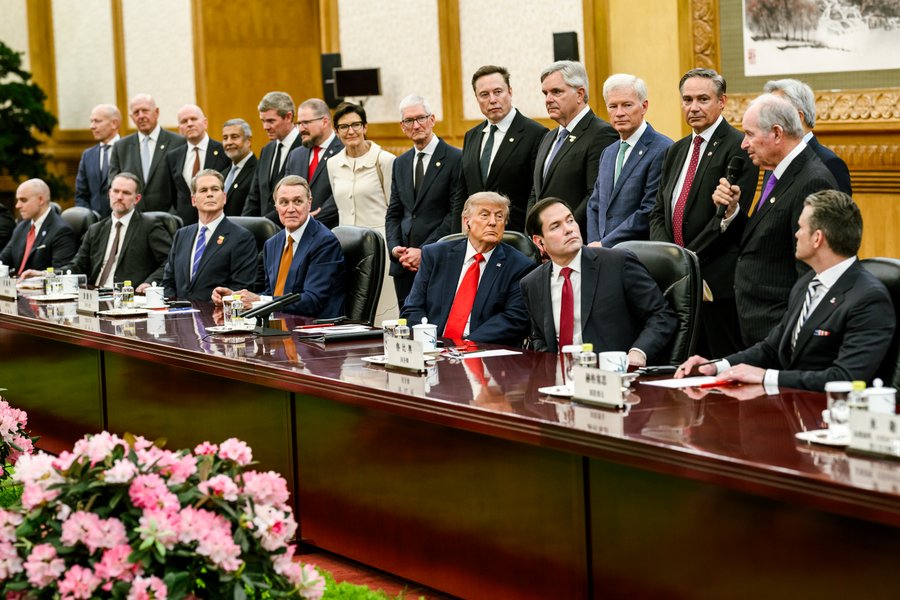
Xi-Trump Summit on May 13-15, 2026. U.S. President Donald J. Trump met with Chinese President Xi Jinping in Beijing. Leaders from many of the United States’ largest companies joined a portion of the meeting.
Summits between American and Chinese leaders are always carefully watched for the visual optics and painstakingly scrutinized by analysts for specific policy content and implications for the future. The May 14-15 state visit by President Donald Trump and summit in Beijing with Chinese Communist Party General Secretary and President Xi Jinping is no different. In this instance, three principal questions arise: what happened, what didn’t happen, and what can be anticipated for the future?
What Happened at the Summit
The photographic optics were key to the two sides’ main intended goals of the summit: to project normality and stability in the relationship. The carefully choreographed “photo-ops” were intended to capture a combination of formality and informality.
On the formal side, the images included the two leaders reviewing the PLA honor guard in front of the Great Hall of the People, discussion/negotiation sessions between the two government delegations across a long table inside the Great Hall, and a state dinner also in the cavernous 1959 building complex. On the informal side, the two presidents toured the grounds of the 15th century Temple of Heaven, and President Xi welcomed President Trump inside the Zhongnanhai leadership compound next to the Forbidden City (a rarity for foreign visitors) where they casually strolled among the trees and gardens and were also were photographed having one-on-one discussions in a reception hall.
President Trump’s entourage also figured prominently in some photographs, notably the technology titans Elon Musk (Tesla and SpaceX), Tim Cook (Apple), and Jensen Huang (Nvidia). Other notable financial industry leaders included the heads of Blackstone, Goldman Sachs, BlackRock, Citicorp, and Blackstone. On the government side, Trump brought along three cabinet secretaries: Secretary of State Marco Rubio, Secretary of Defense Pete Hegseth, and Secretary of Treasury Scott Bessent (this is the first time I can recall these three most senior cabinet officials ever accompanying an American president to China). For its part, Xi Jinping’s delegation was equally senior and included Premier Li Qiang, Vice Premier He Lifeng, Politburo member Cai Qi, State Councilor Wang Yi, Secretary of Commerce Wang Wentao, and Defense Minister Dong Jun.
We can expect each set of government interlocutors to now establish more regularized communications and meetings (including in the defense sphere)—but there will be no return to the over-institutionalized and unwieldy bilateral counterpart dialogues (which ballooned to 98 during the Obama years before the first Trump administration reduced them to a handful of fewer than five, a practice followed during the Biden administration). The two sides did agree to establish two new bureaucratic mechanisms: a Board of Trade (to negotiate tariffs and other trade-related goals on specific “non-sensitive goods”) and a Board of Investment (a forum to discuss each sides’ investment concerns and opportunities in the other country, also in areas not related to national security).
Optics sometimes convey substance in diplomacy (sometimes not). In this instance, they illustrated the most important outcome of the summit: the stabilization of relations following a very volatile first year of the second Trump administration, after eight years of escalating strains during Trump 1.0, and fluctuant but stressed ties during the Biden administration. Both leaders sought to portray a new tenor in the relationship, although obviously there remain many underlying difficulties and competitive elements. Viewed from the perspective of international relations theory this is a classic example of the “agent-structure” paradigm: the degree to which individual leaders can have a defining influence on state-to-state relations and can overcome structural/systemic constraints in bilateral relations and the global environment.
The new zeitgeist that Xi and Trump have sought to establish is perhaps best illustrated by the new phrase they agreed to describe the relationship: a “constructive U.S.-China relationship of strategic stability” (建设性的中美关系战略稳定). While not unimportant for the American side, for the Chinese side such phrases are extremely meaningful—because they constitute a tifa (提法) which is a framing narrative from which a variety of specific policies derive. This is not the first time that the two sides have agreed such a narrative phrase to characterize the trajectory of relations, most recently when in 2013 Xi Jinping announced (and President Obama seemed to agree to) a “new type of major power relations” (新型大国关系). However, this is the first time in a joint U.S.-China agreement that the three individual adjectives and nouns “constructive,” “strategic,” and “stability” have been used.
Indeed, it was particularly stability (stabilization) that was the principal goal of the summit. As Foreign Minister Wang Yi elaborated after the summit, “It should be healthy stability where competition is kept within proper limits and is not turned into a zero-sum game.” Wang Yi’s use of the term “competition” is also a significant admission and concession, as the Chinese side has been highly reluctant to even use the term—but in his May 17 media briefing Foreign Minister Wang elaborated at some length about how competition could serve as a positive spur for each country and mutual improvement, rather than as a strategy to counter the other. However, Wang did not discuss or define what was meant by “strategic” (战略). For Americans, that term usually refers to the military and security affairs while “strategic stability” usually refers to the nuclear weapons balance. Some other Chinese commentators subsequently equated “strategic” with “comprehensive all-around relations.”
What Didn’t Happen at the Summit?
Beyond photo-ops and the language used, the summit actually achieved a limited number of concrete outcomes. The lack of tangible outcomes may have reflected the lack of pre-summit preparations, as the White House was known to have been unfocussed, unprepared, and disengaged in the months and weeks leading up to the summit (to the great frustration of the Chinese side which always seeks intensive pre-planning and meticulous scripting of such meetings). There was no mutually agreed communiqué (also likely reflecting the lack of pre-summit preparation and agreements on “deliverables”).
One limited achievement was to reinvigorate people-to-people exchanges, especially of students (which have significantly atrophied in recent years). Xi Jinping reiterated his November 2024 invitation for 50,000 American students to come to China over a five-year period (currently there are only a paltry 1200). Hopefully, the Chinese side will also significantly open-up to American scholars who seek to do field research in Chinese society, archives, libraries, and other venues (as Chinese scholars are routinely able to do in the United States).
Concerning trade, the two sides discussed increasing Chinese purchases in several sectors (notably in agriculture and aviation) although individual deals and specific numbers of purchases were not given and there were some discrepancies between the two government readouts.
Iran was also discussed—but, again, no specifics were given. What was said was that the two sides agreed that the Strait of Hormuz “should remain open to the free flow of energy” and no tolls should be charged by Iran or any other actor.
According to the Chinese post-summit readout the two presidents also exchanged views on “the Middle East situation, the Ukraine crisis, and the Korean Peninsula.” Interestingly, a post-summit “fact sheet” issued by the White House (but not stated by the Chinese side) said that “President Trump and President Xi confirmed their shared goal to denuclearize North Korea”—if so, this would be the first time in a long time that either government has restated this older mutual goal and it would indicate that neither accepts the DPRK’s substantial nuclear arsenal (now an estimated 40-60 nuclear warheads) as a fait accompli.
Artificial intelligence, fentanyl, and military-military relations were also apparently discussed between the two sides (but not necessarily the two leaders). Again, specific commitments concerning these topics were illusive.
Clearly, the most sensitive and important issue discussed concerned Taiwan. President Xi laid down an unmistakably strong marker in his opening meeting when he warned President Trump: “If handled poorly, the two countries could collide or even enter into conflict, pushing the entire China-U.S. relationship into an extremely dangerous place.” Xi also reiterated China’s longstanding position that the Taiwan issue is “the most important issue” in U.S.-China relations and the most important of China’s “core interests.” Xi also directly asked Trump if he “planned to militarily intervene in Taiwan,” to which Trump apparently was non-committal (thus upholding the longstanding American policy of “strategic ambiguity”).
Xi also pressed Trump specifically on the $14 billion arms sales package for Taiwan (which Trump had held up as an olive branch prior to the summit). Again, apparently Trump was non-committal—but on the flight back to the United States aboard Air Force One he told journalists: “I’ll make a determination over the next fairly short period,” adding that “I have to speak to the person that right now, as you know—you know who he is—that’s running Taiwan.” That would be Lai Ching-te, and it would be highly provocative to Beijing and a violation of decades of non-contact between the U.S. and Taiwanese leaders (in 2017 Trump did break this taboo by receiving a congratulatory phone call from Tsai Ing-wen).
By Trump’s directly discussing arms sales to Taiwan with Xi was a violation of the so-called “Six Assurances” given to Taiwan in 1982, which held, among other things, that the U.S. side would never discuss or negotiate arms sales and defense assistance with the PRC government. While in Beijing, Trump also shockingly told Fox News in an on-camera interview, with respect to arms sales to Taiwan: “It’s a very good negotiating chip for us, frankly. It’s a lot of weapons.” This implied linkage of Taiwan arms sales to other issues in the broader U.S.-China bilateral relationship is also unprecedented. The net effects of Trump’s discussions with Xi and statements concerning Taiwan arms sales are major departures from decades of disciplined official American positions and only confirm Taipei’s worst fears prior to the summit.
What About the Future?
The two heads-of-state will meet again three more times this year: Xi accepted Trump’s invitation for a reciprocal state visit to Washington on September 24, on November 18-19 when China hosts APEC in Shenzhen, and on December 14-15 when the United States is the host of the G-20 economic summit in Miami. Simply having this roadmap ahead, with the Beijing summit behind them, adds further continuity and stability to the U.S.-China relationship. Let’s see if it lasts.
