
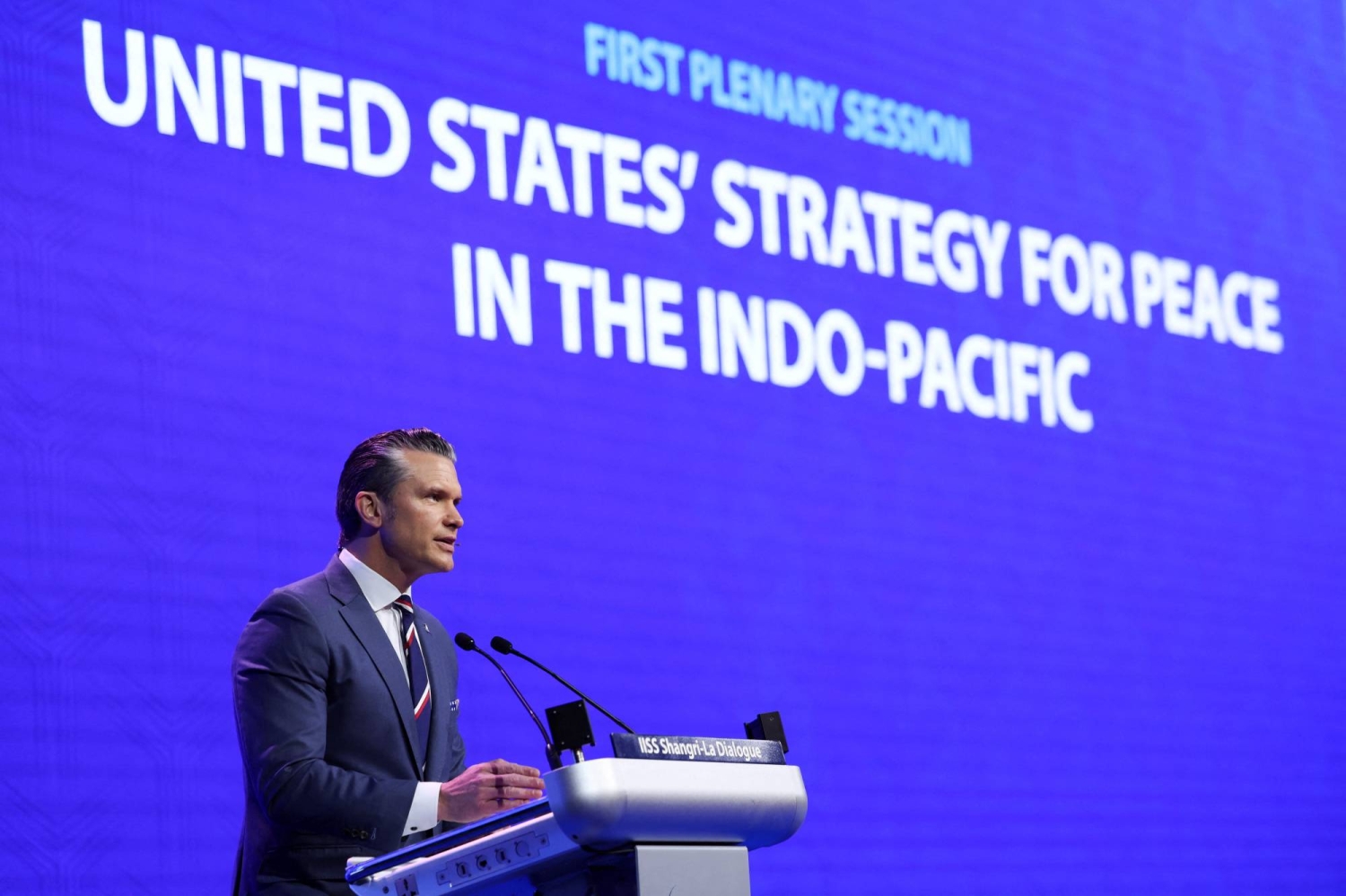
U.S. Secretary of Defense Pete Hegseth speaks during the 23rd IISS Shangri-La Dialogue at the Shangri-La Hotel in Singapore on May 30, 2026.
When it comes to the principle of multi-alignment – that is, the formation of non-binding yet effectual ties with a number of exogenous actors, including but not limited to great powers or regional blocs – ASEAN, the eleven-member bloc in Southeast Asia, is most definitely an astute exemplar.
Whilst the bloc’s origins can be traced to the US-backed communism-containing bulwark of Southeast Asia Treaty Organization (SEATO) established in 1954, the end of the Cold War and the establishment and expansion of the ASEAN grouping have seen member-states embrace growing dexterity and dynamism in their approaches to powers with apparent stakes in the region – including the US, China, and Russia.
On the Sino-American dyad, the conventional doctrine that has guided most of ASEAN’s members, as well as its nebulous and fluid ‘establishment consensus’, is one of “Infrastructure and Investment from China, Security from the US, and Trade with Both”.
Beijing, with its ardent push for infrastructural investments as a means of both employment creation and augmentation of its strategic influence, has emerged as a dominant provider of connectivity infrastructure for a number of continental ASEAN states; additionally, Chinese manufacturers seeking to relocate portions of their supply (and now value) chains abroad have turned to the neighbourhood that lies to their south for convenient joint ventures and overseas production bases.
Yet such economic integration had long occurred without a corresponding increase in military or security partnerships. The South China Sea remains an issue of concern – to varying degrees of urgency – in China’s bilateral relations with Vietnam, the Philippines, Malaysia, and Brunei. Indonesia, qua the North Natuna Sea, also has an indirect stake in the disputes. As such, ASEAN states have long relied upon American security, intelligence, and military support as a means of containing the perceived regional ambitions of China, or – as my learned colleague Cheng-Chwee Kuik puts it – of hedging between the two powers.
The shifting sands under the changing winds
Much has changed since January 2025.
With Donald J Trump’s return to the White House, ASEAN has effectively taken a backseat to the plethora of other foreign policy issues of interest to the self-branded “dealmaker” – Canada, Mexico, China, Greenland, Ukraine, Venezuela, Cuba, and, of course, Iran at present.
Out of the eleven ambassadorial postings to ASEAN member-states (granting that the junta government is not recognised as the legitimate representative of Myanmar), only three have been filled as of writing – Brunei Darussalam, Singapore, and Thailand. The remaining eight – including long-standing partners in the Philippines, Vietnam and Indonesia – are vacant.
Indeed, the White House had to recall its nomination for the self-anointed “alpha male” Australian-born Nick Adams as Ambassador to Malaysia, amidst significant controversy surrounding his remarks on Islam and women.
Whilst ministerial and technocrat-driven dialogue and conversations remain broadly intact (as evidenced by the relatively effusive response US Defense Secretary Pete Hegseth received at the Shangri-La Dialogue this year, where he also couched his statements on China in distinctly less hostile rhetoric than last year), the message from the top is clear: Trump does not have a serious ASEAN policy. He does not take ASEAN seriously. Where there may be individuals who are serious about ASEAN on his team, their voices are often muffled and negated by those around them who are neither serious about ASEAN, nor, indeed, very serious about foreign policy at all.
The ongoing crisis over the Strait of Hormuz speaks in part to how little Trump’s team cares for the interests of ASEAN – who is amongst the worst-afflicted regions in the world given many of its members’ dependence upon Gulf States for energy supply. More precisely, around 84% of the crude oil and 83% of the liquified natural gas passing through the Strait in 2024 was bound for Asia.
Nor does the damage inflicted by attacks on American bases in the Gulf by Iran – an economically dependent and technologically defective regional power (at best) – particularly reassuring for a region that has turned towards the US for defense protection, especially against powers that are considerably more potent than Iran. It is clear that ASEAN states need a defense Plan B.
A Multi-pronged Approach
There is no panacea. The solution must be multi-pronged.
Firstly, ASEAN should engage in defense multi-alignment. On the one hand, members should seek to keep American interlocutors engaged and informed – but by no means count upon them for absolute security guarantees. Building on the legacy of the Look East Policy introduced in 1991, New Delhi is receptive and has indicated interest in shoring up military cooperation with ASEAN via advanced missile deals and maritime security enforcement.
Jakarta has increasingly embraced, both as a gesture of goodwill and demonstration of multi-directional flexibility, military cooperation with Beijing in select contexts – as evidenced by the “Peace Garuda-2024” exercise in December that year. In April this year, Jakarta and Washington announced an upgrade to their defense partnership whilst President Prabowo visited Russia. Vietnam, for one, has deepened its military and security ties with Russia, expanding the remit of the partnership to encompass public and domestic security.
Select ASEAN states are cultivating and developing hardware and software synergy with parties beyond the US. For others with skin in the game in the South China Sea, such as Malaysia and the Philippines, not putting all their eggs in one basket could well prove to be sound advice.
Secondly, ASEAN must invest heavily into their domestic military technological capabilities and integrate such developments into their overarching visions for economic transformation.
Spending on defence procurement and R&D by key ASEAN nations (e.g. Indonesia, Malaysia, the Philippines, Singapore, Thailand, and Vietnam) had surged by $2.7 billion between 2022 and 2024, from $7.8 billion – denoting a 35% increase over two years.
It is high time that such capital be redirected towards efficacious regional and domestic military-industrial champions, which could draw upon US- and Russia-originating technological interfaces, yet also be applied and implemented more effectively within the particular geo-security landscape of ASEAN.
Improvements in hard technology must be complemented by comparable amelioration of challenges pertaining to corruption, command inefficiency, and non-interoperability between different defense systems, on the domestic level. The bolstering of accountability and transparency of procurement and innovation would go hand-in-hand with the ensuring that ASEAN states can maintain “minimum credible deterrence” against external challenges and potential disruptors.
There are, of course, challenges. On the regional level, the Thai-Cambodian conflict and extensive strife in Myanmar remain persisting issues for security, and demand more long-lasting, structural solutions that appear elusive at present.
Thirdly, where possible and with full adherence to the constraints of sovereignty and political reality, ASEAN states should devise a more carefully calibrated approach to their multi-dimensional relationship with China, leveraging their precipitously growing role in defining market access and re-exports for Chinese manufacturers, as a means of bargaining for a more sustainable modus vivendi over the South China Sea.
During General Tô Lâm’s four-day visit to Beijing in April 2026 – the first after his renewing his leadership – the Vietnamese leader stressed the vitality of strengthening socialist ties, infrastructural connectivity, and AI partnerships with China, whilst designating the territorial disputes between the two countries as amongst areas of divergence to be “effectively manage[d]”.
Even despite the trenchant acrimony that had erupted in the past few years, the Philippines appears to be endeavouring to re-establish “stable foundations” for its relationship with China, taking “baby steps” through exploring prospective joint oil and gas exploration in the South China Sea. Whilst some had attributed such a move to the current energy crisis that has embroiled the region, it is not inconceivable that the gesture is also an emphatic and calculated move aimed at signaling to Washington that Manila’s geo-strategic allegiance should not be taken for granted.
In short, ASEAN states must be prepared to pursue numerous Plan Bs on the defence front – in a way that accords to them maximal flexibility, heightened leverage, and, amidst these trying times, some semblance of contextually optimal outcomes.
