
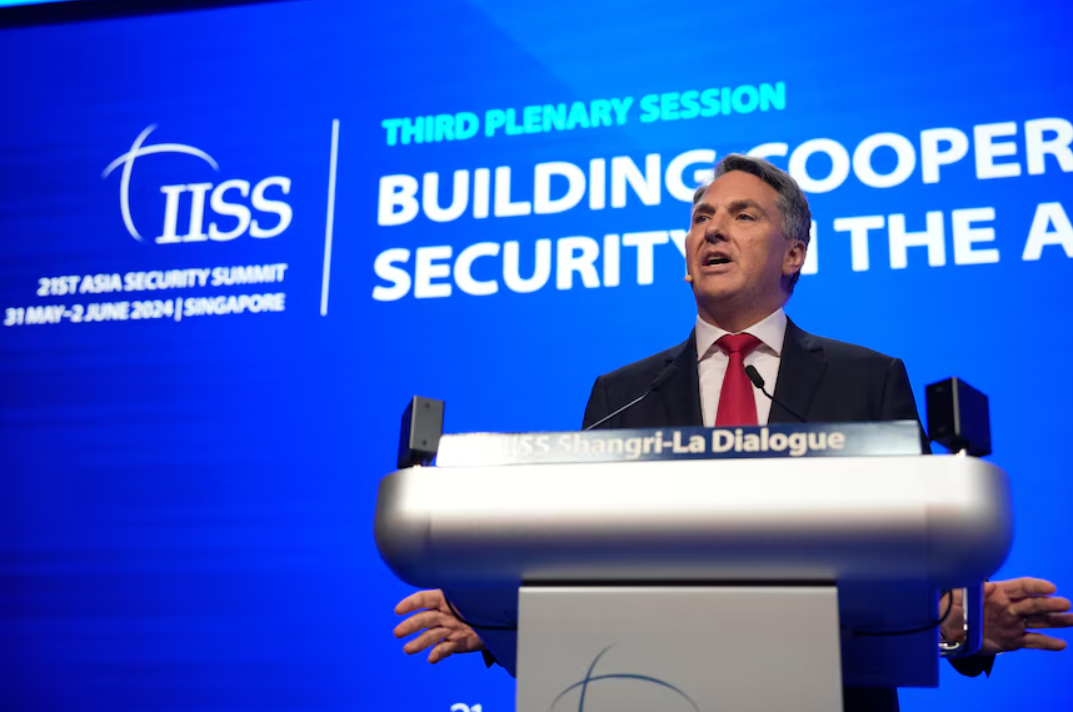
Richard Marles, Australian Deputy Prime Minister and also Defence Minister, speaks at the Shangri-La Dialogue in Singapore, May 20, 2026.
The recent Shangri-La Dialogue in Singapore offered a window into the evolving realities of power in the Indo-Pacific. U.S. Secretary of War Pete Hegseth’s address struck a notably more measured tone than his previous interventions. Gone were the sharper edges of 2025 rhetoric. In their place emerged a focus on securing a “favourable but durable balance of power,” preventing any single hegemon — implicitly China — from dominating the region. Allies were urged to shoulder greater burdens, with familiar calls for increased defence spending. Conspicuously absent was any direct reference to Taiwan.
This shift from assumed primacy to pragmatic balancing marks a significant evolution in American strategic thinking. For decades, U.S. preponderance in Asia served as the unchallenged foundation of regional order. That datum can no longer be taken for granted. Hegseth’s emphasis on “peace through strength” via a workable equilibrium echoes the influence of thinkers like Elbridge Colby, who have long warned of material limits constraining U.S. commitments across multiple theatres. The message was clear, namely that allies and partners must contribute meaningfully, as the era of subsidised security draws to a close. The U.S. is seeking to outsource resourcing responsibility and front line risks.
Nowhere has this recalibration landed more uncomfortably than in Australia’s defence planning, particularly around the AUKUS partnership. At the Dialogue, the U.S., UK and Australian defence ministers announced a significant adjustment to Pillar 1: Australia will receive three in-service Virginia-class submarines rather than the originally envisaged mix of new and used vessels. Defence Minister Richard Marles characterised the change as “streamlining” for simplicity, cost savings and operational uniformity alongside the Collins-class fleet.
Critics were less charitable. The move confirms long-standing doubts about deliverability. U.S. submarine production has struggled to meet even domestic requirements, with Virginia-class output lagging targets amid workforce shortages, backlogs and supply chain pressures. Congressional analyses and UK parliamentary evidence had flagged these constraints years earlier. What began as a bold, transformative commitment of introducing nuclear submarines to Australia’s naval fleet, now appears scaled back to what is feasible rather than what was promised. Pillar 2 advancements in uncrewed systems offer some distracting consolation, but the submarine pathway — central to the original pact — has lost lustre.
This development does not occur in isolation. It reflects deeper structural constraints on American power projection. Recent CSIS analysis following the Iran conflict highlights the toll of sustained operations. Munitions stocks — particularly long-range strike systems and air defences — were heavily drawn down. Replenishment timelines stretch into years for key capabilities, compounded by earlier support for Ukraine. Critical materials such as rare earths, magnets, and tungsten remain vulnerable chokepoints in the U.S. industrial base. Forward bases have also shown vulnerabilities in recent conflicts, as I have previously argued. What this means is that an American deterrence architecture across Asia, premised on a network of forward bases, is no longer viable.
Compounding these pressures is America’s acute dependence on Chinese rare earths and critical minerals. China controls around 90% of global rare earth processing and magnet production, which was mobilised by way of stringent export controls imposed since 2025 in response to U.S. tariffs and trade measures. Shipments of key materials have been severely curtailed, with licensing requirements creating delays, uncertainty, and outright bottlenecks for U.S. defence contractors. Particularly stark is China’s near-total monopoly on samarium, where it produces essentially 100% of global supply. Samarium-cobalt magnets are indispensable for high-temperature environments in precision-guided munitions, missile fin actuators (such as those in Tomahawk cruise missiles), radar systems, and guidance components that must maintain performance under extreme heat and stress. Disruptions here directly threaten the ability to sustain munitions production and replenish depleted arsenals, precisely the vulnerability exposed in recent conflicts.
These realities test the assumptions underpinning Australia’s strategic posture. For generations, Australian policy has operated on the premise that deep integration with U.S.-led architectures best serves national interests. Clinton Fernandes has described this as a “subimperial” orientation: Australia as a capable junior partner enforcing a U.S.-led order while advancing its own regional influence. This mindset treats sustained American primacy as synonymous with Australian security.
Yet the 2026 National Defence Strategy reveals underlying tensions. It affirms the alliance as “fundamental” while gesturing toward greater self-reliance and sovereign capabilities. It acknowledges a more contested region but stops short of fully confronting the implications of a United States that is resource-constrained and domestically focused. It never quite comes to grips with what greater self-reliance actually entails, and what indeed threatens such reliance. The document holds two ideas in uneasy suspension: continued deep engagement to anchor U.S. presence, and recognition of Asia’s shifting multipolarity as a result of diminished U.S. capability. Security researchers and analysts Hugh White and Sam Roggeveen have highlighted this contradiction in recent discussions pointing to the difficulty of preparing for a world where American commitment may prove more conditional than in the past.
Australia’s regional environment compounds the uncertainty. Southeast Asian states are hedging actively. Indonesia, Malaysia, Singapore and others deepen economic ties with China, pursue diversified energy arrangements (including with Russia), and explore alternative defence suppliers. Cross-border payment systems bypassing the U.S.-dominated SWIFT channels and accelerated regional integration reflect a pragmatic accommodation with shifting power realities. Australia risks appearing tethered to a fading presumption of U.S. dominance while neighbours move toward managed multipolarity.
Domestic politics mirror this fluidity. Recent RedBridge polling shows One Nation surging to 31% primary support, ahead of Labor at 28% and the Coalition at 20%. While foreign policy is not the sole driver — housing, migration and cost-of-living concerns arguably dominate — longstanding establishment consensus positions face pressure. Bipartisan commitment to AUKUS and the U.S. alliance, once seemingly ironclad, now sits amid broader disillusionment. Voices from the Greens to independent analysts, such as Mark Beeson amongst others, question reliance on long-term U.S. dependability in an era of American retrenchment rhetoric.
The growing doubt revolves around the wisdom of anchoring core national defence planning to architectures explicitly premised on indefinite U.S. preponderance. When that preponderance itself faces material and political headwinds, such bets carry growing risks. Clinging to yesterday’s certainties in a transformed Asia appears increasingly anachronistic.
Australia finds itself at a strategic crossroads where old muscle memory collides with emerging limits. The AUKUS adjustment is symptomatic rather than causative — a tangible reminder that delivery depends on American industrial and political realities beyond Canberra’s control. As U.S. officials openly discuss favourable balances rather than dominance, and as regional actors quietly diversify, the foundations of Australia’s long-standing posture show strain.
The future remains profoundly uncertain. No single power, including China, can effortlessly dictate terms across the vast Asia-Pacific region. Yet assumptions of seamless American extension of primacy into coming decades look threadbare. Hanging onto them is foolhardy. For Australia, this opens space for uncomfortable but necessary reckoning: how to navigate a post-U.S. primacy era without illusion or panic. The present pathway, heavily invested in structures built for a different distribution of power, invites scepticism about its long-term viability. Whether political leaders acknowledge this erosion or persist in familiar framings will shape the intensity of the reckoning ahead.
As Asia rearranges itself around new centres of gravity, Australia cannot escape the need to confront these shifts. The era premised on U.S. hegemony as a regional constant is ending. The denouement is not by way of some dramatic rupture, but through incremental revelations of limits. It is little wonder that the U.S. seeks to outsource resourcing responsibility and front line risks. The debate this forces upon those in Australia will only grow louder as material realities continue to assert themselves. In that uncertainty lies both risk and the possibility of clearer-eyed adaptation, and perhaps the jettisoning of what Alan Gyngell once wryly described as Australia’s fear of being abandoned by a great transatlantic protector.
