
Trump’s tariffs failed to reshore manufacturing or reduce trade deficits, instead weakening U.S. alliances and strengthening China’s global position. They accelerated a shift in power toward control of supply chains and critical materials—an area where China holds a decisive advantage.
Samarium, gadolinium, terbium, dysprosium, lutetium, scandium, yttrium.
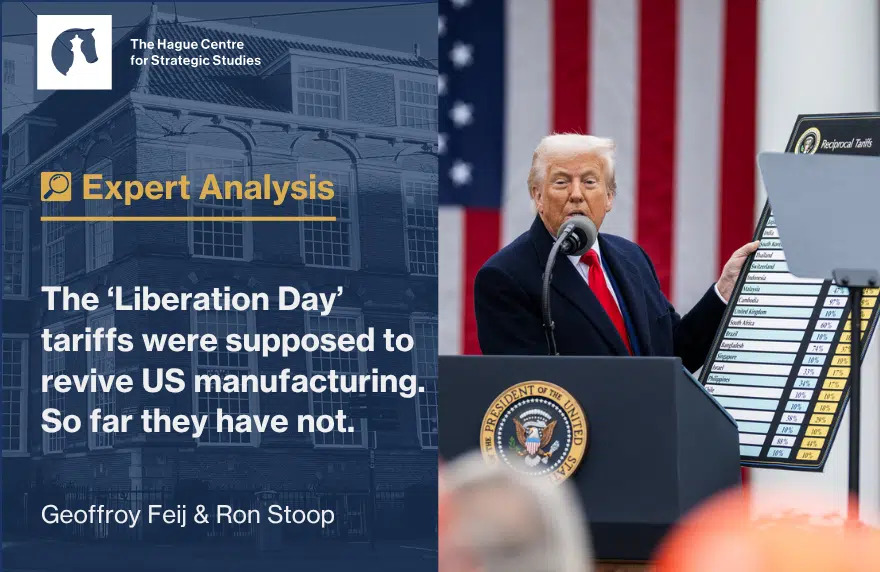
Two days after “Liberation Day” China’s Ministry of Commerce issued an administrative notice imposing export licensing controls on all seven of these heavy rare earth elements. The document listed the materials, specified the licensing procedure, and ended. No press conference, no primetime address, no slogan for the day.
That contrast defined everything that followed. April 2, 2025 mattered less for its immediate economic effects in the United States than for what it revealed about where power now resides. Washington escalated at the border and Beijing answered upstream, targeting critical inputs, rewriting the structure of global power.
In the year since Trump imposed its tariff regime, China has expanded its commercial presence across three continents, American allies have learned that alignment did not necessarily shield them from U.S. arbitrary coercion, and Washington has repeatedly confused the exercise of power with its depletion.
The economic verdict has been documented exhaustively elsewhere: the factories did not return, the overall U.S. goods deficit hit a record, manufacturing contracted, and households paid more for the same imported goods. Damning as those outcomes are, they still capture only part of the story. The deeper failure rested in the gap between what the tariff regime was meant to do and what it actually did.
Behind the tariff push stood a cluster of concerns. In Washington, dependence on Chinese-centered supply chains and the so-called non-market practices had come to be seen as a national-security liability, while import competition had hollowed out politically salient industrial regions. The administration also treated persistent trade deficits and allegedly discriminatory regulation targeting American firms as evidence that the U.S. had surrendered leverage to trading partners across the board. The global application of the tariffs reflected that fusion of motives.
Yet the move was conceived as a response to foreign predation and functioned instead as an accelerant to the geopolitical reordering Washington claimed it wanted to arrest. That gap between intention and outcome is the real legacy of Liberation Day.
There is a precedent for using tariffs as coercive leverage. In 1971, Richard Nixon closed the gold window and imposed a 10 percent surcharge on all dutiable imports. Declared as part of an emergency economic program, the measure aimed to compel allied currency revaluation and relieve pressure on the dollar amid a widening external imbalance.
It worked because the objective was precise, achievable, and reversible. Besides, America’s Cold War military protection made its allies reluctant to push back. Once the Smithsonian Agreement delivered currency realignment, the surcharge was lifted within days. As Douglas A. Irwin argues, Nixon’s demand was specific, actionable, and transparent, which enabled its prompt reversal once the immediate objective was met.
Liberation Day had no such architecture. Its stated aims—reshoring manufacturing, eliminating trade deficits, restoring industrial sovereignty—were unlikely to be achieved through tariffs alone. Nixon used a blunt instrument for a precise objective. Trump used a similar instrument for objectives it could not reach. This time, the shock had no settlement mechanism waiting at the other end.
The regime, however, was grounded on a questionable premise: that bilateral trade deficits are scorecards of national power, that deficits with China, Europe, or Japan prove foreign exploitation, and that tariff walls can reverse them all. That confusion arguably conflated bilateral trade balances with geopolitical leverage.
The geopolitical consequences are now visible.
First, the tariffs became a test of hierarchy inside the U.S. alliance system. Washington imposed costs not only on adversaries but on allies, treating them as subordinate units to be disciplined. Alliance no longer insulated states from economic coercion and instead enabled extraction. In doing so, Washington weakened the very coalition it would need in any sustained contest with China. A state can coerce allies or organize them. It cannot do both without degrading its own position.
Access to the American market was recast as a political instrument, available for withdrawal at Washington’s discretion and on criteria detached from institutional process. In Beijing, Brussels, and elsewhere the lesson was that Washington was prepared to use market access selectively, not only against adversaries but across the wider trade system.
Second, the tariff war did not merely fail to slow Beijing; it appeared in several respects to have strengthened China’s external position, especially its capacity to redirect trade and deepen commercial ties elsewhere. It showed that China possessed precise countermeasures: Beijing had been preparing for U.S. decoupling for years and Liberation Day compressed the timetable and furnished the justification.
What Washington presented as confrontation ended up facilitating the outward expansion it sought to contain. Chinese exports rerouted through Southeast Asia and Mexico with a speed that reflected prior preparation. Commercial agreements across the so-called Global South deepened.
Europe largely absorbed the costs with limited collective pushback, yet China used the disruption to expand its commercial position at a moment when EU capitals were poorly equipped to resist. Germany imported more cars from China than it exported there for the first time. Chinese penetration of European manufacturing intensified in the same months that European exporters were being hit by U.S. tariffs.
Moreover, partial decoupling did not produce clean blocs, but brokerage zones. Rerouting through third countries created profits for intermediaries. Middle powers and transshipment economies gained leverage because Washington tried to harden economic boundaries. The result was a more stratified commercial order, in which China’s intermediaries extract rents, mediate flows, and hedge.
In that sense, the U.S. helped create conditions that China was able to exploit for commercial expansion. The trajectory culminated in what Beijing could plausibly regard as its own liberation year: While Trump publicly floated tariffs of up to 200 percent, China posted a record trade surplus of nearly $1.2 trillion, the largest ever recorded by any country.
Third, Washington announced tariffs on finished consumer goods crossing borders. Beijing reached behind those borders into the supply chains that make those goods possible in the first place.
Dysprosium and terbium, two of the seven restricted elements, are essential to the permanent magnets used in F-35 fighter jets, Virginia-class submarines, and Tomahawk missiles. They are not available in significant quantities outside China’s processing base, which accounts for more than 90 percent of global refining capacity. The Department of War later committed $400 million to cultivate a domestic magnet supply chain and established long-term price support and offtake guarantees for rare earth inputs, accepting above-market costs to secure access to materials constrained by China.
That episode revealed the real structure of contestation. While tariffs are mere border instruments, the decisive competition is over upstream chokepoints: rare earth processing, battery cell manufacturing, semiconductor fabrication, and the industrial steps that determine whether finished goods can be produced at all. Washington built its coercive theory around the one instrument its principal rival had already engineered to absorb.
Fourth, Europe’s predicament illustrates the costs American power now imposes on those who depend on it. The EU accepted Washington’s tariff baseline, absorbed the damage to its exporters, and received nothing in return: no exemptions, no serious coordination against Chinese competition, no recognition that the burden was unevenly distributed.
Seventy years of Atlantic alliance did not purchase immunity from American extraction. Europe now finds itself caught between two powers applying pressure from opposite directions, without the industrial capacity, political cohesion, proper leadership, or institutional means to resist either effectively.
Fifth, the episode marks the rise of techno-bureaucratic statecraft over theatrical economic nationalism. The contrast between Washington’s tariff spectacle and Beijing’s administrative notice points to a deeper change in the form of power. Geopolitical lead today depends less on the visible scale of punishment than on administrative control over classifications, licensing, processing, and compliance. States that master these technical instruments will outrun those that rely on declaratory coercion.
Sixth, once Washington justified tariffs through emergency executive powers—later ruled unlawful by the Supreme Court—, it weakened its own authority to contest the same logic when used by others. In other words, China can now present its industrial protections as reasonable decisions and find a receptive audience across the Global South, which has watched Washington discard the rules it once wrote and enforced.
One year after Liberation Day, China is more commercially embedded across the non-American world than at any previous moment. Europe, acting as a U.S. subordinate ally, is more exposed, more constrained, and more dependent. The U.S. has spent twelve months teaching governments that alliance with Washington is a cost center with uncertain returns.
And then there is that MOFCOM notice again, Announcement No. 18 of April 4, 2025.
Xi Jinping did not need to match Washington in drama, scale, or declared ambition. It only needed to show that it understood more clearly than Donald Trump where economic power now resided: in the twenty-first century, economic power is not written in tariff schedules and bullying but in export-control annexes, processing capacity, and materials with no substitute. The document ran a few pages. It was enough.
