
Interdependence has shifted dramatically toward greater global diversity in supply chains. Successful dialogue and cooperation now will help shape a new, complementary, win-win bilateral trade relationship for the next decade.
The successful visit to the United States by Chinese President Xi Jinping in September was a historic landmark in the relationship between the world’s two largest and most important countries.
In a span of just four months, China and the U.S. each received a high-level visit from the other side, with two more meetings expected at the APEC summit in Shenzhen, China, in November and at the G20 summit in Florida in December. These represent the most vigorous contacts since the two countries established diplomatic relations in 1979, and augur well for an improved relationship going forward. They are a great plus for global peace and progress.
At the end of the visit, the two sides announced eight deliverables and understandings. The first and most important is that the “constructive China-U.S. relationship of strategic stability” agreed to during President Donald Trump’s China trip in May is further defined by a new expression— “on the basis of respect, fairness, and reciprocity”—which makes explicit the principle that the world’s two largest countries are equal partners.
A series of agreements were also reached on trade and business, the ballast of the bilateral relationship, including a reciprocal tariff reduction on $30 billion of goods each way, an extension of the trade measures suspension agreed upon at Kuala Lumpur by another two months (to Jan. 10), the creation of a board of trade and board of investment, discussions on investment and financial services and, importantly, the start of consultations on artificial intelligence.
No change for Washington
While all of the above is constructive and encouraging, three major problems remain:
First, there is no fundamental change in Washington’s unilateral tariff policies. During the one-year trade measures suspension period (Nov. 10, 2025 to Nov. 10, 2026), Washington launched Section 122 tariffs worldwide in February that include China, along with Section 301 tariffs in July naming 60 economies, including China. The actual U.S. tariff level on China was 27.3 percent in June, the highest among all major U.S. trading partners. The $30 billion for tariff reduction refers to 2018-19 (during Trump’s first term), leaving intact all the tariffs added so far during his second term.
Second, the existing export control measures, especially in chips and AI were not moved or reduced.
Third, there has been no fundamental change in Washington’s view of the Chinese industrial and trade regime or the huge trade surplus. During the G20 meeting of financial ministers and central bankers in Florida in late August, U.S. Treasury Secretary Scott Bessent prepared a statement blaming China’s “subsidy and excessive capacity” for the huge trade surplus and new global imbalance. Hence, a parallel pattern will likely coexist. The constructive dialogues will move ahead with more deliveries, but the three major problems persist.
Trade rebound defines tariffs
Surprisingly, the actual bilateral trade performance in recent months defines the tariff barriers. According to Chinese customs data, since Trump’s visit to China in May, there has been a strong upturn in China-U.S. two-way trade, which averaged $56.6 billion per month during the June-August period—89.4 percent of the historic monthly high in 2022. Chinese exports to the U.S. recovered to 87.9 percent and U.S. exports to China to 94.5 percent of the 2022 high, although most of the U.S. unilateral tariffs on Chinese goods remain.
The strong rebound caused the cumulative trade volume during the January-August period to rise 5.5 percent over a year ago. Of that, Chinese exports to the U.S. were up 6.2 percent and U.S. exports to China were up 3.4 percent. U.S. Commerce Department data also showed that imports from China shot up 33.1 percent year-on-year in June, followed by another 2.6 percent rise in July.
This shows that, China-U.S. trade has been pushed mostly by the rapid improvement in the overall bilateral relationship, outweighing the restrictions inherent in the tariff barrier.
In a US-China Business Council member survey in June, more than half of the members planned to expand their business in China, and the percentage who said they were optimistic and relatively optimistic rose to the highest point since 2021. An AmCham Shanghai survey also found that 58 percent of its members were positive about their China business over next five years, up from 41 percent a year ago. A recent poll by the Chicago Council of World Affairs also showed a constructive trend, with 57 percent of respondents positive on China.
Washington’s export ban or control has been less effective. According to China customs data, Chinese imports of integrated circuits shot up by 61.7 percent during the January-August period, reaching an astonishing volume of $427.67 billion. China was by far the world’s largest chip trade destination, with Taiwan, Japan and South Korea reaping the most. China’s IC exports doubled to $256.75 billion during the same period of time.
Changes in trade paradigm
• An apparent decline in mutual interdependence. The China-U.S. bilateral trade reduction has little effect on their global trade figures. Over the past six years, Both China and the U.S. have seen global trade grow steadily, despite the fact that bilateral trade has performed poorly. As a result, both China and the U.S. saw large drops in global share.
China’s global export market share ($ billion)
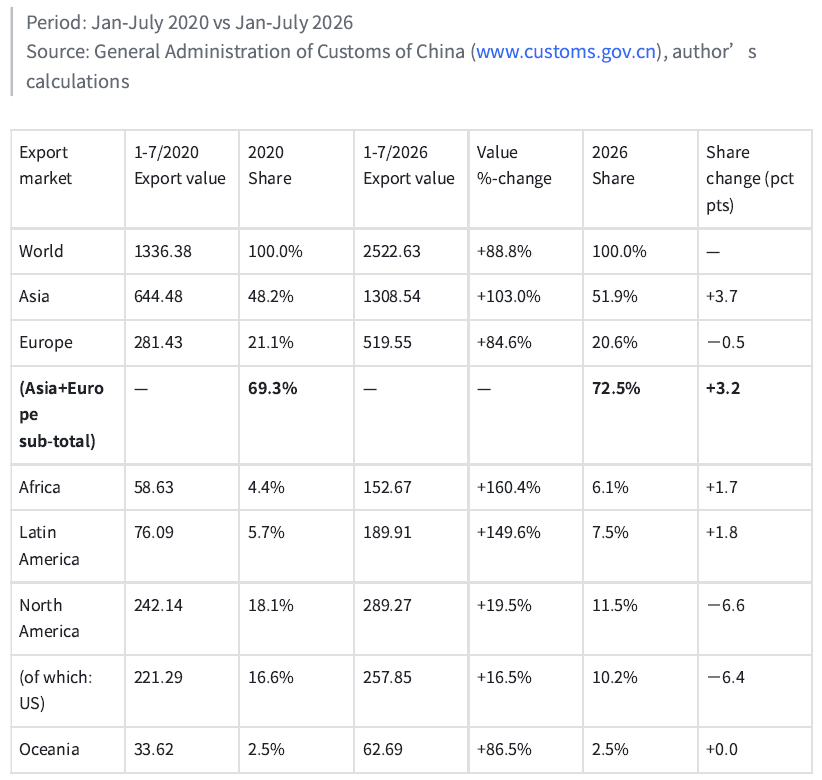
Global exports of China increased by 88.8 percent over the past six years. The U.S. share fell from one-sixth to one-tenth. Asia and Europe combined increase by 3.2 percentage points, and account for 72.5 percent, seven times larger than the U.S. share. Africa and Latin America combined added 3.5 percentage points while Oceania’s share remained unchanged.
U.S. global imports mirror a similar pattern ($ billion)
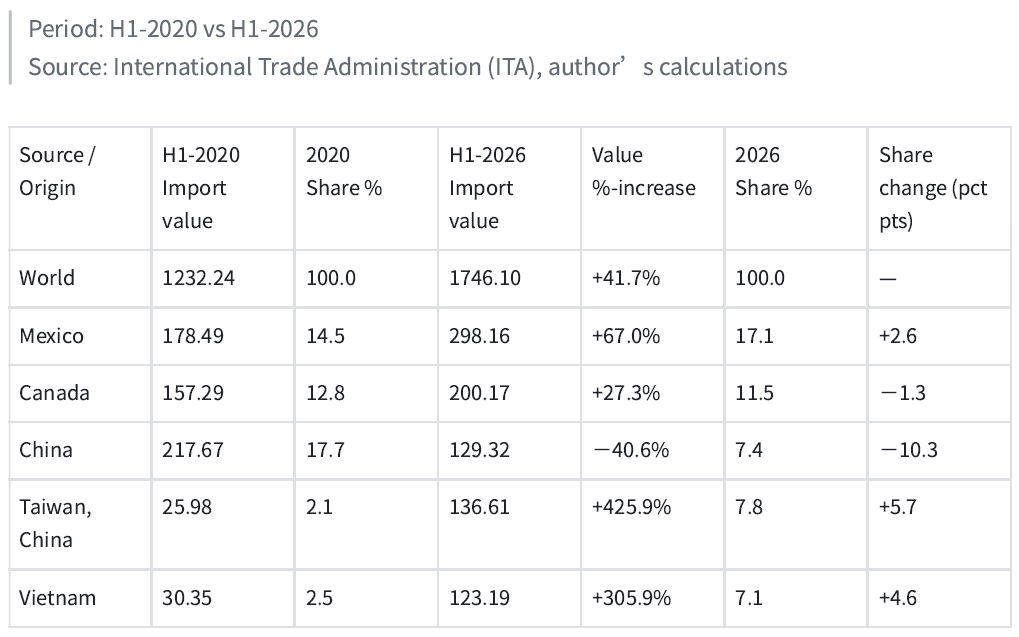
Mainland China’s share fell by 10.3 percent, while Taiwan and Vietnam combined added 10.3 percent, showing a shift of supply chains out of China but staying within Asia.
In other words, the poor performance in bilateral trade has not affected either party’s global growth. Hence an apparent decline in China-U.S. bilateral interdependence.
A new cross-regional supply chain is shaping up, taking away part of the bilateral supply chain between China and the United States.
Cross-regional supply chain shifts ($ billion)
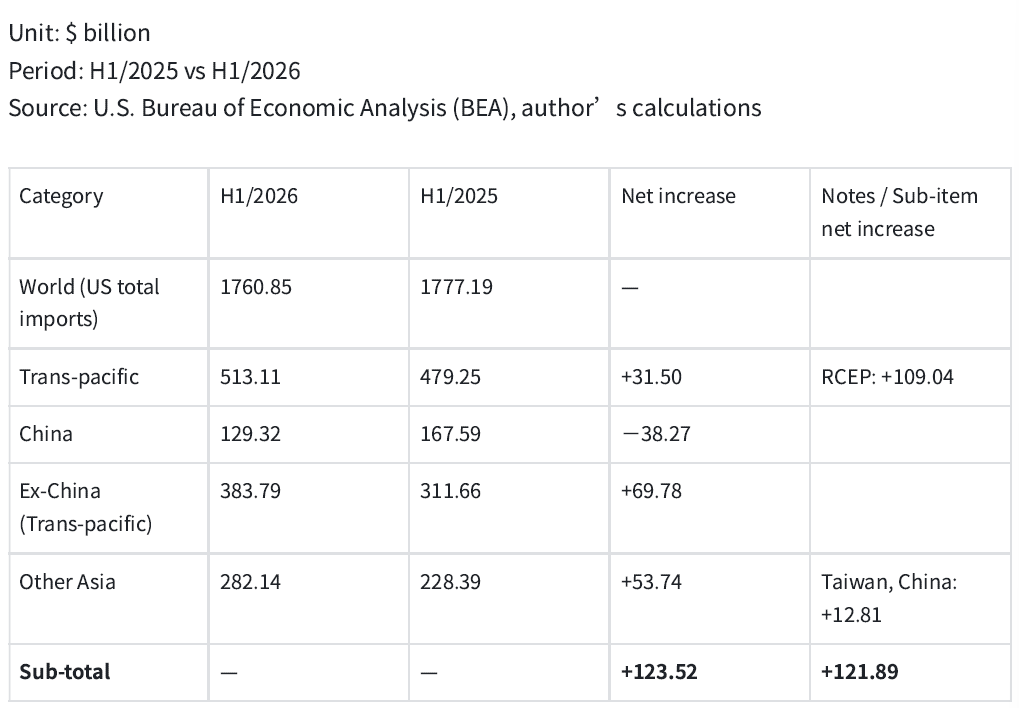
The net increase of U.S. imports from Asia and the Pacific (other than China) was virtually the same as the net increase of RCEP and Taiwan’s imports from China. The China-U.S. bilateral supply chain has been partially replaced by cross-regional supply chains, but with the global supply chain remaining firm.
China has emerged as the world’s largest manufacturing and export power by far, outcompeting the U.S. in various fields. This may be impossible to overcome through traditional tariff and trade restriction measures. Last year, China accounted for 32 percent of the world’s manufacturing output, more than twice the share of the U.S. (15 percent), and larger than the second through sixth countries combined. Its automobile output was also larger than that of the U.S., Japan, Germany, Mexico and South Korea combined. China accounted for 60 percent of global new-energy vehicle output, 80 percent of solar panels, 65 percent of power battery, 84 percent of embodied robots and 85-90 percent of refined rare earth minerals. The China-U.S. trade supply chain is no longer a smile curve, or vertical division, where China processes and assembles and the U.S. reaps the most benefit. Rather, it is more of a head-on competition, with China gaining comparative advantages.
China and the U.S. are already on a new track—AI cooperation and competition. Both will engage in dialogue for AI security and AI-led frontier industries, and also for possible collaboration.
Reshaping China-U.S. trade
Bilateral trade relations and activities between the two major world powers is in a reshaping phase.
First, the strategic relationship between the two countries, anchored by their top leaders, will play a decisive role in bilateral trade relations. The above-mentioned historic visit to the U.S. by President Xi Jinping and the overall relationship—a constructive relationship of strategic stability, on the basis of respect, fairness and reciprocity— has set the key tone also for the trade relationship. Under this strategic guidance, the institutional dialogue and working mechanisms of the Board of Trade and Board of Investment could secure a stable and growing environment of trade and investment.
Second, under this strategic guideline and with effective dialogue mechanisms, mutual investment should be encouraged and facilitated. Leading companies are encouraged to increase investment significantly, as key R&D centers and manufacturing hubs, covering NEVs, industrial robots, agriculture, biotechnology, pharmaceuticals and financial services, not only for the host country’s market but for the whole cross-regional supply chain. The business communities of the two countries are encouraged to expand investment. Chinese and American companies are encouraged to engage in joint investment projects in third countries, especially in Europe and in the Global South.
Third, the dialogue mechanisms need to tackle the main concerns of each side, including scrapping unilateral tariffs, export controls, industrial and trade policy concerns and trade imbalances, reasonable solutions should be sought for both.
Fourth, they should focus their best efforts to make a good start in AI dialogue and possible cooperation, covering the latest trends, models, chips, data and security boundaries. Possible cooperation should be on the agenda from the start.
Successful dialogue and cooperation in the 21st century will help shape a new, complementary, win-win bilateral trade relationship for the next decade.
