
China’s export controls on rare earths have exposed Japan’s persistent dependence, prompting Tokyo to promote deep-sea mining as a path to self-sufficiency. However, the Minamitorishima project appears driven as much by political signaling as by industrial viability, given high costs, technological constraints, and China’s continued dominance in refining.
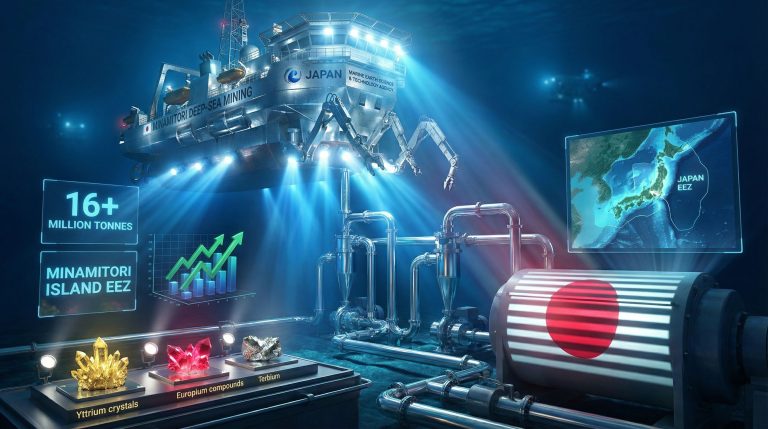
China’s January 2026 export ban on dual-use items, including rare earths, has compelled a reluctant yet consequential reckoning within Japan’s industrial and political establishments. In contrast to the contested informal embargo of 2010 – whose very occurrence remains disputable – Beijing’s current “dual-use” regulatory framework, reinforced by an export control list targeting 20 Japanese entities alongside an additional 20 placed under watch, manifests a sophisticated combination of trade policy and national security imperatives.
In response to the anticipated shortfall in rare earth imports from China, Japan has advanced the extraction of “rare-earth-rich” seabed mud near Minamitorishima in the Ogasawara Islands as a definitive solution to its resource dependency. Yet, as critically assessed by Mainichi Shimbun, this initiative may operate less as a viable industrial strategy than as, at the risk of overstating the point, an expression of “resource populism” – a political discourse designed to mobilize the Japanese public to garner electoral support by projecting security, and more importantly, the capacity of the Takaichi’s administration to safeguard national interests, despite substantial economic and technical counter-indicators.
Institutionalized Leverage vs. Strategic Diversification
The current conflict marks a modest departure from China’s reactive policy of 2010 when – despite China’s declarations that it would adopt “strong countermeasures” against Japan – it never publicly acknowledged imposing an export suspension of rare earths. As noted earlier, at the beginning of 2026 Beijing introduced two distinct measures: a ban on dual-use exports to Japan, and the designation of 20 Japanese firms on an export control list, with 20 more added to a watch list. Together, these policies signify the legalization of economic leverage. By situating these restrictions within a national security apparatus, Beijing has fashioned a surgical tool that targets Japan’s manufacturing – especially high-tech sectors with potential to enhance Japan’s military capabilities, particularly in automotive and defense industries – while maintaining a veneer of regulatory legitimacy “to safeguard national security and interests and fulfill international obligations such as non-proliferation.”
Japan, conversely, has gradually shifted from a state of “rare earth panic” to one of “strategic diversification.” According to Simran Walia, since 2010 Japan has reduced reliance on Chinese rare earths from over 90% to approximately 60-70%. However, the “last mile” of dependency remains the most precarious. Japan continues to rely almost entirely on Chinese facilities for the processing and refining of heavy rare earths, for example, dysprosium and terbium, which are indispensable for permanent magnets used in electric vehicles (EVs). Thus, this residual dependency on China could prove detrimental, constraining Japan’s EV industry and leaving it vulnerable to external pressure. More critically, the reliance also threatens other rare-earths-dependent sectors beyond EVs, therefore undermining the resilience of Japan’s wider industrial base.
Minamitorishima: Scientific Endeavour or Political Theater?
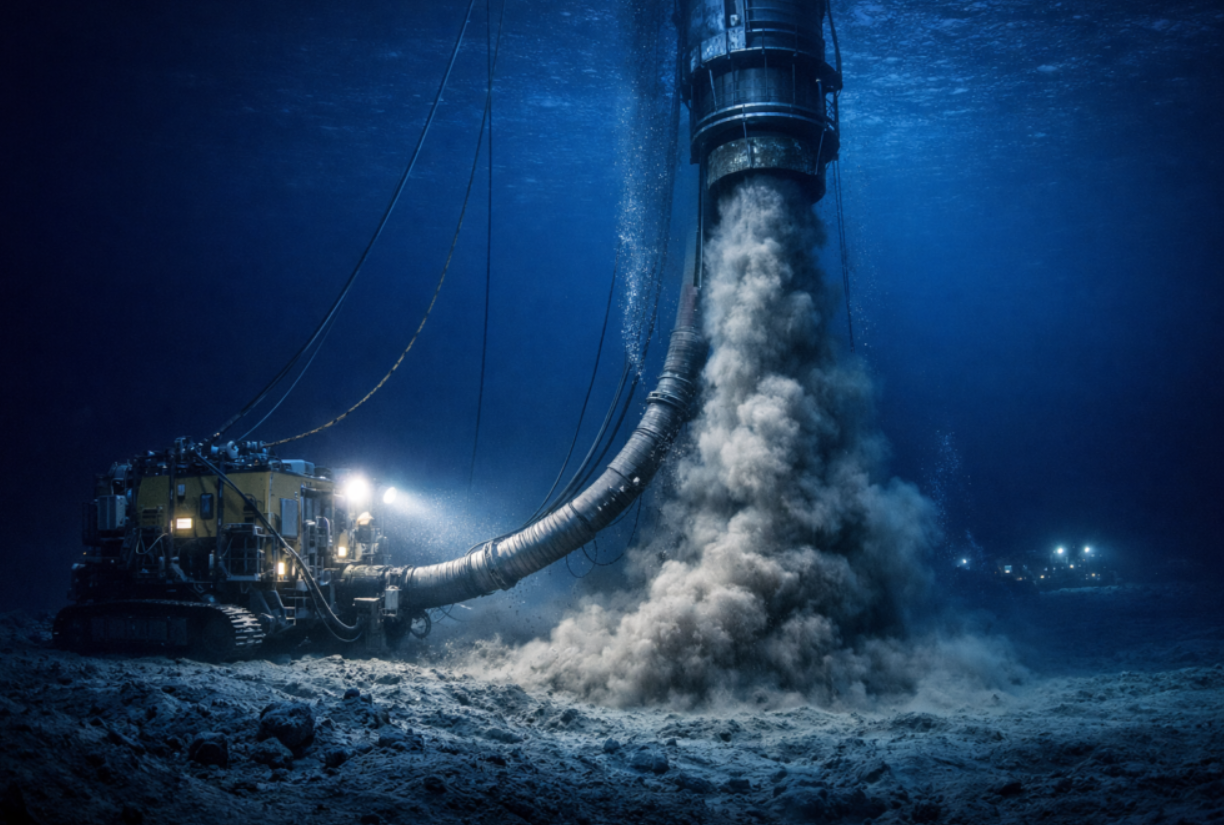
It is within this atmosphere of heightened vulnerability that the Minamitorishima deep-sea mining project has been thrust into the domestic political spotlight. In early February 2026, the successful retrieval of mud from depths of 6,000 meters was hailed by members of the Liberal Democratic Party (LDP), including Prime Minister Sanae Takaichi, who averred that “Japan will not have trouble with rare earths from now on, both for the current generation and the next generation,” as a historic breakthrough for economic security. However, reports from Japanese media outlets, notably Mainichi Shimbun, reveal a significant divergence between political rhetoric and scientific reality.
Internal government leaks suggest that the announcement of the retrieval was timed to coincide with election cycles, serving as a symbolic countermeasure against China to reinforce the administration’s nationalist credentials. While the engineering feat of retrieving mud from depths of 6,000 meters is noteworthy, the quality and concentration of the minerals contained within those samples remain unverified: “Analysis of the amount of rare earths contained in the mud is yet to be completed. The technology is still at the stage of demonstrating that it is possible to continuously pull up mud from the deep sea.” By describing the resource as “nearly inexhaustible” in stump speeches, Prime Minister Takaichi and LDP politicians have calculatedly conflated a speculative laboratory experiment with a skeptical commercial-scale industrial solution.
The Economic Chasm and the “Imphal” Analogy
The most profound critique of Japan’s deep-sea mining strategy lies in its economic feasibility. Projections from the Dai-ichi Life Research Institute suggest that the cost of domestic deep-sea extraction, transportation, and refinement could reach $70,000 per ton – a staggering nearly 20 times the 2013 market price of Chinese-processed rare earths ($3,600).
In a global market where cost-competitiveness underpins economic advancement – particularly the EV transition – such a price disparity renders the “miracle mud” commercially unviable without sustained and substantial state subsidies, which are unlikely to materialize. One Japanese commentator thus has drawn a sobering historical parallel to the “Battle of Imphal,” a disastrous World War II military failure characterized by logistical impossibility and a reckless disregard for material reality. The analogy suggests that Japan’s current pursuit of rare earth self-sufficiency is driven by a “national fantasy” that ignores prohibitive costs and environmental hurdles. More fundamentally, Japan has not developed the processing and refining infrastructure necessary to compete with China, which controls nearly 90% of global rare earth refining capacity.
Despite Japan’s advances in niche areas such as high-purity separation and magnet redesign, its deep-sea extraction project remains economically unviable and technologically insufficient to close the gap with China’s industrial dominance in the short term. As a result, while the Minamitorishima initiative may translate into popular support for the Takaichi administration by showcasing a fragile yet potentially promising outcome, it ultimately risks becoming a fiscal sinkhole for taxpayer money rather than fulfilling its pledge of delivering genuine self-sufficiency. Under the banner of “economic security,” projects that defy market fundamentals are increasingly manifested as political maneuvers, transforming the concept into a blank check for ventures whose economic viability remains deeply compromised.
The Hidden Danger of Over-Promised
The risks of political over-promise are manifold. By implying that a domestic solution is imminent, the Japanese government creates a moral hazard for Japanese industry which is likely to discourage investment in more pragmatic, if less “patriotic,” alternatives such as expanded “urban mining,” the development of magnet technologies that reduce or eliminate reliance on heavy rare earths, and deeper multilateral partnerships with resource-rich states such as Australia and Vietnam. At the same time, if the feasibility tests scheduled for 2027 fail to deliver on the inflated expectations cultivated by the Takaichi administration, the resulting credibility gap could weaken Japan’s bargaining position. It will not only erode domestic confidence but also create space for its competitor – China – to exploit Japan’s unfulfilled claims, thereby reinforcing its dominance in the rare earths sector. Moreover, China could leverage this asymmetry by deploying export restrictions as a strategic instrument, recalibrating Japan’s policy responses in ways that align more closely with China’s national interests, particularly given the potential effectiveness of such measures. In this sense, a strategy built on the “mirage” of 6,000-meter mud risks leaving the nation’s industrial flank exposed once the political theater subsides.
