
The announcement by the United Arab Emirates that it would withdraw from OPEC has drawn intense international attention. Should conditions in the Strait of Hormuz improve, the UAE would be well positioned to rapidly expand its share of the global oil market.
On April 28, the United Arab Emirates unexpectedly announced that it would withdraw from OPEC (Organization of the Petroleum Exporting Countries) and the broader OPEC+ alliance, effective May 1. The abrupt move has triggered global concerns. Why was this decision made at a moment when international attention is fixed on the Strait of Hormuz and the U.S.-Israel-Iran conflict? How does the UAE’s exit intersect with this crisis, and what consequences might it carry?
Founded in the 1960s, OPEC consists of major oil producers from the Gulf, Africa and South America and is primarily designed to coordinate oil policies and push back against Western dominance in global oil markets. In 2016, 11 non-OPEC oil-producing countries, including Russia, formed an alliance with OPEC to coordinate production policies, giving rise to the expanded OPEC+ framework.
While both OPEC and OPEC+ aim to achieve greater autonomy in pricing and a break from Western market control, they have helped stabilize global oil prices and contributed to global energy governance. In contrast, the International Energy Agency (IEA) largely defends the interests of major industrialized oil-consuming nations. Its strategic petroleum reserve system is critical for moderating prices while functioning as an important mechanism of energy governance.
The UAE produces approximately 4.1 million barrels of oil per day, with a maximum capacity of 5 million. Under the 2025 OPEC quota, however, it is permitted to pump around 3.1 million barrels per day, leaving an estimated 1 to 2 million barrels of spare capacity. Spare capacity is central to OPEC’s ability to influence prices, and the UAE’s buffer—which is second only to Saudi Arabia’s roughly 3 million barrels per day, ranks among the group’s most critical levers.
In other words, while the UAE accounts for only about 13 percent of OPEC’s total output (roughly 30-32 million bpd in 2025), it is vital to OPEC’s production policy. Against this backdrop, the UAE’s exit will clearly weaken the organization’s ability to manage oil prices.
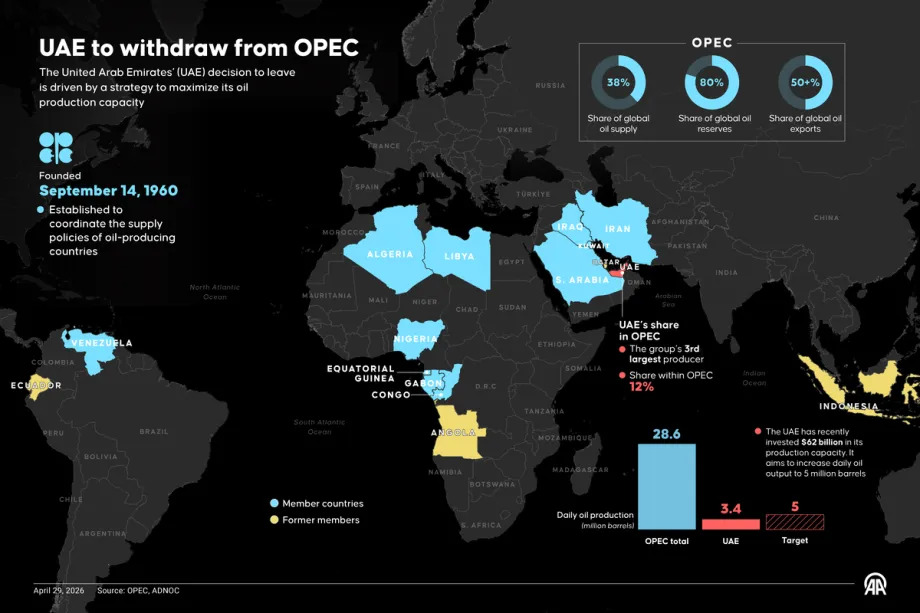
An infographic titled “UAE to withdraw from OPEC” created in Ankara, Turkiye on April 29, 2026. (Mehmet Yaren Bozğun – Anadolu Agency)
Pricing power between OPEC and oil importers is inherently a zero-sum dynamic: The UAE’s withdrawal, theoretically, will strengthen importers’ bargaining position. It is therefore little surprise that U.S. President Donald Trump reacted to the news with enthusiasm.
Yet the picture is more complex. As noted, OPEC has long functioned, at least to some extent, as a stabilizing force in global oil markets. A decline in its pricing power is likely to amplify price volatility. The market will have to seek a balance between greater volatility and enhanced bargaining power. If the costs of sharper price swings outweigh the gains in negotiating power, the outcome will benefit neither exporters nor importers.
The global energy market is currently operating under abnormal conditions. The blockade of the Strait of Hormuz has severely disrupted crude shipments, with prices increasingly driven by geopolitical risk, rather than underlying supply and demand. Over the longer term, fundamentals will reassert themselves in shaping price trends. The impact of the UAE’s exit is clearly overshadowed by the disruption in the strait and cannot yet be fully felt. Only when the blockade is eased will the effects of the withdrawal come fully into view.
For OPEC, member withdrawals are nothing new. In 2024, Angola, a major African producer, exited the group over disagreements on production cuts. Several other African members, including Nigeria, have signaled similar intentions. Previously, Qatar, Indonesia and Gabon withdrew for various reasons. In recent years, largely led by Saudi Arabia, OPEC+ has achieved markedly improved compliance with production targets. Yet its influence has been partly diluted by weak global crude demand amid slowing economic growth and sustained high U.S. output.
Last year, OPEC crude capacity stood at 30-32 million bpd, and OPEC+ at 40-42 million bpd, accounting for 30 percent and 40 percent of global supply respectively—still representing considerable market power. Whether the UAE’s departure proves consequential will depend on whether it triggers a broader ripple effect within the group. Asbsent such a chain reaction, its full impact remains uncertain.
What is particularly noteworthy is the timing of the UAE announcement. Amid heightened tensions surrounding the U.S.-Israel-Iran conflict, Gulf producers are already under significant strain. Against this backdrop, the UAE is effectively striking out on its own as collective pressure within the group intensifies. Many international observers argue that current oil prices are being held artificially low despite sharply reduced supply and falling inventories. Should the ongoing crisis lead to a sustained disruption in flows, a sharp price surge cannot be ruled out.
The UAE’s edge lies in two key areas: large idle capacity and strategic access to ports in the Gulf of Oman. If the strait blockade loosens, the UAE can quickly capture global market share via these outlets, free from OPEC production quotas. In fact, the country has signaled that it can conduct ship-to-ship oil transfers outside the port of Fujairah.
From a political perspective, Angola’s 2024 exit from OPEC was widely seen as receiving tacit support from the United States. At the time, the Biden administration was developing the Lobito Corridor in Africa, with Angola serving as its western gateway; therefore, leaving OPEC was interpreted as a reciprocal gesture of goodwill. The UAE sits across the Strait of Hormuz from Iran, both of which have long engaged in maritime disputes. While Iran is a U.S. adversary, the UAE maintains close ties with Washington.
Meanwhile, UAE-Saudi relations are tense, particularly over Abu Dhabi’s dissatisfaction with Riyadh’s efforts to cap its production levels. Although the UAE has suffered heavily in the current regional conflict and domestic sentiment has increasingly called for the closure of U.S. military facilities, a broader geopolitical logic is likely to pull Abu Dhabi closer to the United States. In this sense, leaving OPEC gives the UAE greater flexibility to advance its relationship with Washington.
