
The U.S.-led Pax Silica initiative seeks to reduce dependence on China across critical-mineral, semiconductor, and AI supply chains, but its success will depend on sustained commitment, concrete project delivery, and meaningful benefits for developing-country partners.
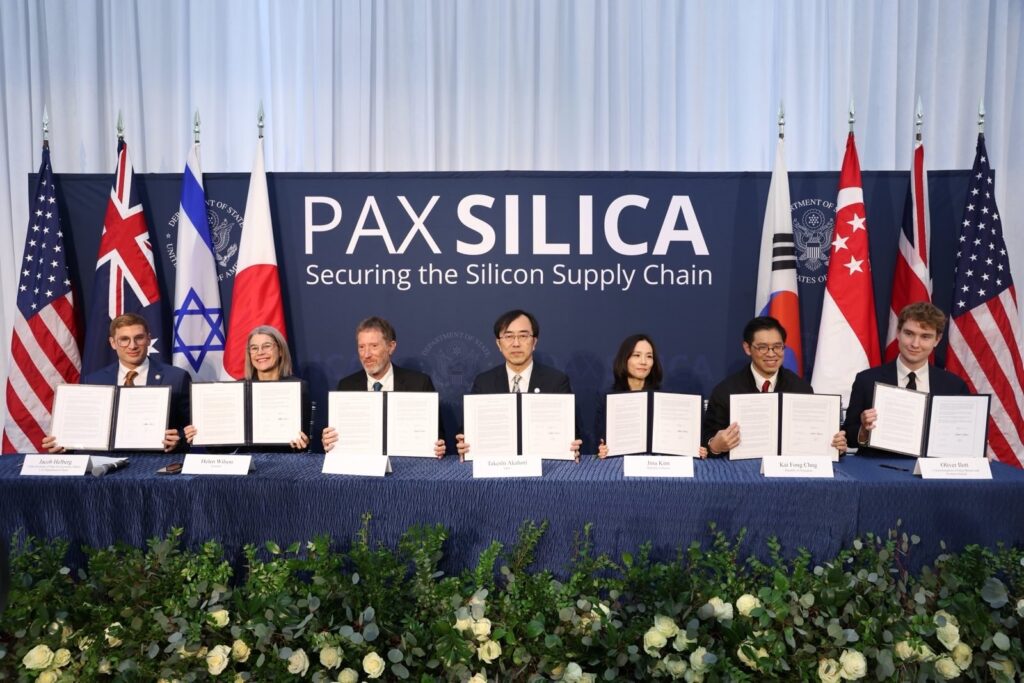
In the high-stakes race for AI and computing power, China is moving up from the foundation to the front, catching up with the West. The United States is doing the reverse, rebuilding its material and production base to reinforce its lead. Washington is working backward to develop a complete supply chain independent of Beijing. Last December, the U.S. launched Pax Silica, a coalition of 24 countries aimed at creating a future AI ecosystem from energy and raw materials to advanced manufacturing. Its pioneering project, an industrial hub, is set to open in the Philippines. Endurance, continuity, and the question of whether geopolitics can trump economics will shape the prospects of this U.S.-led endeavor.
From mining and refining critical minerals to accelerating domestic semiconductor production, China is becoming an emerging rule-maker in the evolving technology order. Since 2018, it has been hosting annual international AI conferences. To meet the challenge, Washington rolled out the Clean Network program in 2020 to prevent Chinese suppliers from dominating global information and communication solutions. However, outside U.S. allies, calls to ban Huawei and other Chinese vendors largely went unheeded, especially in the Global South. Affordability, performance, compatibility, lack of competitive alternatives, and the opportunity cost of being left out prevailed over US pressure. In 2023, Beijing proposed the Global AI Governance Initiative. Last July 16, 29 countries agreed to establish the World AI Cooperation Organization, which will be headquartered in Shanghai. With China’s entrenched capacity and growing confidence in both the hard and soft dimensions of the global digital infrastructure, the stakes are high for Pax Silica. Failure to compete may mean further erosion of U.S. technological lead. Two key challenges stand out.
Playing the long game
First is endurance. China’s rise as the world’s largest mineral refiner and production hub is neither inevitable nor providential. Rather, it is the result of a consistent industrial policy to develop national capacity, assured of a huge domestic demand, driven by ambitious targets and sustained by a willingness to bear great costs. It took about three to four decades for the country to become the world’s top ore processor and global factory. And it paid a steep price to attain this position, enduring tremendous environmental, health, and social harm, which were redressed in later years as the country’s economic strategy produced developmental dividends.
China produces 76.35% of the world’s refined cobalt and 44.44% of refined copper. It also accounts for 79.38% of global graphite output, 69.23% of rare earths, 42.31% of molybdenum, 20.67% of bauxite (from which aluminum is derived), 17.8% of lithium, and 13.1% of silver. The U.S. has high import reliance on China for a range of critical minerals with civilian and military applications. These include yttrium (93%), bismuth (60%), rare earths (56%), antimony (54%), arsenic (52%), graphite (43%), magnesium (32%), tantalum (22%), gallium (19%), and tungsten (14%). These minerals are used in the manufacture of microchips, mobile phones, computers, consumer electronics, wind turbines, solar panels, electric batteries, transmission cables, precision-guided munitions, jet engines, and missile propulsion systems, among others.
Pax Silica brings together affluent, technologically advanced countries and resource-rich developing nations. The U.S. is leveraging its alliances and partnerships to disperse production of critical minerals and industrial inputs and reduce the time needed to develop an integrated supply chain untangled from China. Cost and gain will be unevenly distributed, valuations may differ, and negotiation skills among members may vary. But lopsided deals in which some parties bear disproportionate harm, with few safeguards and little benefit, should be avoided. Metrics should go beyond commercial viability to include improved mining regulation, technology transfer, and more value-added processing or manufacturing in developing member countries. This will increase the initiative’s appeal and help future-proof long-term deals from potentially disruptive domestic politics.
China offered market, investment, and infrastructure to lock in long-term supply agreements. The Belt and Road Initiative (BRI) built roads, railways, ports, and industrial parks. On the ideational level, Beijing is positioning itself as a leader of the Global South, pursuing South-South cooperation with resource-rich developing countries in Asia, Africa, and Latin America. In 2021, the country launched the Global Development Initiative. The so-called resource curse has long plagued several poor but mineral-rich countries wracked by persistent conflict, corruption, and weak governance. The absence of such countries in Pax Silica is likely deliberate. The project does not want to get sucked into risky conflict areas early on or create missionary expectations. But there are cases that show how access to capital and technology can transform commodity exporters. For instance, Chinese investment upgraded Indonesia’s nickel-refining capacity, vindicating Jakarta’s resource nationalism and inspiring other countries to leverage their natural resources to elevate their position in the value chain.
Washington should recognize this development. More developing states are exercising their agency to chart policies that maximize the value of their finite natural bounty, create better opportunities for their people, and reduce adverse impact on the environment. The U.S. should go beyond transactional minerals-for-security deals like those floated for Ukraine and DR Congo. Concerns that reshoring may mean Global South members will simply perform their usual role of supplying raw ores for processing abroad need to be allayed. America has to offer enticing incentives beyond alarming partners about the perils posed by a rival’s near-monopoly on rare earths and overcapacity.
Less optics, more execution
The second hurdle is continuity. Pax Silica is not the first major U.S. initiative intended to counter China’s burgeoning economic clout. The Blue Dot Network, rolled out in 2019, aimed to certify projects to access a diverse pool of funds, thereby providing an alternative to China’s largely state-backed BRI finance. It morphed into the Build Back Better World (B3W) in 2021 and rebranded as the Partnership for Global Infrastructure and Investment (PGII) the year after. But beyond adopting standards and principles, these pitches did not lead to a pipeline of projects. In 2020, the U.S. also proposed the Economic Prosperity Network to restructure supply chains disrupted by the COVID-19 pandemic. The Indo-Pacific Economic Framework (IPEF), launched in 2022, was seen as America’s counteroffer to free trade agreements (FTAs), which have become unpopular at home, but which regional partners hope to see as the economic largesse that complements deepening alliance ties. None of these proposals made much headway.
In contrast, China’s BRI, criticisms and all, has delivered concrete projects. These include highways, a mass transit system, coal power plants, and fiber optic cable under the massive China-Pakistan Economic Corridor (CPEC). In Southeast Asia, notable completed projects include the Laos-China railway and Jakarta-Bandung high-speed rail (HSR). Malaysia’s East Coast Rail Link, set to open next year, and the ongoing Thailand-China HSR construction are also part of BRI’s broad portfolio. In an apparent role reversal, while Washington retreats from globalization, Beijing doubles down on promoting free trade, ratifying its membership in the Regional Comprehensive Economic Partnership (RCEP) in 2021 and upgrading its trade accord with ASEAN last year. In 2021, Beijing also applied to join the Digital Economy Partnership Agreement (DEPA) and a free trade pact that the US used to champion, the Trans-Pacific Partnership (TPP), which was rechristened as the Comprehensive and Progressive TPP (CPTPP) in 2018. The U.S. also ceded leadership in green energy and mobility to China by rolling back incentives for renewables and electric vehicles in favor of fossil fuels. Hence, Pax Silica needs to do better. Restoring the credibility of U.S. economic pitches is on the line.
Even in the Philippines, site of the proposed debut Pax Silica project, U.S. pledges fell short. The $300 million acquisition by American private equity firm Cerberus of the former Hanjin shipyard in Subic, which filed for bankruptcy in 2019, was billed as the biggest public-private partnership in the 75-year history of Philippines-U.S. relations. But while the investment may have forestalled a possible Chinese takeover of the insolvent enterprise, the deal failed to revive the shipyard’s fortunes until another Korean company with a solid shipbuilding track record, HD Hyundai, entered the equation in 2024. In 2022, when Vice President Kamala Harris visited Manila, the US proposed a menu of initiatives, such as developing a nickel and cobalt processing facility and a geothermal power plant in Mindanao. Not much has been heard about these promises since then.
Pax Silica can be transformative. Washington’s desire to break Beijing’s stranglehold on critical minerals can dovetail with partners’ desire to diversify markets and investors and grow their own industries. It makes sense for the Philippines, eager to catch up with fellow ASEAN peers, to offer attractive concessions to secure a potentially groundbreaking deal. Negotiation delays, whether efficiency-seeking firms will follow their governments, and leadership changes are variables that cannot be ignored. For instance, elections in Pax Silica members and non-signatory participants, such as the U.S., Philippines, and Taiwan, in 2028 may affect investors’ calculus. For sure, the initiative has stirred interest. Building urgency may be the next step. But the most important work is to ensure that proponents stay committed. Absent continuity and endurance, Pax Silica may worryingly join a growing number of U.S. initiatives that did not measure up.
