
The U.S. faces a growing strategic risk from a shrinking pool of China experts, weakening its ability to manage intensifying competition with China. Efforts to limit engagement for security reasons may deepen this problem by reducing understanding, underscoring the need for targeted, security-conscious investment in expertise.
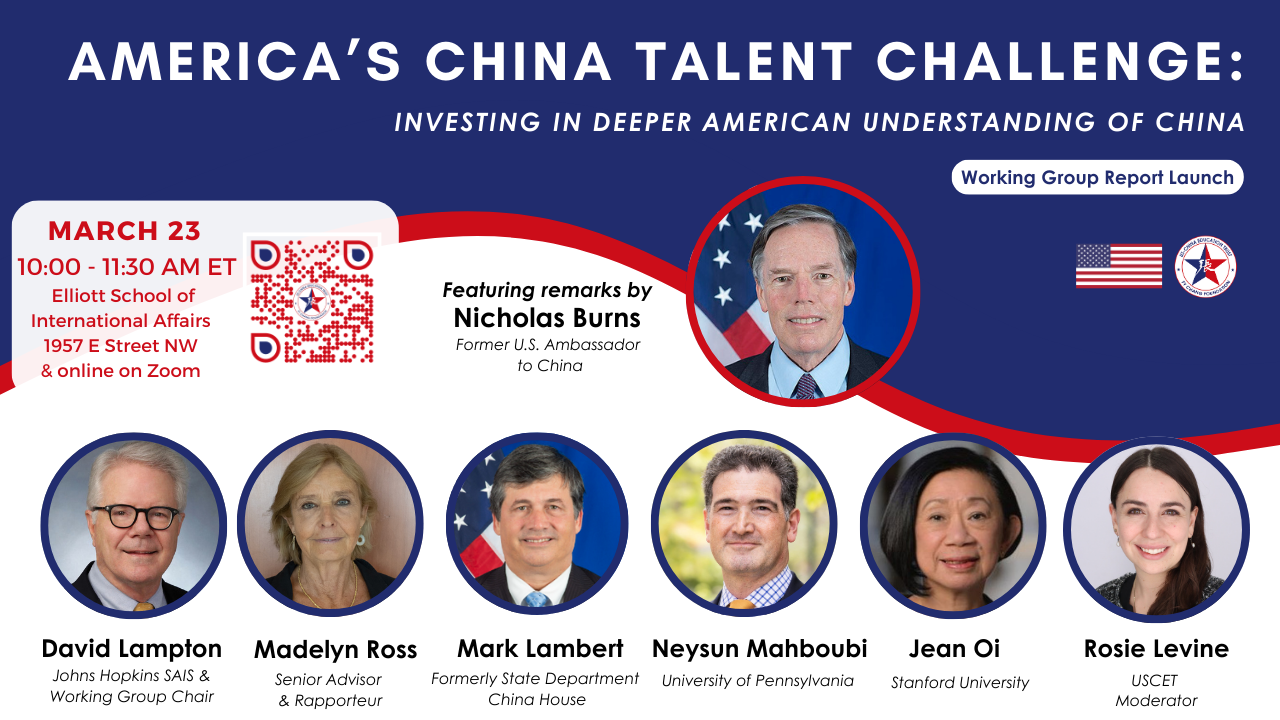
At a moment when U.S.-China relations are increasingly defined by strategic competition, a less visible but deeply consequential challenge is emerging: the erosion of America’s China expertise. A recent report by the US–China Education Trust warns that the United States could face a critical shortage of China specialists within the next decade. This is not simply an academic concern. It is a strategic issue with implications for national security, economic competitiveness, and crisis management.
For decades, the United States relied on a steady pipeline of “China hands”, individuals with advanced Mandarin skills and extensive firsthand experience in China. These experts informed policymaking, facilitated diplomacy, and helped interpret China’s political and economic signals. Today, that pipeline is weakening. The retirement of a generation trained during earlier periods of engagement coincides with a sharp decline in the number of Americans studying in China. The result is a narrowing base of expertise at precisely the moment when the bilateral relationship is becoming more complex and consequential.
Yet calls to rebuild this pipeline often encounter a powerful counterargument: security risk. Concerns about intellectual property theft, academic espionage, coercive data practices, and political influence have led to tighter scrutiny of academic exchanges and research collaboration. Programs such as the now-terminated Confucius Institutes became focal points for these concerns, while initiatives like the Department of Justice’s “China Initiative” reflected a broader securitization of U.S.-China engagement.
These concerns are not unfounded. The protection of sensitive research, critical technologies, and personal data is a legitimate priority. Universities and research institutions cannot operate as if geopolitical realities do not exist. However, treating all forms of engagement as inherently suspect risks producing a different kind of vulnerability: strategic blindness. Reducing exposure to China may mitigate certain risks, but it also diminishes the United States’ capacity to understand its principal competitor.
This tension, between openness and security, lies at the heart of the current policy dilemma. It is also where the remarks of former U.S. Ambassador to the People's Republic of China, Nicholas Burns, take on particular significance. By describing the study of Mandarin and lived experience in China as a “national security imperative,” Burns reframes the issue. The question is not whether engagement carries risk, but whether the absence of expertise carries greater risk. In an era of heightened rivalry, misunderstanding and miscalculation may prove more dangerous than carefully managed exposure.
The strategic implications are clear. Without a new generation of China specialists, U.S. policymakers may increasingly rely on secondhand analysis, filtered intelligence, or worst-case assumptions. This can distort decision-making, reduce policy flexibility, and heighten the risk of escalation in moments of crisis. In the economic sphere, a diminished pool of China-literate professionals could undermine the ability of American firms to navigate regulatory shifts, assess market conditions, or identify opportunities. In technology and standards-setting, insufficient expertise could weaken the United States’ capacity to compete effectively in global governance arenas.
At the same time, China continues to invest in developing deep expertise on the United States. This asymmetry does not guarantee strategic advantage, but it does shape the informational landscape. A country that better understands its competitor is better positioned to anticipate its moves, interpret its signals, and calibrate its responses.
If the problem is clear, the solution must move beyond general calls for “more exchange” and instead focus on targeted, security-conscious policies.
First, the United States should expand federally funded fellowship programs dedicated to China studies. Building on models like the Fulbright Program and the Boren Awards, a new “China Strategic Fellowship” initiative could be established with an annual target of 1,000 participants. This program would combine intensive language training, in-country experience, and post-fellowship government or public service requirements. Funding could be structured through a joint allocation by the Department of State and the Department of Defense’s National Security Education Program, with an initial budget of $150–200 million annually.
Second, visa policies should be recalibrated to facilitate educational exchange while maintaining robust screening. Rather than broad restrictions, the focus should shift to risk-based, field-specific controls. For example, greater scrutiny could be applied to sensitive STEM fields, while expanding visa access for humanities, social sciences, and language study. At the same time, the United States should negotiate reciprocal arrangements to increase the number of American students in China, potentially through a dedicated bilateral education channel insulated from broader political tensions.
Third, domestic investment in China studies must be strengthened. Title VI funding under the Higher Education Act, which supports National Resource Centers and Foreign Language and Area Studies (FLAS) fellowships, has stagnated in real terms. Doubling Title VI funding to approximately $150 million annually would provide critical support for university-based China expertise. In parallel, a public-private partnership could be developed to support China-focused research and training, drawing on foundations and corporations with long-term interests in U.S.-China relations.
Fourth, new institutional pathways should be created to integrate China expertise into government service. A “China Track” within the U.S. civil service, modeled loosely on the military’s foreign area officer programs, could provide structured career incentives for developing deep regional expertise. This would help ensure that language skills and lived experience are not peripheral assets but core components of national security capacity.
Fifth, risk mitigation mechanisms must be strengthened to address legitimate security concerns. Universities should expand compliance frameworks, including transparent disclosure requirements for foreign funding, enhanced research security protocols, and targeted training on intellectual property protection. Federal agencies, in turn, should provide clearer guidance to avoid overreach and reduce the chilling effect on legitimate academic activity. The goal should be “secure openness”: a system that protects sensitive areas while preserving the flow of knowledge and experience.
Critically, rebuilding China expertise should not be framed as a return to a previous era of engagement. The context has changed, and policies must reflect that reality. The objective is not to eliminate risk, but to manage it intelligently while preserving strategic capabilities. A more selective, structured, and security-aware approach to exchange can achieve this balance.
The alternative, continued erosion of expertise, is far more costly. A United States that lacks deep knowledge of China risks making decisions based on incomplete information, reinforcing adversarial narratives, and narrowing the space for effective diplomacy. In a relationship where misperception can have global consequences, this is a risk that cannot be ignored.
Ultimately, great power competition is not only about military strength or technological innovation. It is also about understanding, specifically the ability to interpret intentions, anticipate actions, and navigate complexity. In this sense, human capital is a strategic asset.
The warning issued by the US–China Education Trust should therefore be seen as a call to action. Rebuilding America’s China expertise will require sustained investment, policy innovation, and a willingness to balance openness with security. But the payoff is clear: a more informed, more agile, and ultimately more effective approach to managing one of the most important relationships of the 21st century.
