
Unfiltered, people-to-people interactions reveal the human complexity behind international relations and challenge simplistic “us vs. them” narratives. These everyday cross-cultural exchanges, including those through digital media like streamers’ travels, can reduce hostility and reshape how younger generations perceive countries like China and the United States.

On their journey through China, the two streamers Michael and Ludwig stumbled upon a festive gathering in a rural village. (Whoopsies ©ludwigahgren Instagram)
The upcoming planned meeting between U.S. President Donald Trump and Chinese President Xi Jinping has captured the attention of a D.C. policy community desperate to understand the status of bilateral relations. But it is a much lower-profile visit that has drawn the eyes of young Americans: Michael Reeves and Ludwig Ahgren, two Los Angeles-based streamers crossing China on motorcycles. No maps, no phones, no translators.
Their journey is presented as raw and unfiltered, from the omnipresent swear words to footage of one rider sick from food poisoning. Amidst escalating U.S. military operations in Iran, they encounter a man at a gas station who condemns Americans as 'not good people,' gesturing aggressively as if firing a weapon. Moments later, the man recommends a restaurant down the road where the travellers can find lunch.
Statecraft often obscures the human dimension of international relations. While politicians negotiate tariffs and export restrictions, the streamers’ unfiltered journey reveals the messy, visceral reality of cross-cultural engagement.
And it’s necessary. Necessary for people to argue about whether Michael and Ludwig have food poisoning or just drank too much cold water; to debate if traversing China with minimal language skills is rude or adventurous.
When nations clash, they tend to fall into what author Amanda Ripley calls “high conflict,” an endless doom-loop fuelled by simple, us-versus-them narratives. The streamers’ adventure won’t stop trade wars or deescalate strategic competition. But people-to-people contact does something vital: it complicates the narrative. It pushes us away from “high conflict,” replacing caricatures with messy human realities, making the abstraction of enemy hood harder to sustain.
Historically, finding “good conflict” required a passport and a plane ticket. Today, it plays out in real-time across our screens; the internet’s great paradox is that it simultaneously Balkanizes and bridges. Unlike during the Cold War, when people had to depend on stealing the satellite signal from Russian TV or being chosen for a study abroad programme under the Lacy-Zarubin Agreement[1] to learn about the other country, today’s netizens can engage in cross-cultural exploration from their own homes.

A family from the United States has visited a couple in China after a joyful exchange on RedNote as so-called TikTok refugees. (Photo from RedNote)
When the U.S. briefly banned TikTok in 2025, over 500,000 American users migrated to China’s Xiaohongshu (also called RedNote), forming hybrid communities where Memphis teens helped students from Tianjin with their English homework and Chinese grandmothers shared traditional remedies for stomach aches. Likewise, Chinese and Filipino gamers blend emojis, slang, and Russian swear words to coordinate strategy, and K-pop fans worldwide share messages on Weverse about their favourite artists. U.S.-China relations suffer under a bifurcated digital ecosystem, but workarounds stubbornly persist due to the insatiable curiosity of young people.
“Tip to Tip”, as Michael and Ludwig’s adventure is named, has spawned offshoots including a website that automatically collects and translates BiliBili comments related to their trip. There are almost 35,000 unique comments, some of whom are Westerners that have made BiliBili accounts because of this series. It’s even more amazing if you look at YouTube: 30 million combined views on the vlogs—roughly the audience of Trump’s 2026 State of the Union.
These millions of viewers aren’t tuning in for the kind of foreign policy analysis debated in D.C. think tanks. Yet, by watching an uncut hour of the Chinese countryside passing by — cleverly named “POV you're 两个白色的外国人 (two white foreigners) driving across China” — they are arriving at conclusions about U.S.-China relations all on their own.
A year ago, another American internet celebrity, IShowSpeed (“Speed”), livestreamed his own two-week adventure in China. He garnered around 37 million live viewers over the two weeks, and his trip repeatedly reached the top 20 “hot topics” on Weibo. Even more “realistic” than “Tip to Tip”, Speed’s streams were live, capturing everything from tasting local delicacies to encountering racism. His trip became a soft power win for both China, which got to showcase realistic narratives to the world, and the U.S., due to the overwhelmingly positive response to Speed’s trip from Chinese netizens.
These types of unfiltered (or seemingly unfiltered) interactions strike young people as more authentic than those in traditional media narratives, lending a higher degree of credence to the cultural diplomacy that influencers abroad inevitably end up conducting.
While there are no credible polls on public sentiment towards the U.S. among Chinese youth in the past few years, American adults under 50 are nearly twice as likely as those over 50 to express approval of China. This trend intensifies in assessments of the bilateral relationship: while 38% of older Americans characterize China as an outright adversary, only 20% of their younger counterparts share this view. This is especially noticeable among young Republicans: the difference between under-50 and over-50 spans 23 percentage points, dwarfing the 8-point divide among Democrats.
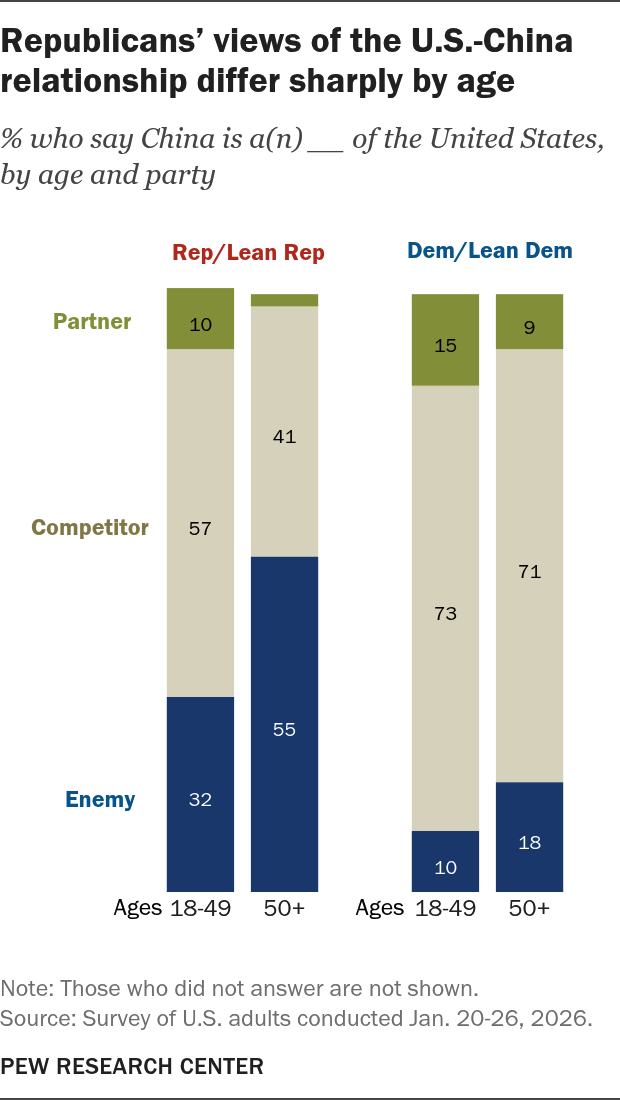
These disparities hint at how digital-native generations, steeped in globalized pop culture, feel less strongly about abstract ideological divides than their predecessors.
Audiences no longer want their diplomacy sanitized or their worldviews reduced to comforting binaries. Rather, they want policy to reflect their lived realities. In a subreddit dedicated to “Tip to Tip”, one comment stands out: “We’re just ants in separate hills, man. We all spit out the same pheromones but the bourgeoisie just f**** us raw and dry everyday [sic]. Thanks for sharing what our fellow worker ants are saying in China.”
It is within this cringe-inducing, crude, chaotic reality that we find our best chance of averting catastrophe. Because ultimately, the messy collisions of people, from sharing cigarettes to dealing with criticism of eating Peking duck ‘the wrong way’, chip away at dehumanizing abstractions.
In 1956, U.S. President Dwight Eisenhower established the “People-to-People Program,” an initiative designed to foster global understanding through cultural, educational, and professional exchanges between citizens. During the opening ceremony, he declared that, “If we are going to take advantage of the assumption that all people want peace, then the problem is for people to get together and to leap governments—if necessary to evade governments—to work out not one method but thousands of methods by which people can gradually learn a little bit more of each other.”
Eisenhower’s programme was shuttered in 2022 by COVID-19, but its legacy continues in the real-time collisions of digital cultures, where streamers’ misadventures make enemies into fellow humans. After all, it’s hard to see someone as a foe when you’ve watched them sing “Take me home, country roads” with the owner of a brick factory in rural Hunan who took pity on them after they accidentally crashed his grandmother’s funeral.
[1] Richmond, Yale (2003). Cultural Exchange and the Cold War: Raising the Iron Curtain. Penn State Press
