
Key U.S. allies in Europe, North America, and Asia are increasingly courting China or hedging toward it in response to growing uncertainty and unilateralism in American foreign policy under Donald Trump. This shift reflects a broader recalibration toward strategic autonomy and multipolarity, as allies seek to diversify partnerships, reduce dependence on the U.S., and manage both the risks and opportunities posed by China’s rise.
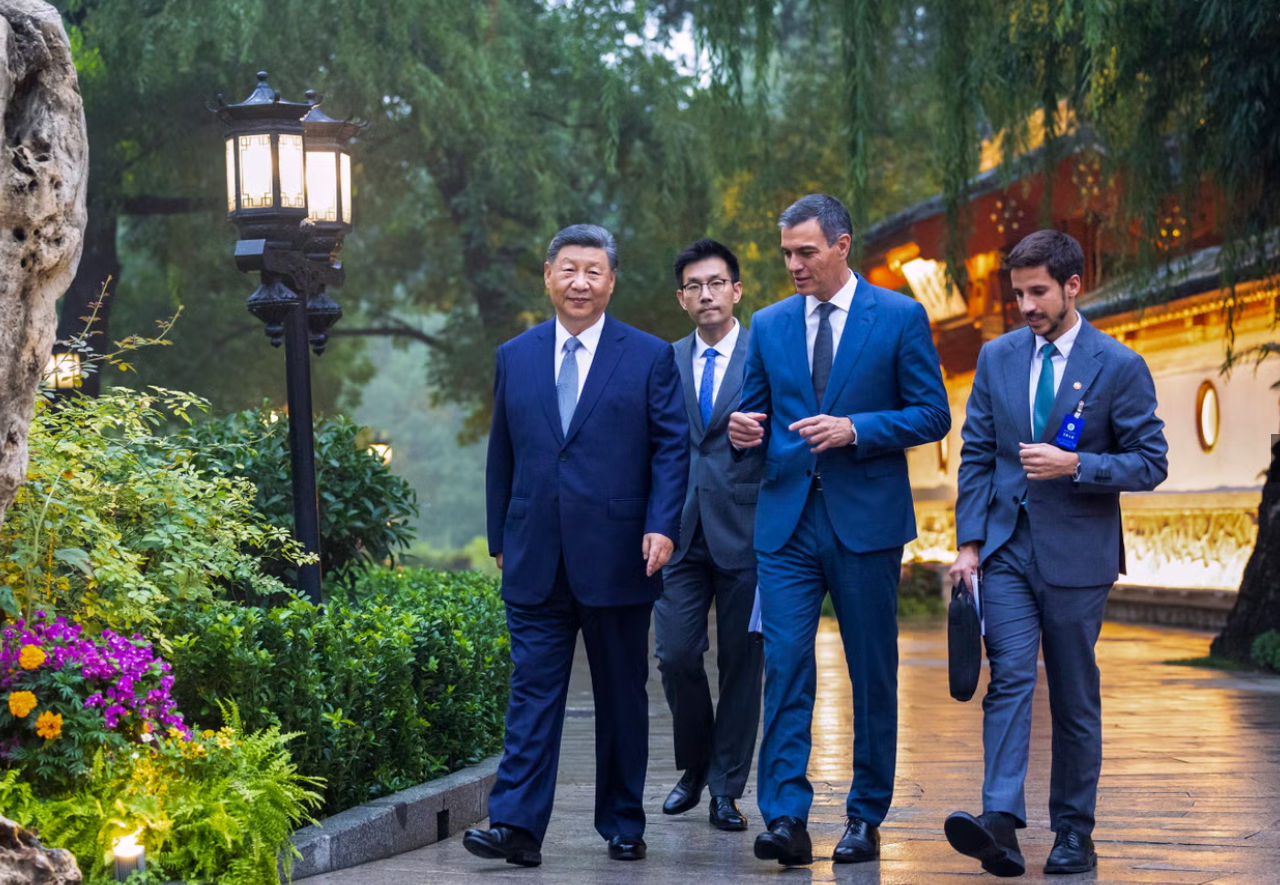
Spanish Prime Minister Pedro Sanchez made his fourth visit in four years to Beijing, April 11, 2026.
“There's going to be a very, very serious restructuring [in our relations with China],” Philippine President Ferdinand Marcos Jr said in an interview amid the ongoing war in Iran. “I think it's certainly going to happen…it's happening now,” he added. The Filipino president, accordingly, expressed openness to restart long-stalled negotiations over a potential joint energy exploration deal with Beijing in the South China Sea.
The statements were quite telling, especially given the Philippines’ central role as a frontline U.S. ally in Asia, and Marcos Jr.’s more skeptical view of China in previous years. But Manila is not alone. In response to the U.S. President Donald Trump’s unvarnished embrace of Machtpolitik, key allies even in the West have been quickly signaling their commitment to ‘de-risk’ from an increasingly unpredictable America. Spanish Prime Minister Pedro Sanchez, a vocal advocate of a more independent European foreign policy, made his fourth visit in four years to Beijing to push for closer economic and technological ties. Crucially, the Spanish leader, who has vociferously criticized Trump’s policies, has called on China to play a more active role in preserving global peace by, inter alia, “demanding as it is doing, that international law be respected and that the conflicts in Lebanon, Iran, Gaza and the West Bank and Ukraine cease.” Sanchez also called on Europe to “redouble its efforts, especially now that the United States has decided to withdraw from many of these fronts."
The Spanish leader is far from alone. Earlier this year, British Prime Minister Keir Starmer made his own consequential visit to China, the first in almost a decade by a British head of government, which ended an “ice age” of bilateral relations. The two sides signed multi-billion economic deals, which aim to expand British companies’ market access in the world’s second largest economy while facilitating large-scale investments in the post-Brexit United Kingdom, which has been desperate to carve out its place of pride in recent years. The two sides also relaxed travel restrictions, including bans on several Sino-skeptic British parliamentarians. The French President Emmanuel Macron had already visited Beijing in December, where he explored potential compromise on trade-related differences while signaling shared commitment to a more inclusive and pluralistic global order. Though unlikely to break with their decades-old miliary alliance with America anytime soon, especially given Europe’s reliance on Washington’s support against a resurgent Russia amid the ongoing Ukraine conflict, the message to Trump is clear: “We got options”!
Strategic Honesty
The U.S. president himself made it clear that he got the message, when he warned allies against deepening ties with Beijing: “Well, it’s very dangerous for them to do that, and it’s even more dangerous, I think, for Canada to get into business with China.” He particularly zeroed in on neighboring Canada, which, according to Trump, was doing “poorly [and] can’t look at China as the answer [to its economic woes]”.
Trump’s decision to zero in on neighboring Canada was no coincidence. Prime Minister Mark Carney’s improbable ascent to power came on the heels of a patriotic backlash against America’s flurry of tariffs and even threat of annexation of Canada. A world-renowned economist and former Bank of England boss (the first foreign-born appointee), with no prior experience in any major elected office, Carney built his domestic political capital and, more recently, global diplomatic influence by directly taking on America.
Shortly after visiting China, where both sides agreed to pursue a strategic partnership after years of extremely acrimonious relationship, Carney delivered what would likely go down as one of the most poignant and potentially consequential speeches of our era. Beginning in French, Canada’s other official language, he warned of “rupture” in the global order, namely the “end of a pleasant fiction and the beginning of a harsh reality, where geopolitics, where the large, main power, geopolitics, is submitted to no limits, no constraints.”
As soon he switched to English, the primary medium of his speech, Carney eerily invoked ancient historian Thucydides’ warning against strategic hubris and great power cruelty: "The strong do what they can and the weak suffer what they must". With likely the Global South audience in mind, the Canadian prime minister admitted that the post-war American-backed “international rules-based order was partially false [since] the strongest would exempt themselves when convenient, [and] that trade rules were enforced asymmetrically.”
With refreshing earnestness, he admitted that Western nations “knew that international law applied with varying rigour depending on the identity of the accused or the victim,” thus the half-brokenness and fragility of the rules-based order. What Trump, in his second term, has done was to dismantle even a pretense of respect for international law.
It's quite telling that when he was asked about a rules-based global order, Trump declared, “I don’t need international law”, insisting that his own “morality” and “mind” would suffice to curb America’s worst instincts. His chief aide, Stephen Miller, was a tad blunter, when he nonchalantly spoke of a global order “governed by strength, that is governed by force, that is governed by power.” After decades of projecting itself as an arbiter of a just and prosperous world, the mask has come off.
Openly mentioning “American hegemony”, Carney warned of a new era where superpowers turn “integration” into “the source of your subordination” – a thinly-veiled assault on Trump’s unilateral tariffs on closest allies and neighbors. Putting on his economist hat, Carney cautioned against “Hegemons” bullying their dominance and, accordingly, called on fellow allies of America to “diversify” and to “hedge against uncertainty” in order to “rebuild sovereignty” grounded in a rules-based order rather than naked power politics.
Strategic Hedging
By openly underscoring the need for “classic risk management” and strategic “adaptation”, Carney declared “[we are] fundamentally shift[ing] our strategic posture”, which actively hedges against Trump’s excesses by building on burgeoning ties alternative partners in Europe, Asia, and Latin America, who have finalized a series of major defense and trade deals with Ottawa in recent years.
Then he shifted to emphasizing the need for collective action, namely how “middle powers must act together” by pooling their markets, military capabilities, and diplomatic capital to “build something bigger, better, stronger, [and] more just” in an increasingly multipolar global order.
While Canada and key European powers are in a position to pool their resources and repair ties with an ascendant China as a hedging strategy, the strategic picture is different for some of America’s closest allies in Asia. In particular, Manila and Taipei, who see more strategic threat than opportunity in Beijing, are making some tough decisions in a brave new world disorder wrought by Trump’s disregard for the post-war liberal order.
In stark contrast to its first iteration, which adopted a hawkish position on China, the second Trump administration seems more open to a global order dominated by few co-existing superpowers. In fact, Washington dropped any reference to “great power competition” in its newly-released National Security Strategy and National Defense Strategy papers, which called on allies to take greater responsibilities for their own security on behalf of America.
It makes sense that frontline U.S. allies in Asia are already recalibrating. In Taiwan, the leader of the Kuomintang Party, which controls the parliament, has openly emphasized her “Chinese” identity and, most recently, expressed her commitment to improved ties with Beijing, though demurring on full endorsement of ‘peaceful reunification’ in the near future. Cheng Li-wun, Chinese Nationalist Party (KMT) Chairwoman, openly expressed concerns over abandonment by America and, similar to many neighboring countries, emphasized the importance of “not choosing” in between the two superpowers, especially since China is “family”. She highlighted the same message during her visit to Beijing, where she met the Chinese paramount leader.
Meanwhile, Vice-President Sara Duterte, who is known for her friendly ties with China, remains as the frontrunner in all pre-election surveys ahead of the 2028 presidential race – raising the prospect of a return of a Beijing-friendly administration in the Philippines. In short, Trump’s swashbuckling approach to allies, and cavalier attitude to international law, has encouraged closest allies to either court closer relations with China or, at the very least, reduce tensions in hopes of avoiding conflict with the Asia superpower.
