
Middle powers on the continent have a real motivation to cooperate. Constrained by structural factors such as their defense systems, however, the so-called transatlantic shared heritage and the scale of the U.S. market, their cooperation is seen mostly in policy coordination and diplomatic statements.
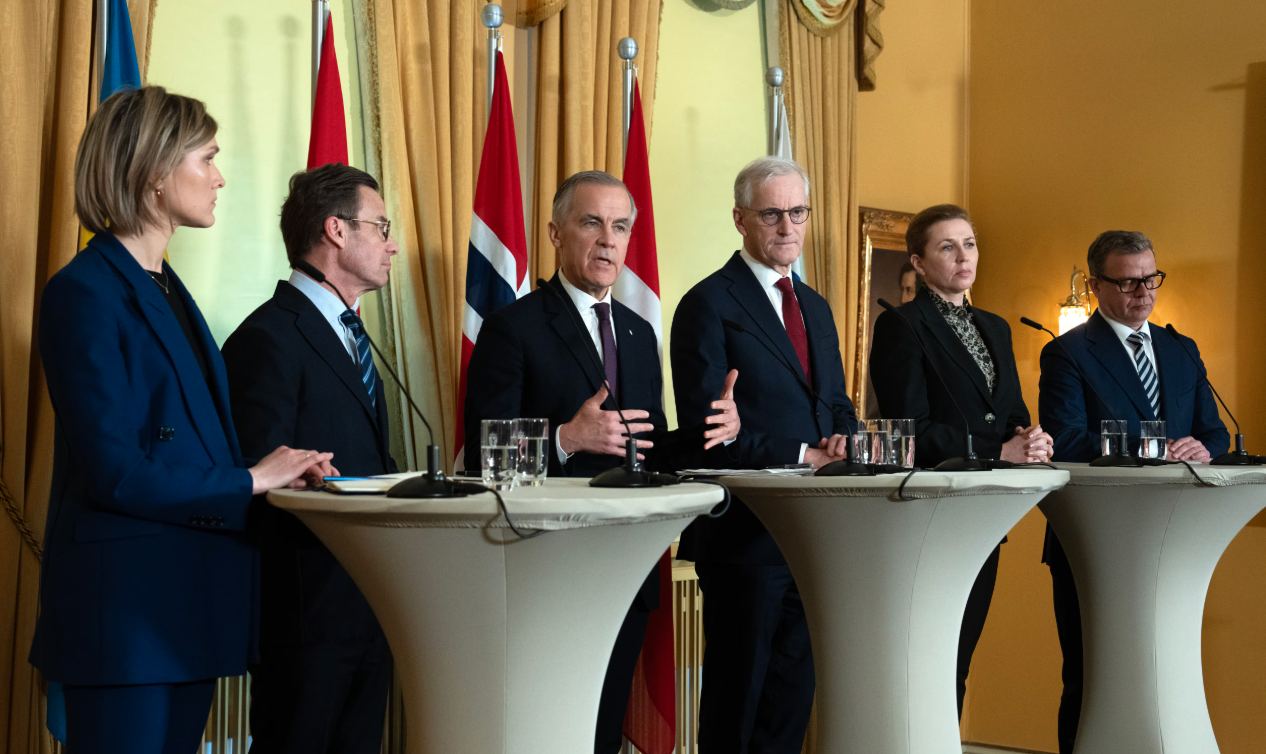
The Nordic-Canada Summit was held on March 15, 2026.
(L-R) Iceland's Prime Minister Kristrun Mjoll Frostadottir, Sweden's Prime Minister Ulf Kristersson, Canada's Prime Minister Mark Carney, Norway's Prime Minister Jonas Gahr Store, Denmark's Prime Minister Mette Frederiksen and Finland's Prime Minister Petteri Orpo hold a joint press conference during a meeting at the government's representative building in Oslo, Norway, on March 15, 2026.
Against the backdrop of persistent tensions in the current international security landscape, European countries have significantly increased their focus on their own security and strategic space. Recently, the Nordic-Canada Summit, held in Oslo, Norway, brought together Denmark, Finland, Iceland, Norway, Sweden, and Canada to coordinate on trade, security and defense cooperation. They issued a joint statement committing to deepening collaboration in energy, technology and defense. The development is widely regarded as an important signal that European middle powers are strengthening policy. It is also a reflection of growing demand in Europe for greater autonomy in security and foreign affairs.
Policy divergences over Greenland and the Ukraine crisis have heightened uncertainty. Former German Chancellor Angela Merkel once aptly noted that Europeans “really have to take destiny into their own hands.”
However, while there are realistic reasons for enhanced coordination and cooperation among Europe’s middle powers, existing power gaps and the current state of interaction suggest that such cooperation is unlikely to fundamentally alter their dependence on the United States in the short term. Rather than reshaping the transatlantic dynamic, it is more more a matter of policy coordination and a diplomatic posture.
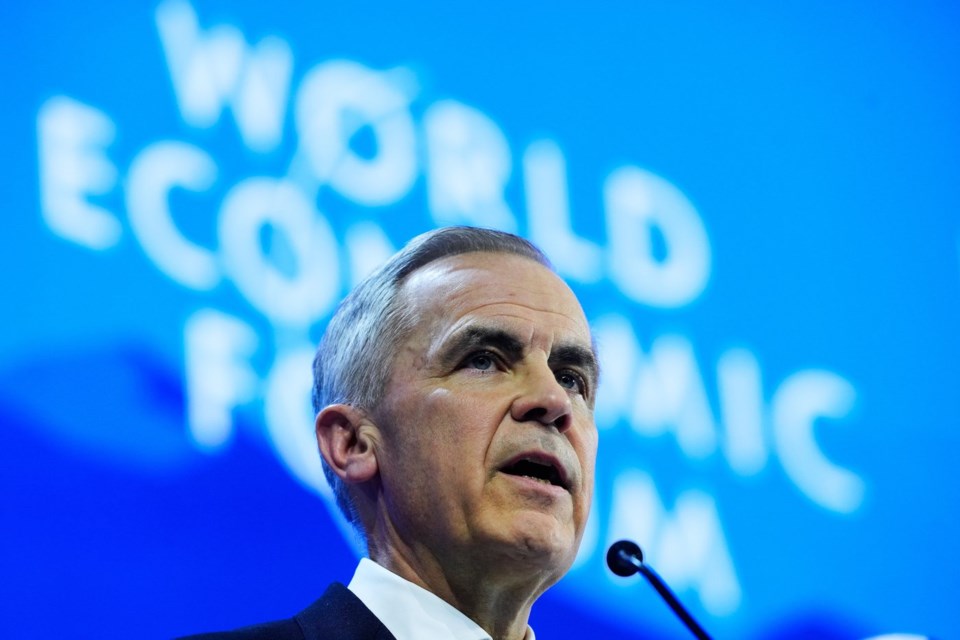
Canada's Prime Minister Mark Carney calls at the World Economic Forum in Davos for middle powers to band together against economic coercion by "great powers" on Jan 20, 2026.
Military dependence on U.S.
In the security realm, European middle powers generally maintain close alliances or partnerships with the United States, and their defense systems rely heavily on U.S. technology, intelligence and security guarantees. In recent years, Nordic countries have further strengthened the U.S. military presence in the region through defense cooperation agreements. The United States has been granted access to 15 military bases in Finland, 17 in Sweden, 12 in Norway; in addition, it may use Keflavik Air Base in Iceland.
In terms of asset structure, approximately 80 percent of Nordic military equipment (excluding Iceland) is U.S.-related. Denmark is typical: Pituffik Space Base in northwestern Greenland has deployed U.S. F-35A fighter jets, and its functions have gradually shifted from early warning to operational support.
These specific arrangements underscore the Nordic countries’ high level of dependence on the United States for defense systems, equipment sources, and combat capabilities. This means that even if European middle powers strengthen cooperation among themselves, alternative arrangements are unlikely to take shape in the short term.
Shackles of shared heritage
Beyond security considerations, institutional factors and values also shape European foreign policy orientations. According to Article 21 of the Treaty of Lisbon, the EU prioritizes relations with like-minded countries — a fundamental framework that guides European foreign policy.
Building on this institutional foundation, shared heritage has gradually emerged as an important political narrative in transatlantic relations. European countries generally regard their institutional, values-based and historical ties with the United States as shared, thereby reinforcing the legitimacy of bilateral cooperation.
This concept is reflected not only on the European side but is echoed in U.S. policy statements. For instance, at this year’s World Economic Forum, Trump emphasized that the shared heritage of the United States and Europe must be jointly safeguarded. National security-related documents released by the Trump administration also define the United States as a key defender of European civilization, framing shared heritage as a cornerstone of transatlantic relations.
In practice, that cornerstone remains solid. During the recent Munich Security Conference, European Commission President Ursula von der Leyen reaffirmed her confidence in transatlantic relations, while EU High Representative for Foreign Affairs and Security Policy Kaja Kallas stated, “America and Europe are intertwined, have been in the past and will be in the future.”
Attractive U.S. market
The scale and consumption capacity of the U.S. market make it highly attractive to European countries. According to the U.S. Department of Commerce, U.S. retail sales totaled approximately $5.42 trillion in 2025, with consumption accounting for around 68 percent of GDP, solidifying the U.S. position as one of the world’s largest consumer markets.
In terms of trade structure, the EU maintained a $218.7 billion trade surplus with the United States, a gap that highlights the imbalance in market dependence of the two sides. At the industrial level, this dependence is even more pronounced. For example, pharmaceutical products account for roughly 30 percent of Denmark’s exports to the United States. Exports from the Netherlands to the U.S. are primarily goods with high-value-added, including semiconductor equipment—a structure that has persisted into 2026. Under these circumstances, even if European countries attempted to explore Asian or internal markets, the U.S. market would remain irreplaceable in the short term.
Overall, while enhanced cooperation between European middle powers in the current international environment reflects their need to address security and economic uncertainties, it is more likely to be a phased policy adjustment with relatively limited impact on reducing dependence on the United States. Their goal of taking their destiny into their own hands still faces numerous structural constraints in reality. In the foreseeable future, European middle powers will likely seek limited adjustments within the existing alliance and institutional framework. The asymmetry in their relations with the United States is unlikely to undergo significant change.
