
Donald Trump has not destroyed a legitimate rules-based international order; rather, his actions have exposed the long-standing hypocrisy of a system in which the United States and its allies have frequently ignored international law while enforcing it selectively against their adversaries.
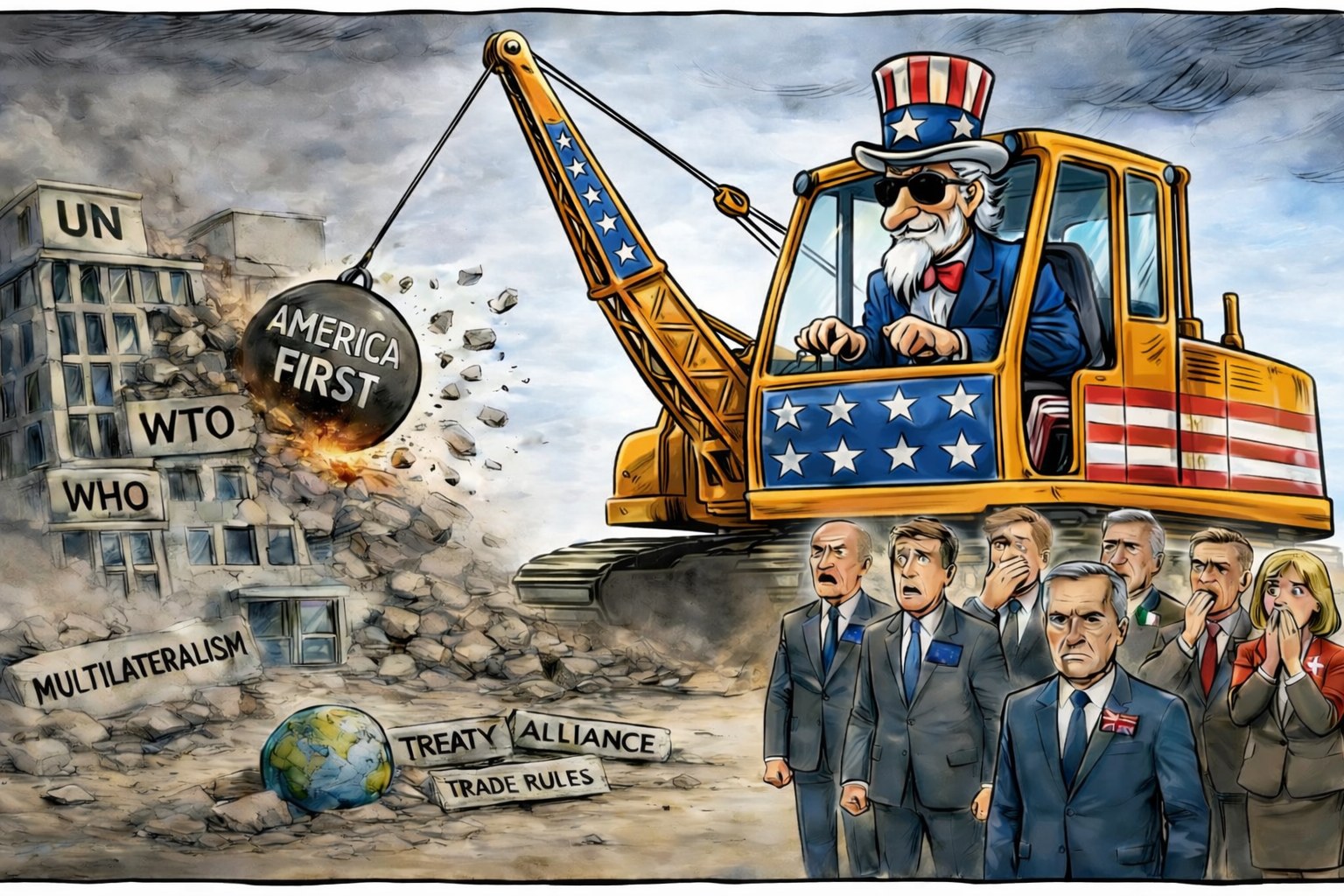
Throughout the world, accusations are mounting that U.S. President Donald Trump’s actions are destroying the “rules-based international order” established by the victorious Allies after World War II. Some of Trump’s initiatives certainly resemble old-style Western imperialism. His initial demand that Denmark sell Greenland to the United States was a prime example. One can readily recall how European leaders in the 18th, 19th and early 20th centuries engaged in similar behavior with respect to territorial aggrandizement.
During that period, the major European powers carved up Africa and portions of Asia into their respective colonial empires. France’s occupation of lands in Southeast Asia – --with the establishment of “French Indochina” to reflect Paris’s rule over Laos, Cambodia, and Vietnam –-- illustrated the West’s imperial ambitions in that part of the world. So did Britain’s merciless pressure on China to “lease” Hong Kong for 99 years.
Both Japan and the United States came somewhat later to the cynical imperial game than did their European counterparts. But when that opportunity finally arrived, they played the game ruthlessly. Washington’s covert takeover of the Hawaiian islands in 1893, as well as its later acquisition of the Philippines and Spain’s other colonies following the U.S. victory in the Spanish-American War, epitomized America’s new orientation. Japan’s colonization of Korea and Tokyo’s seizure of Taiwan from China also were prime examples of an imperialist trend.
Supposedly, though, the defeat of the Axis powers in World War II marked the end of using brute force to acquire the land of other countries. The creation of the United Nations officially sanctified the rule of international law. The gradual decolonization process throughout Africa and Asia in the 1950s and 1960s also led to dozens of new members of the UN. Relations between nation states were to be conducted within a “rules-based” international order. To many observers around the world, Trump’s rhetoric and behavior seem to be a worrisome throwback to the blatantly imperialistic era.
That conclusion is misleading, however. From the outset, that Western-designed and Western-dominated order was rigged. Even some passionate defenders of the current arrangement, such as Canadian Prime Minister Mark Carney, have had to concede that point, however grudgingly. According to Carney, “We knew the story of the international rules-based order was partially false — that the strongest would exempt themselves when convenient, that trade rules were enforced asymmetrically. And we knew that international law applied with varying rigor depending on the identity of the accused or the victim.”
Carney’s description is a colossal understatement. The reality, especially in the security realm, has been far more harsh and hypocritical than his sanitized version. The UN’s first major significant armed mission took place in 1950 during Korea’s civil war. Although it was officially a “police action” under the UN flag, the initiative was a military intervention conducted almost entirely by the United States along with several close allies and security dependents. The People’s Republic of China (PRC) received strong criticism from Western countries for sending its troops into the fighting in late 1950 to support the communist regime in Pyongyang, but it is appropriate to mention that Washington and its allies had intervened months earlier, turning an internal Korean conflict into an international one.
Despite their pious, idealistic statements throughout the decades about the “rule of law,” U.S. and allied leaders have waged numerous other wars of aggression. They also have arbitrarily altered boundaries by force and embraced flagrant double standards with respect to both international law and basic ethics.
The so-called rules-based order means that Washington and its allies (especially its allies in NATO) can do virtually anything they want without fear of adverse legal, economic, or military consequences from the “international community.” Countries not enjoying the status of being U.S. allies or clients—and especially those Washington regards as Western adversaries—are harassed and bullied.
Members of the U.S. and European foreign policy establishment have repeatedly contended that the rules-based order “preserves stability worldwide.” For example, Joe Biden’s administration and its supporters insisted that Russia’s invasion of Ukraine posed a potentially mortal threat to that system, and, therefore, must be decisively defeated. George H. W. Bush’s foreign policy team invoked the same rationale to justify assembling a coalition of countries that used military force to expel Saddam Hussein’s army of occupation from Kuwait in 1991.
Yet the United States and its allies have launched military interventions on multiple occasions that clearly violated the purported standards of a rules-based system. That was the case in 1999 when NATO launched an air war against Serbia, a recognized fellow member of the United Nations, and then proceeded to amputate Kosovo, one of Serbia’s provinces.
Proponents of Washington’s various military interventions typically justify such deviations by arguing that principles of justice and human rights sometimes must overrule normal, recognized standards of state-to-state conduct. The justice/human rights rationale featured prominently in the Clinton administration’s case for interventions in the Balkan wars.
The preventing “genocide” narrative became a crucial feature of NATO’s intervention in Kosovo. Yet, subsequent analyses confirmed that only 2,000 deaths had taken place prior to the onset of NATO’s bombing campaign—a very low total for any case of civil strife. Even some vocal supporters of the intervention, such as Brookings Institution scholars Ivo H. Daalder and Michael O’Hanlon, later conceded that what had occurred in Kosovo did not constitute genocide.
The rationales for the Western military interventions in Iraq and Libya were even weaker than those invoked with respect to Bosnia and Kosovo. Allegations that Saddam Hussein’s government was involved in the 9-11 terrorist attacks were baseless, as were the dire warnings that Baghdad possessed an arsenal containing weapons of mass destruction. Nevertheless, George W. Bush’s administration and most members of the West’s foreign policy elite approved violating the supposed rules-based international order with the invasion and occupation of Iraq.
The Obama administration’s justifications for leading a NATO assault on Libya were even weaker. Libyan leader Muammar Qaddafi already had terminated his government’s embryonic nuclear program years earlier. However, Secretary of State Hillary Clinton and other members of President Obama’s foreign policy team cynically exploited one of the periodic armed rebellions in Libya to launch an air war to achieve forcible regime change—a point that Secretary of Defense Robert M. Gates implicitly conceded. Other opportunistic NATO powers joined the regime change crusade.
The results of the Western military interventions in Iraq, Libya, and Syria have been horrific. U.S. meddling in Syria produced a bloodbath that claimed hundreds of thousands of deaths and produced millions of refugees. That massive refugee flow has caused instability and major social tensions in other countries, including several of Washington’s European partners. The NATO intervention in Libya likewise unleashed total chaos for several years.
In addition to the examples of U.S. aggression and NATO’s misconduct as an organization, several individual U.S. allies have behaved in a shameful, hypocritical fashion. In 1974, Turkey invaded and occupied nearly 40 percent of Cyprus. Washington reacted with studied indifference. Four decades later, Turkish troops still occupy the conquered lands, and Ankara established a puppet regime there.
Israel’s conduct has been even worse. The theft of Palestinian lands for transfer to Israeli settlers on the West bank continues at a brisk pace. Even worse has been the Israeli government’s treatment of Palestinian inhabitants in Gaza. Security forces have killed thousands of Palestinian civilians, including children. The human rights violations there have become legendary.
Despite his many flaws, Donald Trump has not destroyed a just and effective, rules-based international system. Such a system has never been anything more than a cynical, hypocritical façade for U.S. and NATO imperialism.
